You're in the middle of a sale process, or you're about to be. The buyer sounds serious, the valuation looks decent, and the LOI already feels like momentum. Then the work shows up, diligence requests, redlines, data room scrambles, tax questions, IT issues, employee retention, and a closing checklist that seems to grow every hour.
That's the part founders underestimate. In the Pacific Northwest, the deal doesn't usually fall apart because someone misread the headline price. It falls apart because the company wasn't ready, the buyer found hidden risk in systems or data, or the seller signed away too much control too early. The merger and acquisition process rewards preparation, not optimism.
What the M&A Process Looks Like in 2026
A Seattle founder can sign an LOI on a Thursday and still wait months to see cash. The signature looks like momentum, but it is only one gate in a process that keeps testing whether the deal still works. That matters because global dealmaking still moves in cycles, with more than 790,000 transactions announced worldwide since 2000, over $57 trillion in known value, and 2021 reaching $5.9 trillion in global deal value before the market cooled sharply. Cross-border activity still shapes the market too, with 42% of all M&A deals in 2022 crossing borders, so legal, tax, and regulatory planning cannot be an afterthought. WorldMetrics' merger and acquisition statistics makes that point plainly.
Treat the process as a set of gates. Preparation and materials take 4 to 8 weeks, outreach and NDAs take 3 to 6 weeks, management meetings and bids take 2 to 4 weeks, LOI and exclusivity take 1 to 3 weeks, confirmatory diligence takes 6 to 12 weeks, and definitive documents and financing can run 4 to 10 weeks in parallel. Regulatory approvals can then add 30 days to 12+ months before closing. Palmstone Capital's M&A process overview is useful because it shows where founders lose time, not just where the calendar says the deal should move.
Practical rule: if a buyer asks for exclusivity before the company has clean financials, clean IP assignments, and a credible data room, the seller is already negotiating from weakness.
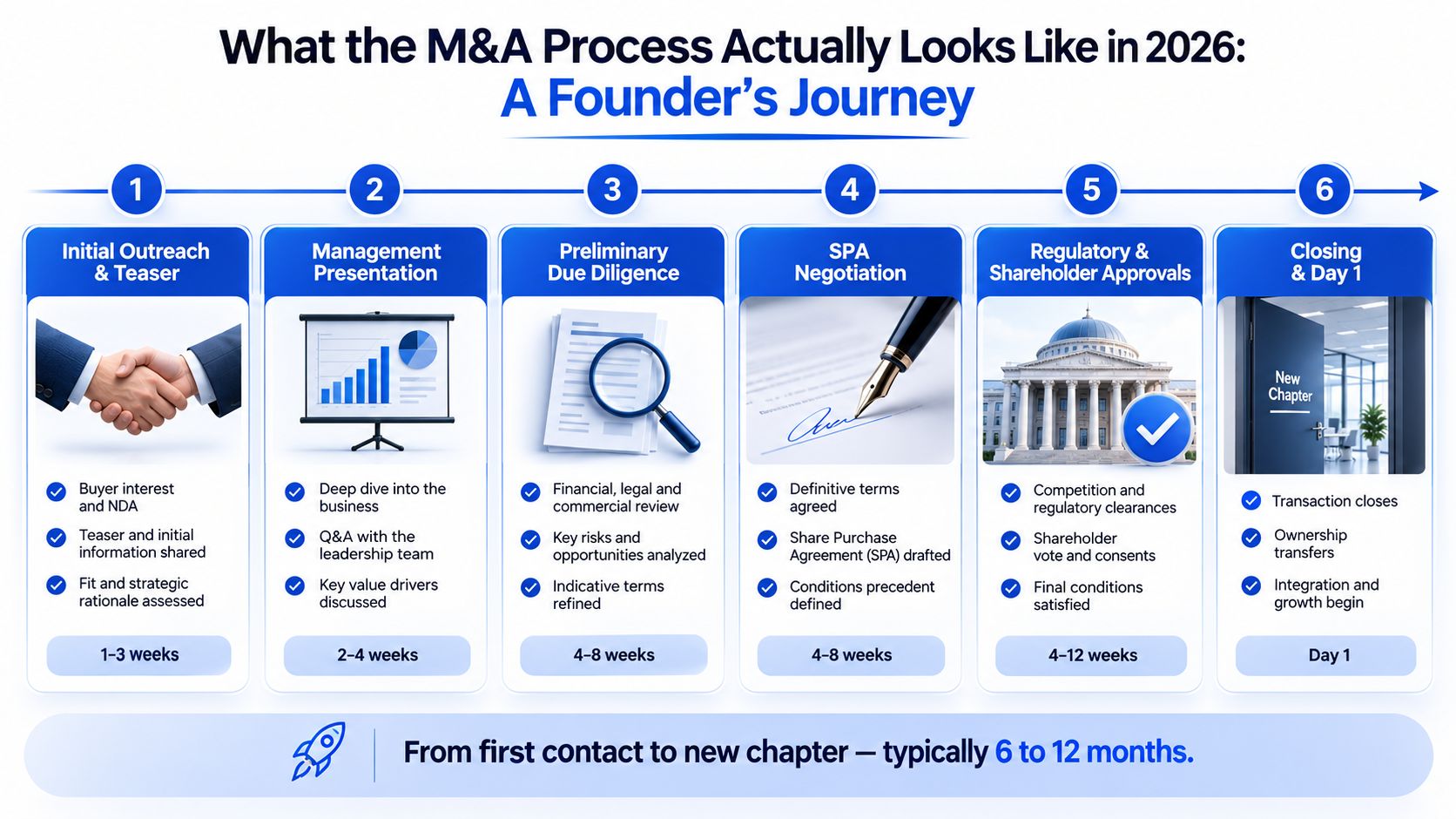
The gate structure is simple. At each stage, the buyer decides whether to keep spending time and money, or walk. AmbitionCFO's M&A readiness guide reinforces the same point. The company that is prepared controls the pace.
Founders in Pacific Northwest tech deals keep losing money in the same places. Weak IP assignment chains. Messy cap tables. A buyer discovering the product depends on one engineer and a pile of undocumented workarounds. And IT, data, and culture problems that were treated like cleanup work instead of deal risk.
Deal teams also miss the legal exposure sitting in the systems themselves. Washington UTSA issues show up fast if source code, trade secrets, or contractor access were handled loosely, and Washington Consumer Health Data Act problems can surface when product teams collected or shared sensitive data without disciplined controls. Cross-border buyers add another layer, especially when a transaction starts to look like a CFIUS-style review. That is why the buyer will test your contracts, code, permissions, and retention rules early, and why a founder should use AI contract review to catch drift in the paper before diligence does.
Preparing the Company for Sale and Sourcing Buyers
A serious process starts long before outreach. If the cap table is messy, the customer contracts are inconsistent, or the employee files don't match reality, a founder is not “going to market,” the founder is inviting a discounted process. The cleanest deals in Seattle, Bellevue, Portland, and the broader Puget Sound region usually come from companies that spend real time on the unglamorous work first.
The 90-day preparation standard
The fastest way to lose negotiating power is to let the buyer discover the basics. That means getting the data room ready, reconciling financial statements, checking IP assignments, reviewing open-source use, and confirming every contractor and employee invention assignment is signed. A founder should also know whether the buyer will see a stock sale, an asset sale, or a structure tied to a carve-out. The structure drives tax, risk allocation, and how much cleanup is left for the seller.
A practical internal checklist lives in cap table management guidance, because the cap table is where many premium deals break down. The same is true for entity records, board consents, and any side letters that never made it into the main file set.
Who to approach in Washington
Buyer sourcing in Washington is broader than many founders assume. Strategic acquirers often pay for speed and product fit. Private equity buyers like platforms and tuck-ins. Cross-border buyers show up in tech, health, climate, and industrial software. Search funds can also be relevant for smaller businesses where the owner wants continuity more than a trophy valuation.
Founder-led outreach makes sense in sub-$25M deals when the buyer universe is narrow and the story is simple. A banker process makes more sense when there are many possible bidders, or when the business needs disciplined market pressure to surface the right price. For a founder selling to a UAE buyer, advice for UAE founders selling is a useful reminder that process discipline, documentation, and buyer screening matter just as much outside the U.S.
Clean records don't just make diligence easier. They protect price, reduce retrade pressure, and shorten the seller's list of excuses for missed answers.
The early mechanics are straightforward. The seller circulates an IM or CIM, buyers sign NDAs, management gets selected for first-round calls, and then the serious bidders submit indications of interest. A founder should be ready to reject any buyer who wants broad exclusivity before proving real intent.
| Stage | Typical Duration | Key Deliverable |
|---|---|---|
| Preparation and materials | 4 to 8 weeks | Data room, CIM, diligence readiness |
| Outreach and initial review | 3 to 6 weeks | NDA, buyer screen, first looks |
| Management meetings and bids | 2 to 4 weeks | First-round indications of interest |
| LOI and exclusivity | 1 to 3 weeks | Signed LOI, control terms set |
| Confirmatory diligence | 6 to 12 weeks | Final diligence and deal cleanup |
| Definitive docs and financing | 4 to 10 weeks | Signing-ready documents |
Negotiating the LOI and Term Sheet
Founders sign LOIs too fast because the price line is the most visible line. That is a mistake. In Washington deals, the LOI is often not fully binding on economics, but the exclusivity, confidentiality, break-up mechanics, and access rights can bind the seller in practice long before the purchase agreement is final. The buyer gets a low-cost option if the founder treats the LOI like a formality.
The economics that matter
Five terms drive most of the value. Headline price is only one of them. Structure matters because a stock sale and an asset sale produce different tax and liability outcomes. Earn-outs can preserve upside, but they also invite disputes over measurement. Escrows and holdbacks change how much cash the seller receives at closing. Working capital targets can move real dollars after the deal closes if the target is set aggressively.
Control terms matter just as much. Exclusivity determines how long the seller is locked up. Information rights decide how much the buyer can inspect before committing. Termination and break fee language tells both sides how expensive it is to walk. If those clauses are loose, the buyer can drag the process while the seller's position weakens.
The clause founders underrate
A founder who negotiated exclusivity down to 30 days kept an advantage because the buyer had to move or lose the deal. Another founder signed a 90-day lockup with no fiduciary out, then spent the whole summer trapped while the buyer slow-walked diligence and reopened issues. The second founder lost time, lost optionality, and still had to answer the same diligence questions again.
If the LOI does not protect the seller's ability to keep talking to other bidders unless the buyer performs, the founder has given away negotiating position for free.
The rest of the document matters too. Reps and warranties survival, indemnity caps, and employee retention pools often matter more than the headline number because they control what survives closing. A balanced form will preserve enough flexibility for the seller while still giving the buyer real protection. In Washington deals, founders should read those provisions with the same care they give to data and IP risk, especially where a checklist for diligence and deal risk review helps surface hidden problems before they become price cuts.
A clean way to review the draft is to separate buyer-friendly terms from balanced terms. Buyer-friendly language pushes broad exclusivity, long survival periods, and vague earn-out metrics. Balanced language tightens the performance metric, limits the lockup, and ties post-closing claims to real disclosures instead of open-ended risk. For a practical drafting lens, see representations and warranties guidance.
Running Diligence Across Legal, Financial, IP, and Data
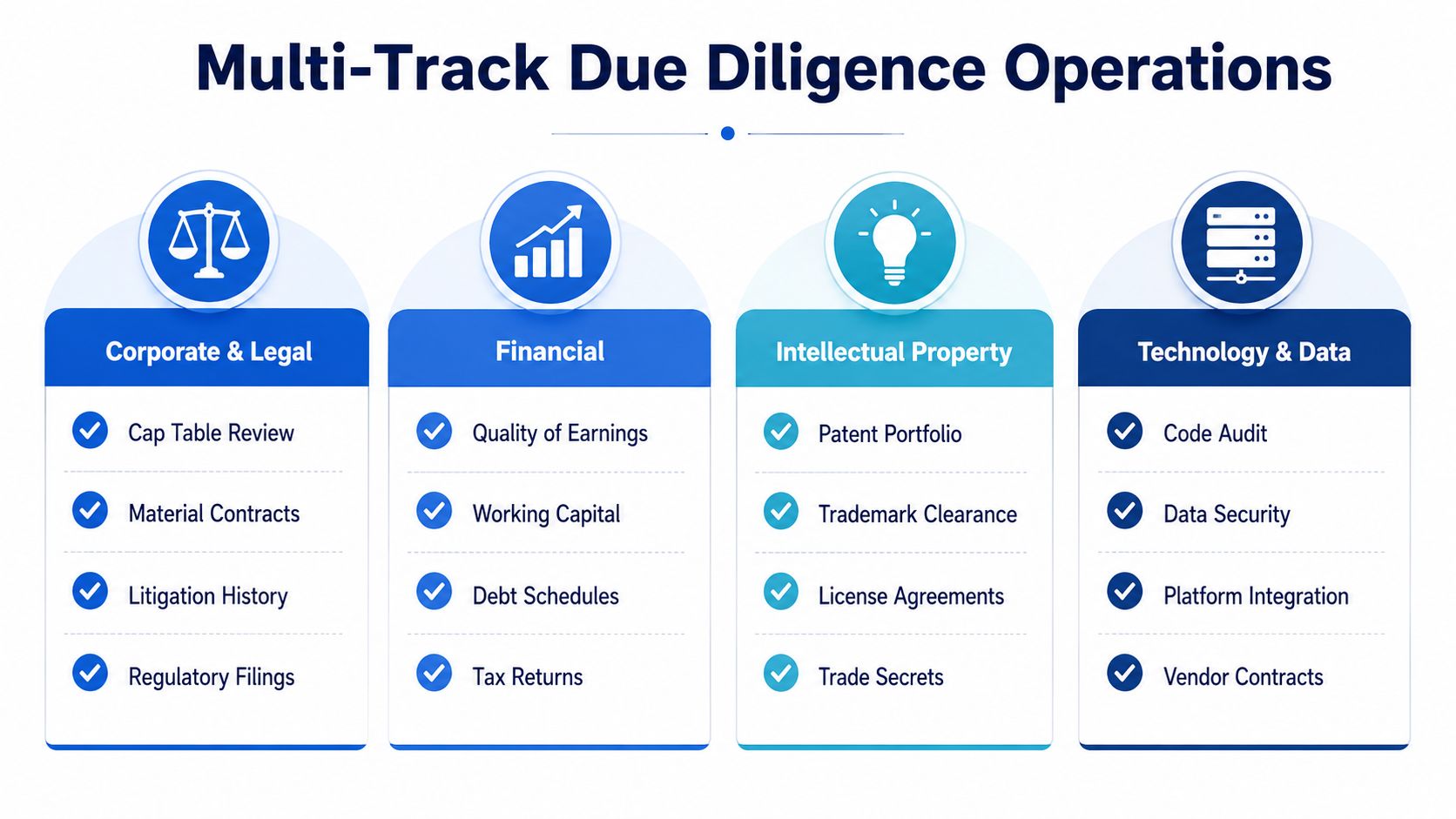
Diligence is not one workstream. It's four or five at once, and the seller who lets them blur together is usually the seller who gets retraded. The buyer's team is testing whether the company is real on paper, real in the books, real in the codebase, and real in how it handles data.
What each diligence track is looking for
Legal and corporate diligence focuses on the cap table, charter docs, board approvals, material contracts, and litigation history. Financial diligence looks at quality of earnings, working capital, debt, and tax records. IP diligence asks whether the company owns the software, inventions, trademarks, and trade secrets it claims to own. Technology and data diligence checks whether the business can survive contact with the buyer's security, integration, and reporting requirements.
A founder who wants a deeper screen should compare that with a diligence checklist built to uncover M&A deal risks. The useful checklists always force specificity, because vague answers invite buyer distrust.
Washington-specific exposure that gets missed
Washington founders need to treat privacy and data issues as deal issues, not compliance trivia. If the company handles consumer health data, the buyer will care about the Washington My Health My Data Act. If the company's conduct could trigger unfair or deceptive practice concerns, the Washington Consumer Protection Act can become part of the risk conversation. If the company relies on trade secrets or software that was never cleanly documented, the buyer will ask whether the Washington Uniform Trade Secrets Act exposure has really been contained.
The red flags are consistent. SaaS churn that the seller explains away but never quantifies. Customer concentration that makes revenue fragile. Open-source code use that was never reviewed by counsel. A history of breach notification, even if the incident is old. Hidden TSA dependence after a carve-out is another one, because it says the seller never separated the business.
Founders should test privacy and security before signing, not after the buyer finds the problem.
A practical 25-item checklist should include entity records, cap table, option grants, board consents, customer MSA forms, renewal clauses, refund history, debt schedules, tax returns, IP assignments, contractor agreements, open-source policies, security policies, incident logs, privacy notices, cookie disclosures, data maps, third-party vendor terms, TSA obligations, product roadmap dependencies, litigation threats, regulatory notices, employment agreements, benefits plans, bonus promises, and any unresolved breach response. For a more structured version, this due diligence checklist resource is a useful internal reference point.
Drafting the Purchase Agreement and Closing Mechanics
The purchase agreement is where the fight starts. Diligence tells the buyer what exists. The SPA decides who carries the risk if something is missing, overstated, or priced wrong. Founders who hand this off to “standard documents” usually learn that standard means the buyer's standard.
How Disclosure Schedules Work
Disclosure schedules are not a paperwork appendix. They are the seller's chance to carve known exceptions out of the reps and warranties, and that matters because a rep without a disclosure is a promise with teeth. A serious buyer will read the schedules line by line, compare them against diligence responses, and ask whether any gap was accidental or tactical.
In Washington tech deals, sloppy drafting costs money. If the company has privacy gaps, open-source issues, weak contractor paper, or undocumented data practices, those facts belong in the schedules, not in a later apology. Buyers do not forgive surprises just because the founder says the issue was “known internally.”
R&W insurance can help bridge the gap between buyer and seller, but it does not replace disciplined disclosures. It can reduce escrow friction, yet it also brings its own underwriting process and exclusions. In smaller Washington tech deals, the key question is not whether insurance exists in the abstract. It is whether the policy covers the risk the parties care about, including exposure under the Washington Uniform Trade Secrets Act and the Washington Consumer Health Data Act if the business touches sensitive code or consumer data.
For founders, the practical move is simple. Put the problem on the schedule early, or expect it to surface as a purchase price cut, a special indemnity, or a busted deal. That is where a clean understanding of representations and warranties helps keep the fight focused.
Signing, closing, and the gap in between
Signing and closing are different events. Signing locks in the deal terms. Closing happens only after the conditions are met, including financing, regulatory approvals, and any third-party consents. If the gap is long, the buyer will use it to revisit risk questions, especially if diligence surfaced something that should have been disclosed earlier.
Founders lose time here by treating the gap as a formality. It is not. Every unresolved consent, every missing assignment, and every messy employment file gives the buyer another reason to slow the wire. In Washington deals, that delay becomes more expensive when the business depends on key engineers, cloud vendors, or customer contracts that were never papered cleanly.
Working capital targets also deserve hard attention. If the target is too aggressive, the seller can lose value at closing even after a strong headline price. Escrows and holdbacks do the same thing more slowly, because they move part of the purchase price into a delayed payout bucket.
Founder-specific issues show up here too. Founder equity treatment needs to be mapped cleanly. Section 280G excise tax exposure can become a messy surprise if parachute payments are not modeled early. Restrictive covenants, especially non-compete and non-solicit language, need to be reviewed against the buyer's real integration plan, not a generic template. Earn-out measurement should be drafted to avoid a later accounting fight dressed up as a business disagreement.
If the target has technology, data, or customer-facing software, the closing mechanics should reflect that reality. Code escrow, transition services, data transfer obligations, and post-close access rights need to be spelled out with care. That is especially true in Washington, where a buyer will care whether the company's IP assignments are complete, whether contractors assigned their work, and whether consumer data handling can survive post-close integration without creating a new problem under state law.
Regulatory Antitrust Tax and Cross-Border Approvals
A founder can get the headline price right and still watch the deal stall in approvals. The buyer may like the business, the lawyers may like the paper, and the closing still slips because the regulatory path was never mapped with discipline. In Washington deals, that mistake gets expensive fast, especially when the company touches sensitive data, software infrastructure, or customers in regulated sectors.
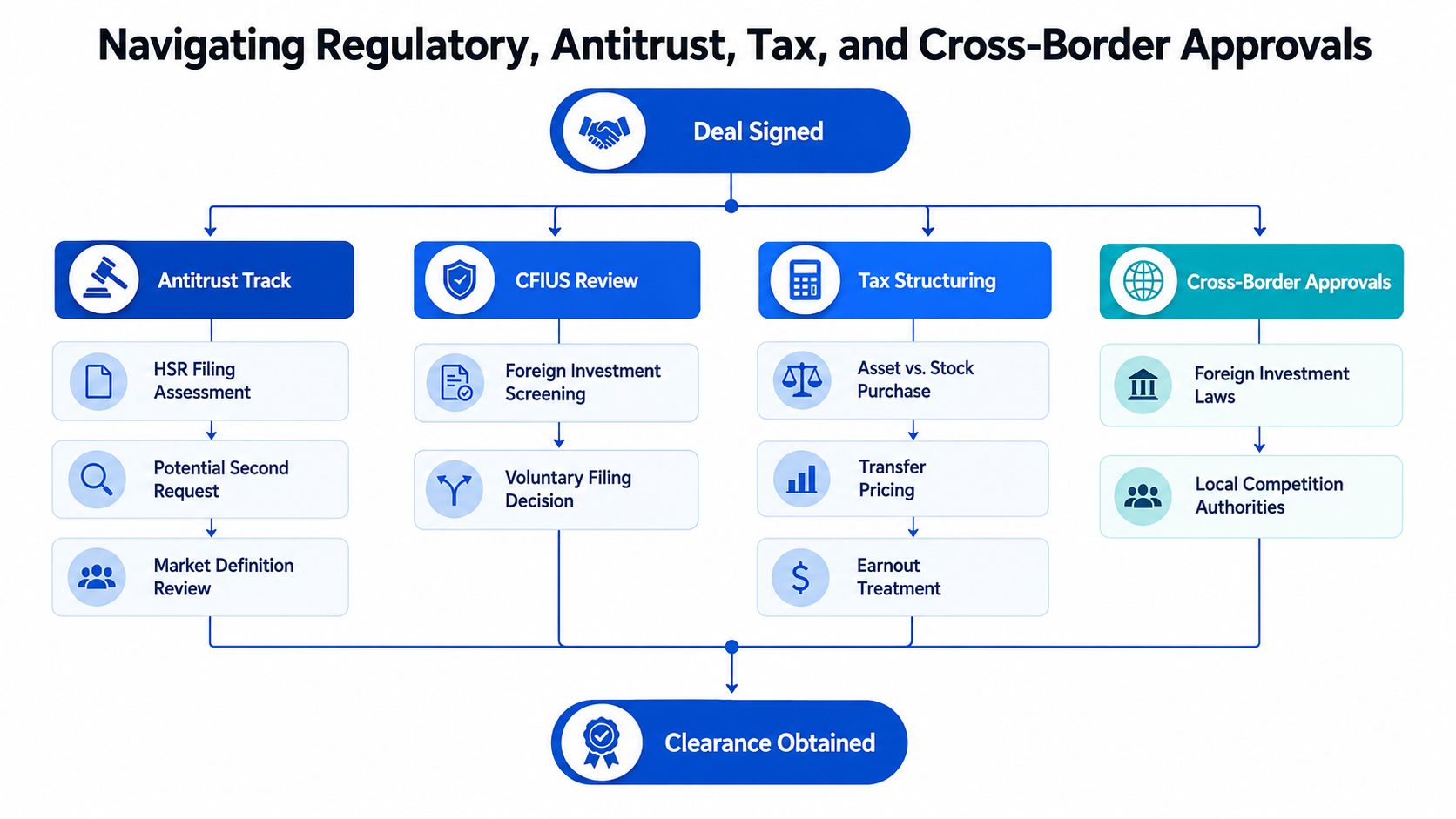
What Slows Deals: Antitrust, CFIUS, and Tax
Antitrust review is where founders often lose time. The issue is not whether a filing exists in the abstract, it is whether the buyer and target overlap in a way that invites market definition fights, second requests, or a longer clearance process. That risk goes up in software, data services, and adjacent sectors where buyers try to argue synergy and regulators look for concentration.
Cross-border deals create a separate approval track. CFIUS-style review matters when foreign investment touches sensitive technology, data, or infrastructure, and buyers from China, the Middle East, and parts of Europe should expect more scrutiny if the facts trigger it. A seller cannot control the rulebook, but a seller can control timing, disclosure, and whether the issue is surfaced early enough to keep the process moving.
Tax and Washington-specific traps
Structure changes the economics. Asset deals and stock deals take different tax paths, and Washington founders need to pay attention to apportionment, business and occupation tax, and possible sales tax exposure tied to what exactly is being transferred. The buyer will usually expect cooperation on post-signing notices and filings too, because tax work does not stop when the signature page is done.
Washington-specific IP and privacy issues can turn into approval issues as well. A company built on trade secrets, customer health data, or consumer data practices needs to address those points before buyer counsel turns them into closing conditions. That is where Washington UTSA exposure and Consumer Health Data Act issues become deal terms, not side notes. The same discipline applies if the transaction also needs local competition or foreign approvals outside the U.S., because those approvals stack on top of domestic ones and stretch the timeline.
If the regulatory memo is written after the LOI, the founder is already negotiating from a weaker position than the buyer.
The right approach is simple. Check whether any approval can delay closing. Check whether a foreign buyer triggers extra screening. Check whether the structure adds avoidable tax friction. If any answer is unclear, slow the deal and force the issue into the process before it shows up in closing conditions or post-signing demands.
Post-Merger Integration That Captures Value
The founders who lose money after closing usually had decent deals on paper. The business case looked clean, the lawyers documented the risk, and then nobody owned the operating transition. The founders who protect value do the opposite. They treat integration as part of the transaction thesis, not the cleanup crew.
A Portland software founder sold a business and assumed the buyer would figure out systems, reporting, and customer handoffs later. It did not happen that way. Sales leadership changed, product documentation was thin, and the support team spent months answering the same questions in different systems. A different founder in Seattle built the integration plan before signing, named owners for IT, finance, HR, and customer communications, and used the diligence findings to set Day 1 priorities. The second business moved faster because the buyer knew where the risk lived.
A strong Day 1 plan starts with communications, reporting, and decision rights. Employees need to know who approves what. Customers need continuity. Managers need a cadence for updates, not a promise that things will settle down soon. If a retention package is needed for engineers, operators, or a customer-facing leader, it should be tied to role criticality, not ego.
The workstreams are simple, but only if someone owns them. IT and data need migration milestones. Finance needs reporting continuity. HR and benefits need clean handoffs. Customer success needs a script for key accounts. Product teams need a roadmap that reflects the buyer's integration reality, not the seller's old backlog. For teams using software to review contracts and assign workflow tasks, This integration guide shows how automation can keep execution organized without letting legal judgment drift.
Day 1 should be boring. If the buyer spends the first week solving preventable access, payroll, or reporting problems, the deal team underprepared the transaction.
The 30, 60, and 90-day rhythm should be set before closing. By day 30, the buyer should have stable governance and visible reporting. By day 60, the critical systems should be aligned or clearly staged. By day 90, the board should see whether the integration is preserving customer relationships and retaining the people who matter.
The video below reinforces the integration mindset because most value is won or lost after the documents are signed.
Post-merger integration decides whether the acquisition keeps paying off once the lawyers step away. The purchase agreement prices the assets, but PMI determines whether those assets still produce value after closing.