Companies don't lose money on SaaS at signature. They lose it months later, when an unused seat tier renews automatically, a price uplift lands without warning, and the exit clause makes migration too painful to attempt. Effective SaaS contract negotiation prevents that sequence by treating timing, renewal design, data rights, and service remedies as economic terms, not boilerplate.
For Washington startups and mid-sized companies, the practical question is direct. What should a buyer negotiate before signing a SaaS contract? The answer is the renewal deadline, price protection, true-down rights, enforceable service levels, limits on data and AI training use, indemnity that survives the liability cap, and a usable exit path.
Why Timing Drives Every SaaS Deal
A founder rarely meets a SaaS agreement in calm conditions. Sales wants the tool live, finance wants the order form approved, and legal review starts when the vendor sends a redline against a quarter-end deadline. That sequence gives the seller an advantage before price or liability is even discussed.
The workload explains why. CIO Dive's summary of a 2024 analysis of more than 1,000 companies found businesses spent an average of 385 hours per year in SaaS and cloud purchase and renewal meetings, managed about 126 active SaaS contracts, and renewed roughly five contracts each month. A company handling that volume can't treat every renewal as a surprise procurement project.
How Long Does SaaS Buying Actually Take
The same analysis put a new purchase at roughly 100 days from start to completion and an average renewal at about 60 days, with buyers typically considering three bids for a new purchase. Those periods cover product evaluation, competing bids, security review, finance approval, legal review, and internal authorization, not just calls with an account executive.
A 30-day review window therefore fails for structural reasons. Security questionnaires, a data processing addendum, insurance requirements, service levels, implementation duties, and executive approval each sit with a different owner. When review starts late, the business keeps the incumbent because switching is no longer credible, even if the price or terms have worsened.
The buying sequence below shows where negotiation advantage appears and where it disappears.
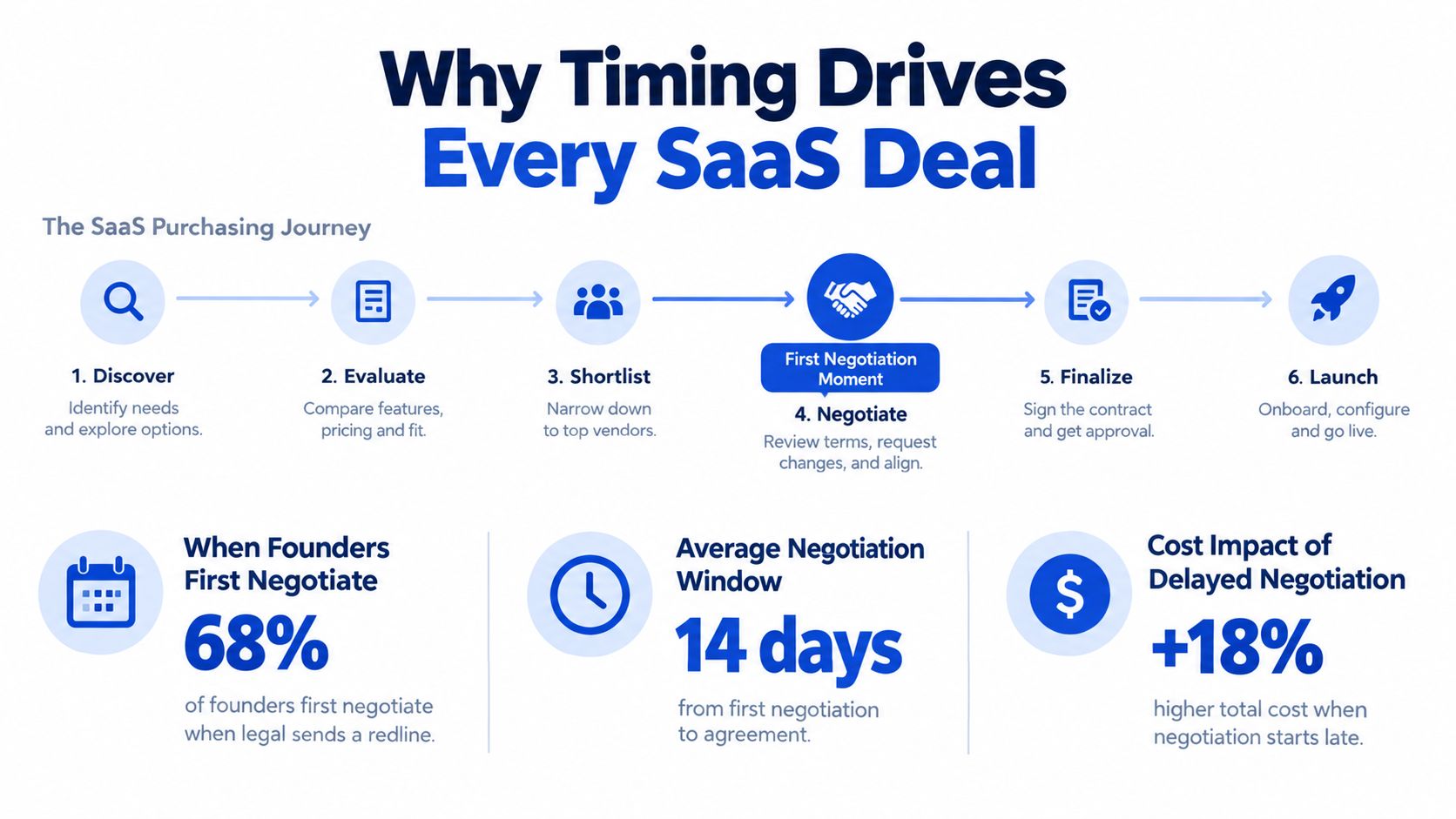
Purchase Versus Renewal Workload
| Workload Indicator | New Purchase | Renewal |
|---|---|---|
| Typical elapsed time | Roughly 100 days | About 60 days |
| Alternatives considered | Typically three bids | Often none unless review starts early |
| Main internal reviews | Product, security, finance, legal, authorization | Usage, price, security changes, legal, authorization |
| Leverage risk | Dependency forms during implementation | Missed nonrenewal deadline |
What a Contract Calendar Should Contain
A central calendar should list the owner, renewal date, nonrenewal deadline, notice method, price-change right, security review date, and implementation milestone for every material tool. The owner shouldn't be a generic operations inbox. A named person must confirm that notice was sent in the contractually required form and that proof was filed with the executed agreement.
Calendar rule: if the nonrenewal deadline isn't visible before budget planning begins, the renewal has effectively already been decided.
Early review also changes the conversation with leadership. Instead of asking for more legal time in the abstract, a founder can show which contracts lose competitive tension first, which tools process sensitive data, and which renewals need a replacement evaluation. That's how SaaS contract negotiation becomes a calendar discipline rather than a last-minute redline exercise.
Commercial Clauses That Decide Real Price
The first-year subscription price is only the entry fee. Lifetime cost turns on renewal pricing, seat reductions, ramp commitments, payment timing, and whether unused capacity can be removed without waiting for the next term.
The comparison below separates terms that preserve flexibility from terms that lock in spend.
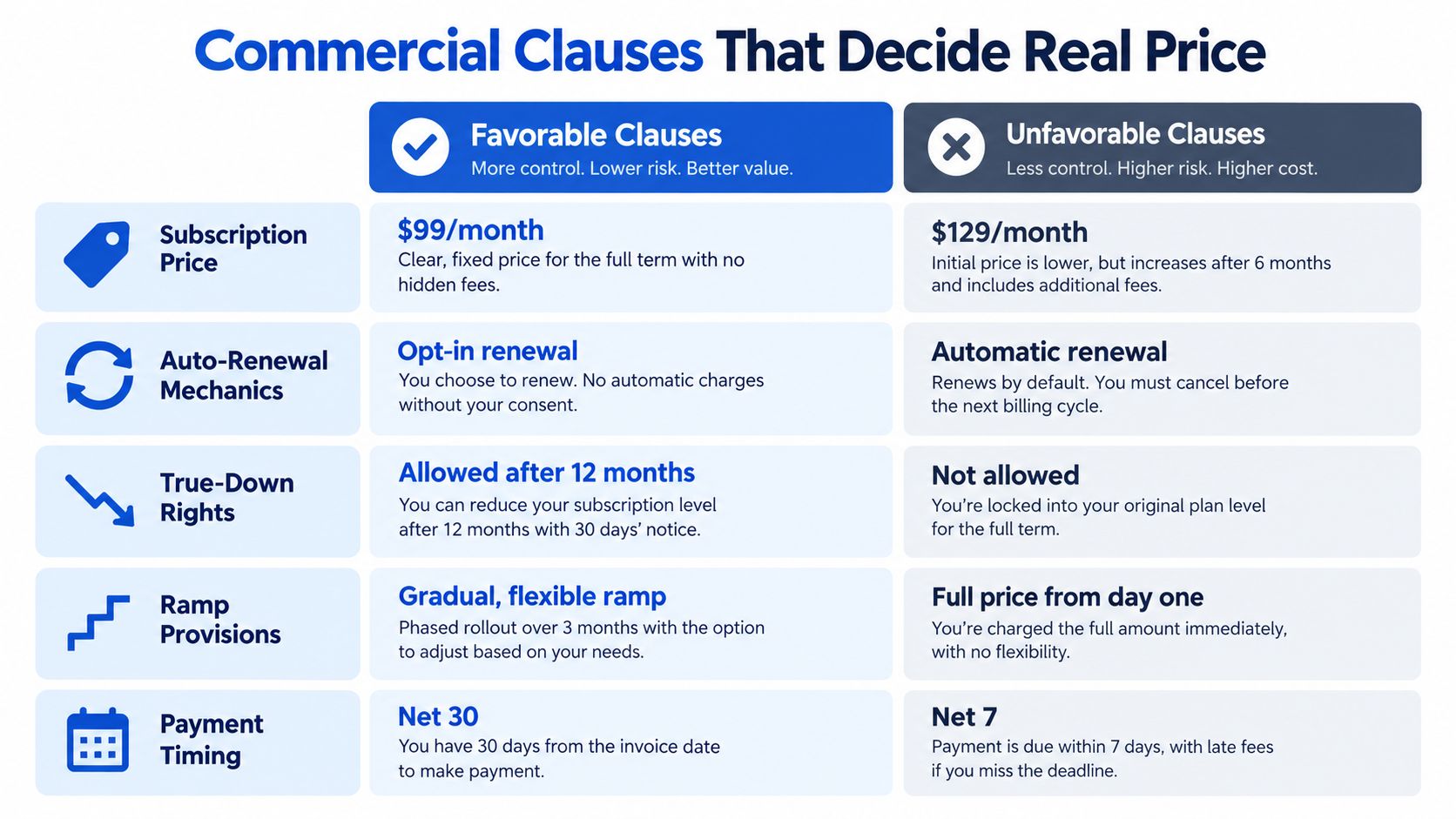
Renewal architecture deserves the same attention as the discount. Vertice's SaaS contract negotiation data reported that 89% of contracts in its dataset contained auto-renewal clauses, 33% allowed the vendor to increase pricing, commonly at renewal, and automatically renewed subscriptions saw an average 9% price increase. A cheap first year can become expensive if the renewal formula is uncapped.
What Price Protection Should Say
What's a reasonable SaaS price increase cap? A formula works better than a promise to act reasonably. Tropic's SaaS agreement guidance describes a commonly negotiated annual uplift range of 2–5%, often paired with a CPI-linked ceiling so an introductory discount isn't erased at renewal. The clause should state whether the cap applies to the whole subscription or only to added users and modules.
Buyers should also negotiate a vendor obligation to send a written renewal reminder, even when the contract already contains a nonrenewal deadline. The reminder doesn't replace internal calendaring, but it creates a second record and reduces disputes about whether pricing changed. Vendors resist uncapped termination rights more than reminders, so the reminder is usually an easier concession.
Renewal Timing and Savings
| When You Begin Negotiating | Average Reported Savings |
|---|---|
| More than 90 days before renewal | 49% |
| 30 to 90 days before renewal | 19% |
Those figures come from the Vertice data cited above. They support a simple operating rule for founders. Negotiation should start while a credible alternative can still be evaluated, not after the notice deadline has converted the renewal into a retention discussion.
A short video walkthrough can help non-lawyers see how commercial terms interact before they enter that discussion.
True-Down, Ramp, and Payment Trade-Offs
- True-down rights: the buyer can reduce unused seats or services at renewal, or at defined points during the term, rather than paying for departed employees and abandoned modules.
- Ramp provisions: fees increase against agreed adoption milestones instead of forcing a startup to buy its forecast on day one.
- Payment timing: annual prepayment may buy a discount, but quarterly payment can protect cash flow and preserve negotiating power if implementation slips.
- Reference rights: a logo or case study has value to the vendor and shouldn't be granted automatically without approval, timing limits, and a revocation right.
A longer commitment can justify a lower rate, but only when the buyer receives price certainty and flexibility in return. A slightly higher rate with true-down rights and a shorter renewal term can cost less for a company with volatile headcount. Platform terms offer a useful comparison point, and founders reviewing vendor paper can compare structure against published legal terms for the platform before accepting unfamiliar renewal language.
Commercial concessions also interact with risk allocation. A discount doesn't compensate for a weak indemnity if the tool will handle customer data or core operations. Washington buyers should read price terms alongside guidance on indemnity clauses in Washington contracts so a commercial win doesn't hide an unpriced legal exposure.
Turning SLAs From Marketing Copy Into Real Obligations
An uptime percentage looks precise until an outage occurs. The contract then turns on definitions that many buyers never read, including the measurement window, excluded downtime, maintenance notice, and the deadline for claiming a credit.
The arithmetic should be stated plainly in every negotiation. 99.9% monthly availability permits approximately 43 minutes of downtime in a 30-day month, while 99.99% permits about 4 minutes, according to the SaaS agreement guidance cited in the commercial section above. A buyer running payroll, customer support, or transaction processing shouldn't accept the lower figure merely because it sounds close to the higher one.
What Makes an SLA Enforceable
NIST cloud computing guidance describes the SLA as the document containing the provider's technical performance promises, the method for discovering and handling disputes, and remedies for performance failures. NIST also places service quality, security, delivery time, and performance parameters inside that framework. A percentage without measurement and remedy language doesn't meet that standard.
The review image below reflects the right posture for this clause. The SLA should be read as an operating manual for failure, not as a sales exhibit.

Questions to Ask Before Accepting an Uptime Promise
- Measurement: whose monitoring system controls, and can the customer access the underlying availability records?
- Exclusions: does scheduled maintenance require advance notice, and are emergency maintenance windows capped or defined?
- Incident duties: what are the response and restoration targets by severity, and how are status updates delivered?
- Credits: how is the credit calculated, how quickly must a claim be filed, and does the credit apply automatically?
- Repeated failure: do consecutive misses create a termination right, or can the vendor keep issuing small credits indefinitely?
A service credit that's cheaper than fixing the outage becomes a pricing feature for the vendor, not protection for the customer.
Credits should escalate as availability falls and shouldn't be framed as the exclusive remedy for every failure. Buyers overreach when they demand unlimited damages for any brief interruption. Vendors usually give more ground on a defined termination right after repeated failures, clearer maintenance notice, and a workable claim process. Those concessions matter operationally because they let the customer leave a chronically unreliable service.
Security commitments belong in the same measurable frame. Rather than accepting a promise to use reasonable security, the agreement can specify incident notification timing, access logging, encryption, backup and recovery objectives, vulnerability remediation, and audit evidence. A Washington buyer can use a structured service level agreement template to test whether the vendor draft defines the promise, the metric, the exception, and the remedy in the same provision.
What should happen after repeated SLA failures? The direct answer is escalation, then exit. The contract should require a root-cause report and corrective plan, increase credits for continued failure, and permit termination without an early-termination penalty if the floor is missed again.
Data Privacy, AI Training, and the Liability Trap
Generic SaaS checklists often ask whether a vendor protects customer data. That question is too broad for an AI-enabled product. The buyer needs to know whether data will be used only to deliver the service or also to train models, profile users, improve products, or benefit other customers.
The market default favors vendors. Stanford Law School's 2025 analysis of TermScout data found 92% of AI vendors claimed data-use rights broader than necessary to provide the service, compared with 63% across broader SaaS agreements. The same analysis found only 17% committed to full regulatory compliance and 33% offered indemnification for third-party intellectual-property claims.
What Should an AI Data Clause Prohibit
Can a SaaS vendor train AI on customer data? It can if the contract grants that right, so the customer should require express opt-in consent for training, profiling, and product-improvement uses beyond service delivery. Silence in the main agreement isn't protection when an AI addendum, privacy policy, or product terms page grants broader rights.
- Purpose limitation: customer data, prompts, files, and outputs may be processed only to provide the contracted service to that customer.
- Training consent: model training requires separate opt-in consent, with a practical opt-out and no loss of core functionality for declining.
- Deletion: prompts, outputs, embeddings, and uploaded files are deleted on the stated schedule, including from backups under a defined process.
- Subprocessors: the vendor lists model and hosting subprocessors, gives notice of changes, and allows objection for material changes.
- Model changes: material model or routing changes require notice when they affect security, retention, output quality, or compliance.
These terms must connect to the main agreement. If confidentiality permits internal product improvement, the DPA restricts secondary use, and the AI addendum allows training, the vendor will rely on the broadest language. Order-of-precedence language should make the negotiated data restriction control over online terms. Technical controls matter too, and engineering teams evaluating vendors should align contract promises with practices for securing production AI endpoints so access, logging, and retention settings match the paper.
Why the Liability Cap Can Empty the Indemnity
An indemnity has little practical value if every covered claim is squeezed under a low general liability cap. A vendor may promise to defend intellectual-property claims, then cap total liability at a few months of fees. Defense costs alone can consume that amount before settlement or judgment is considered.
The cleaner structure names the indemnified claims, states the defense and notice procedure, and places intellectual-property indemnity, confidentiality breaches, and wilful misconduct outside the ordinary cap or under a higher separate cap. Customers overreach when they demand that the vendor insure every business loss caused by generated content. Vendors are more likely to accept responsibility for the service and model they control when the customer accepts responsibility for unlawful inputs, ignored warnings, and unreviewed regulated use.
Washington companies handling personal information, source code, health data, financial records, or confidential product plans should not leave these points to a sales assurance. The DPA, security addendum, AI terms, and order form need one consistent allocation of responsibility. A negotiated data processing agreement should identify processing purposes, subprocessors, security measures, incident notice, return or deletion duties, and audit evidence in language that survives a vendor's standard liability cap.
Security obligations should also be measurable. The FTC's Microsoft Azure cloud privacy assessment illustrates concrete governance practices including access logging, storage logging, firewall-log review, security and privacy training, and nondisclosure duties for personnel with system access. A buyer doesn't need to copy a federal assessment into a startup contract, but it should ask which equivalent controls the vendor will commit to in writing.
Renewal Mechanics and Washington Disclosure Rules
Washington buyers have a statutory tool that many national SaaS templates ignore. It doesn't eliminate auto-renewal, but it makes sloppy disclosure expensive for the seller and gives the customer a concrete reason to demand clearer renewal language.
For contracts entered into after May 1, 2024 that automatically renew or extend for more than one month, Washington House Bill 1441 requires the seller either to provide a separate disclosure form and obtain the customer's signature or to place the disclosures conspicuously in the contract and obtain the customer's initials on the disclosure page. If the seller doesn't comply, the automatic-renewal provision is unenforceable and the contract ends when the current term expires.
The checklist below translates that disclosure duty into signing practice.
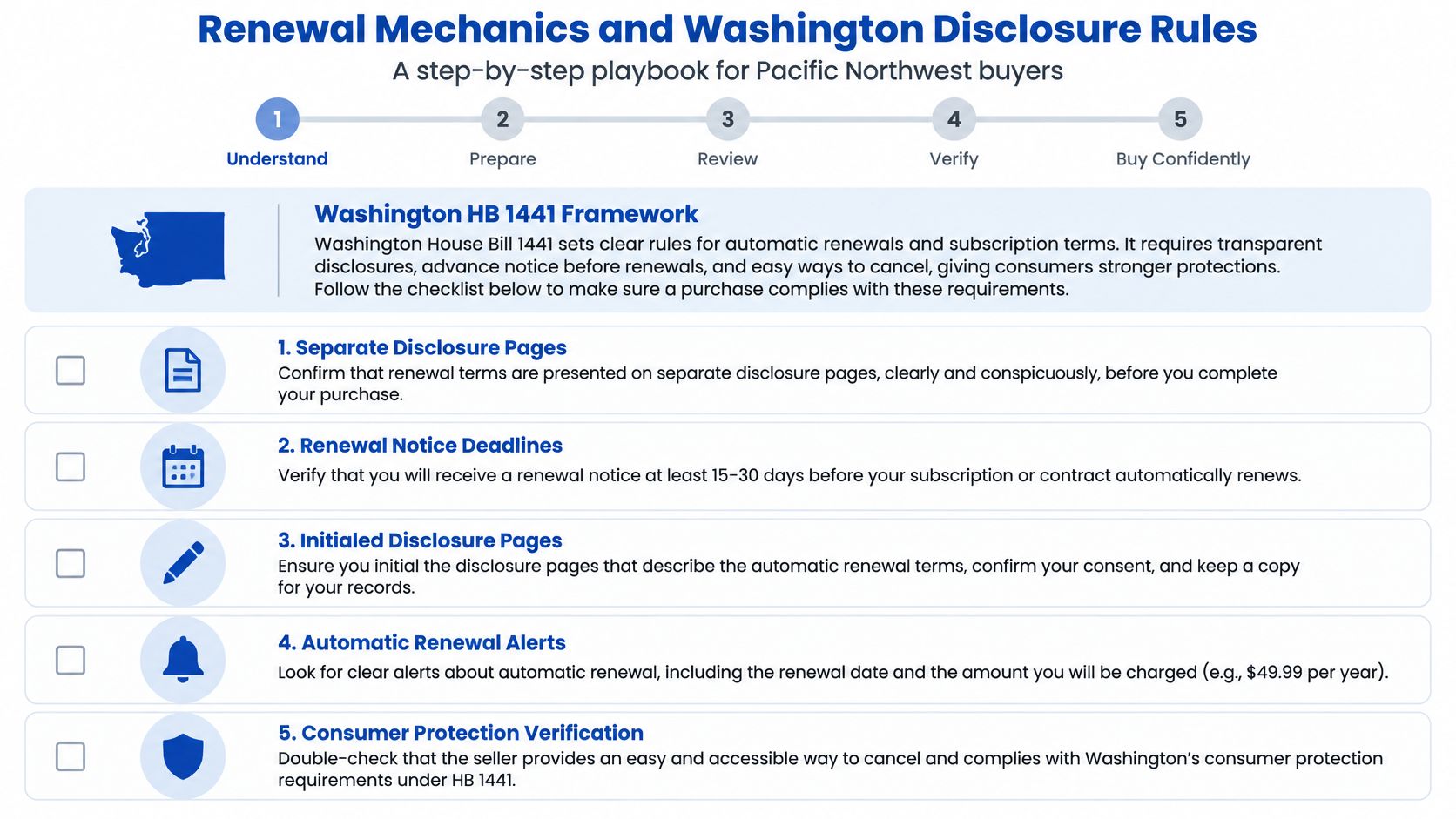
What the Disclosure Must Tell the Customer
The disclosure must state that renewal is automatic unless declined, identify the renewal term length, disclose whether charges will increase, explain how the customer can decline renewal, and state the opt-out deadline. A buyer should confirm those five points before signature, not after receiving a renewal invoice. If a vendor can't point to the signed form or initialed page, renewal enforceability becomes a negotiation issue rather than an assumption.
A second notice rule matters for longer commitments. The House bill report for HB 1441 explains that when an initial term exceeds one year and the contract auto-renews for an additional term longer than one year, the renewal provision can be unenforceable in covered circumstances unless the seller sends compliant written notice at least 15 days but no more than 60 days before the opt-out deadline. Term length is therefore not boilerplate. It changes the notice analysis.
How to Use the Rule Without Overstating It
Does Washington law cancel every auto-renewing SaaS contract? No. The statute creates disclosure and notice conditions, and noncompliance can make the renewal provision unenforceable. The buyer still needs to manage the underlying term, payment duties, data return, and transition plan.
- Nonrenewal procedure: name the recipient, permitted delivery method, and whether email to a stated contracts address is effective.
- Reminder notice: require written notice before the opt-out deadline, even for terms outside the longer-term statutory notice scenario.
- Renewal length: prefer shorter renewal periods where usage or headcount is uncertain.
- Price adjustment: state the formula or cap in the disclosure and order form using identical language.
- Proof file: store the signed disclosure, initialed page, reminder, and any nonrenewal notice with the executed agreement.
Pricing pressure makes these mechanics urgent. Vertice's 2025 SaaS inflation research reported SaaS pricing increased 11.4% year over year as of January 2025, compared with 2.7% average inflation across G7 countries, and the same source material reported renewal-based increases were used by 44% of SMBs and 55% of enterprises. A missed deadline can therefore lock in both another term and a materially higher price.
The operational fix is assignment plus evidence. One owner sends the notice, another verifies receipt, and finance blocks payment assumptions until the renewal decision is recorded. Those controls fit naturally inside broader contract management best practices, particularly for companies whose tools process employee, customer, health, or financial data and can't be replaced on short notice.
Your Negotiation Playbook and 30-60-90 Plan
A playbook converts scattered preferences into decisions a team can make under deadline. It should identify the target outcome, the acceptable fallback, the mandatory terms, and the person who can approve a trade.
Renewal preparation should start earlier than most startups expect. VendorBenchmark's renewal negotiation playbook recommends beginning 12–9 months before expiration with a clause inventory, actual-versus-contracted usage analysis, peer pricing benchmark, and demand forecast. At 9–6 months, the buyer converts that work into a written target outcome, competitive-alternative map, clause-priority list, and internal approval plan.
The First Vendor Meeting
What should a buyer bring to the first SaaS negotiation meeting? The direct answer is usage data, a scope forecast, a credible alternative, a ranked clause list, and approval limits. Without those items, the vendor controls the baseline and every concession looks like a favor.
- Scope review: confirm users, modules, environments, integrations, data types, and implementation duties against actual need.
- Alternative map: identify the replacement option, migration effort, and decision date that keeps switching credible.
- Target outcome: state the desired price structure, term, true-down right, SLA remedy, and data restriction in writing.
- Approval plan: name the finance, security, legal, and executive approvers before redlines begin circulating.
Documented renewals commonly require 3–7 negotiation rounds, with contractual protections addressed in the middle rounds and price finalized later, according to the VendorBenchmark playbook cited above. The same source reported a 9.4% median improvement against vendor renewal baselines, while mature procurement organizations typically capture 11–16%. Those outcomes depend on trading more than headline price. Term length, volume, payment timing, implementation scope, and reference rights can be exchanged for measurable concessions.
Named Concessions and Likely Vendor Cost
| Customer Concession | What to Request in Return | Typical Vendor Resistance |
|---|---|---|
| Longer term | Price cap, true-down right, termination after repeated SLA failure | Moderate if revenue becomes predictable |
| Annual prepayment | Discount, implementation credits, stronger refund language | Low to moderate because cash timing improves |
| Logo or case study | Price protection, added support, training | Low when approval and timing remain controlled |
| Volume commitment | Ramp schedule, unused-license credit, rate protection for added users | Moderate if the forecast is unsupported |
| Mutual indemnity | Vendor IP indemnity outside the ordinary cap | High unless claim scope is tightly defined |
| Audit evidence acceptance | Defined security metrics and incident notice | Moderate for smaller vendors with limited reporting staff |
Non-negotiables should stay narrow. Data return, security duties, termination assistance, purpose limitation for AI use, and liability allocation usually justify a hard line. Cosmetic wording preferences don’t. When redlines stall, escalation works best with a short business note that identifies the operational risk, the proposed compromise, and the decision needed from an executive sponsor. Sending another full markup without priorities rarely moves a vendor legal team.
Sector-specific buying patterns also matter. A professional-services firm evaluating practice software faces confidentiality and migration concerns that differ from a retailer buying marketing automation, so market context such as 2026 law firm software buying advice can help buyers separate category norms from vendor-specific demands. The contract still needs company-specific usage and risk analysis.
The 30-60-90 Plan After Signing
- Days 1–30: file the executed agreement, disclosure page, order form, DPA, SLA, and notice addresses in one record, then calendar the opt-out deadline and price-change date.
- Days 31–60: confirm implementation milestones, admin training, security settings, subprocessor notices, data export access, and the process for claiming service credits.
- Days 61–90: compare actual usage with contracted capacity, test an export in the agreed format, document support performance, and record issues for the first renewal review.
The cheapest renewal concession is the one documented while the vendor still wants the signature.
Exit planning belongs in that first 90 days, not in the final month. The agreement should specify a post-termination access period, authorized users, export format, transition assistance, deletion certification, egress or export fees, and whether read-only access remains available. A 90-day post-termination access period is one example described in the SaaS agreement guidance cited earlier, but the right period depends on migration complexity and record-retention duties.
Startups and SMBs make the same avoidable mistakes. They negotiate only the subscription price, buy forecast capacity without a ramp, let the auto-renewal deadline pass, and accept data-return language that doesn’t identify a usable format. A disciplined SaaS contract negotiation avoids those errors by asking one question for every clause. What will this provision cost if usage falls, the service fails, the vendor changes the model, or the company decides to leave?
By Design Law Firm & Legal Consultancy, PLLC helps Washington startups and growing companies negotiate SaaS, vendor, data processing, and AI-related agreements with clear renewal, liability, privacy, and exit terms. Founders facing a vendor redline, renewal deadline, or Washington auto-renewal question can discuss the contract before dependency removes their negotiating power by visiting By Design Law Firm & Legal Consultancy, PLLC. Contact our law office at (206) 593-1519.