A founder is two days from launch. The app collects emails, charges cards, runs analytics, and sends prompts to an AI vendor. The footer has one borrowed legal page that promises privacy, limits liability, and claims ownership of user content, all in the same paragraphs. That single page is the risk. Privacy Policy vs Terms and Conditions is not a naming choice. One document discloses real data practices to regulators and consumers. The other allocates contractual risk between the business and the user. Neither is finished until both match how the product behaves in production.
Privacy Policy vs Terms and Conditions at a Glance
A privacy policy explains how a business collects, uses, discloses, retains, and potentially sells personal information, plus how individuals exercise privacy rights. Terms and conditions set the contractual rules for using a website, app, or service. Those rules cover eligibility, acceptable conduct, payment, intellectual property, warranties, limitation of liability, dispute resolution, and termination.
The split became urgent in the United States after California enacted the California Consumer Privacy Act (CCPA) in 2018. Under the California Attorney General CCPA guidance, a covered business provides notice at or before collection and maintains a policy covering information collected during the preceding 12 months, categories of sources, purposes, disclosure or sale or sharing, and rights to know, delete, correct, opt out, limit certain uses, and receive nondiscriminatory treatment.
A terms document cannot, by itself, satisfy a privacy disclosure duty.
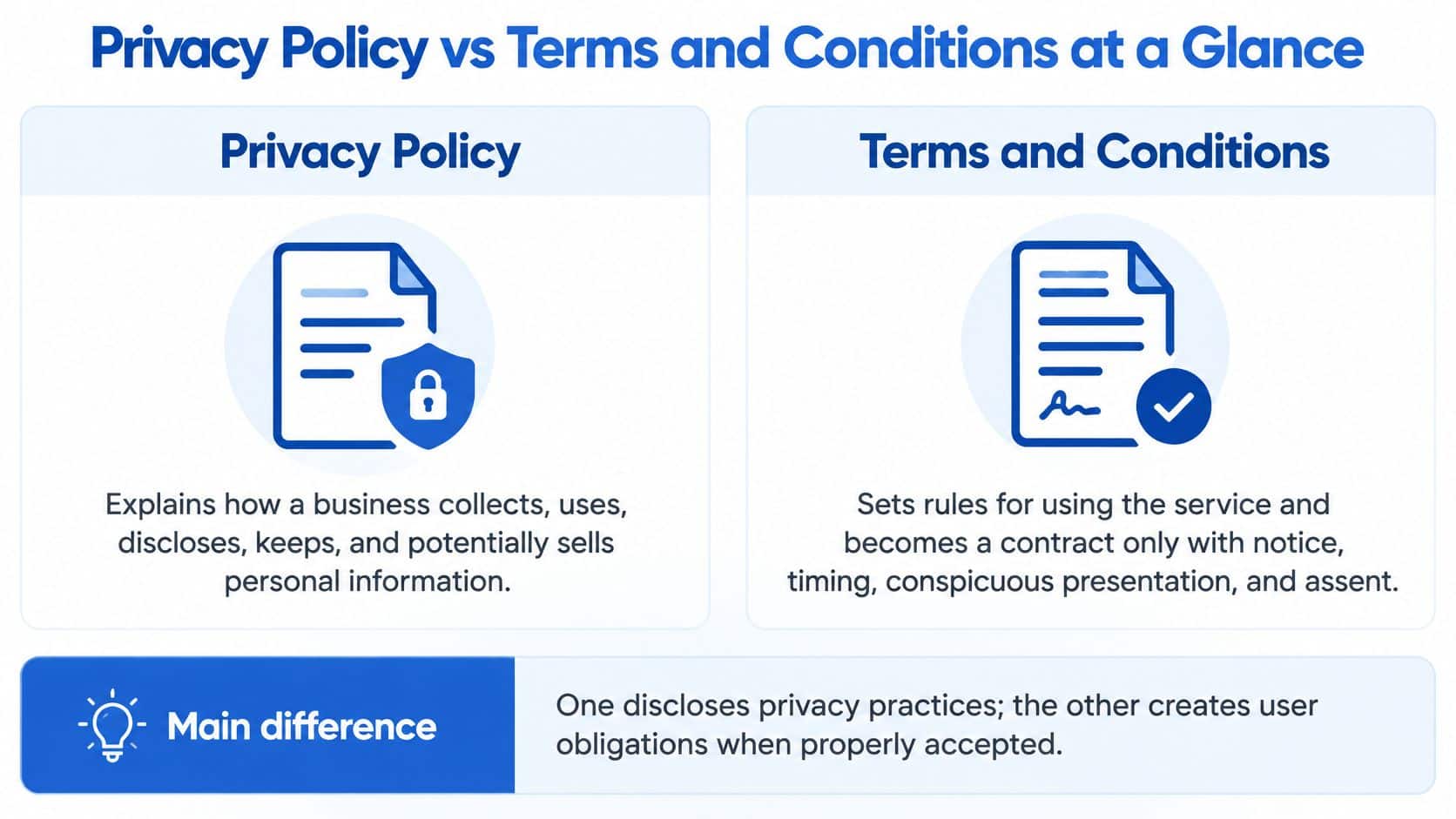
Privacy policy and terms and conditions compared
| Aspect | Privacy Policy | Terms and Conditions |
|---|---|---|
| Core purpose | Explains how personal data is collected, used, shared, kept and sold | Sets the rules for using a website, app or service |
| What it governs | Data practices and individual privacy rights | Contractual relationship between the user and the business |
| Mandatory under | CCPA, GDPR, Washington My Health My Data Act | No single privacy statute, contract law and consumer rules, plus DSA Article 14 for covered intermediaries |
| Typical content | Data categories, purposes, recipients, retention, rights requests | Eligibility, acceptable use, payment, IP, warranties, liability, termination |
| Primary reader | Consumers, regulators and privacy authorities | Users who accept the service and, if needed, courts |
| Risk if missing | Regulatory penalties and failed rights requests | Weak liability limits and disputes resolved under default rules |
A founder launching a web app or mobile product usually needs both. Keep the table open while drafting. Each row decides which document a signup form, payment page, analytics tag, or support tool needs.
What a Privacy Policy Must Disclose Under CCPA, GDPR and Washington Law
A privacy policy is an operational record of data flows, not a values statement. Draft it from systems first. List every form, cookie, SDK, payment processor, CRM, support inbox, and AI tool, then write one disclosure for each flow.
Required privacy policy elements by law
| Required element | CCPA (California) | GDPR (EU and UK) | Washington MHMDA (consumer health data) |
|---|---|---|---|
| Data categories | Categories collected in the preceding 12 months | Categories of personal data and processing activities | Categories of consumer health data collected |
| Purposes | Purpose for each category collected | Purposes and legal basis for each activity | Purpose and intended use of each category |
| Sources | Categories of sources | Source, where the data was not obtained from the person | Categories of sources of consumer health data |
| Recipients | Categories of third parties disclosed, sold or shared with | Recipients or categories of recipients | Categories of third parties and specific affiliates receiving the data |
| Retention | Retention period for each category | Retention periods or criteria | Retention period or criteria stated for each category |
| Rights | Know, delete, correct, opt out of sale or sharing, limit use, non-discrimination | Access, rectification, erasure, restriction, portability, objection | Access, correct, delete, withdraw consent and appeal |
| Where it appears | Link containing the word privacy, plain language, printable | Concise, transparent, intelligible and accessible notice at collection | Separate policy linked from the homepage |
Under the GDPR privacy notice guidance, a notice identifies the data controller and contact details, purposes and legal bases, recipients, international transfer safeguards, retention periods, consent withdrawal, complaint rights, and automated decision making or profiling. It must be concise, intelligible, accessible, and delivered at the relevant time, not buried in website terms. That's why a GDPR notice can't hide inside a contract.
California adds presentation duties. Disclosures use plain language, avoid legal jargon, stay readable on smaller screens, sit behind a conspicuous link containing the word "privacy", and remain printable. A practical model is to review the privacy policy of an analytics vendor before adding its tag, then check whether its collection matches the startup's own disclosure. Founders working through California duties can compare that check against a primer on CCPA compliance requirements before drafting request procedures.
Washington health data changes the test
Washington's My Health My Data Act requires a separate, clearly conspicuous consumer health data privacy policy linked from the homepage. It lists categories collected, purposes, sources, categories shared, and categories of third parties and specific affiliates receiving the data. Collecting, using, or sharing an undisclosed category or purpose requires prior disclosure and affirmative consent. Processor contracts also can't contradict the policy.
Specificity matters at category level. By Design Law Firm & Legal Consultancy, PLLC lists categories it may collect, receive, or maintain, including identifiers, California Customer Records information, protected classification characteristics, commercial information, biometric information, internet or electronic network activity, geolocation data, sensory data, professional or employment related information, non-public education information, and inferences. To exercise CCPA rights under that policy, a request must be sent using the "Contact" section of the Privacy Policy. Verify each table row against live data flows, and flag any row where the answer is unknown. Unknown means not ready to publish.
What Terms and Conditions Must Cover and Where They Go Wrong
The most common mistake is a privacy promise buried in the terms. A sentence such as "data may be shared with partners" inside a liability section doesn't give the notice, categories, purposes, or opt-out route a privacy law requires. It also creates a contract argument the business didn't intend.
Clause allocation between the two documents
| Topic | Privacy Policy | Terms and Conditions |
|---|---|---|
| Personal data collection | Required, with categories and purposes | Reference only, never the sole disclosure |
| Cookies and tracking | Required, including opt-out where sale or sharing applies | Usage rules for the service |
| Acceptable use | Not covered | Prohibited conduct, account rules and enforcement |
| User content licence | Covers personal data within user content | Scope of licence, ownership and takedown rights |
| Warranties and liability | Not covered | Disclaimers, liability caps and indemnities |
| Governing law and disputes | Not usually covered | Choice of law, such as Washington, and dispute resolution |
| Changes to the document | How changes are posted and notified | Effective date, acceptance by continued use, notice of significant changes |
Terms carry the service bargain. State who may open an account, what conduct leads to suspension, when fees are charged and refunded, who owns content and outputs, what licence the business needs to operate the service, and how far warranties and liability extend. For a sense of how a service frames that bargain, examine a website platform service agreement clause by clause, then strip out any provision that doesn't match the actual product.
Choice of law and change clauses
Choice of law belongs in the terms. The laws of the state of Washington govern the website Terms and Conditions of Use for By Design Law Firm & Legal Consultancy, PLLC and any dispute between a user and the firm or its affiliates. That firm may also modify its website Terms of Use at any time, with changes taking effect immediately upon posting, and continued use counts as acceptance. A unilateral change clause is only as strong as the notice behind it. Silent edits to arbitration, fees, or content rights invite enforceability fights.
EU facing platforms face an added layer. DSA Article 14 requires covered intermediaries to state moderation restrictions in the terms, explain whether decisions involve algorithms or human review, describe internal complaint handling, publish terms in accessible machine readable form, and notify users of significant changes.
Test current terms against this short check.
- Account and payment: Eligibility, billing, renewal, and termination are stated in plain terms.
- Content rights: Ownership, licence scope, and takedown authority don't claim more than operations need.
- Risk allocation: Warranty disclaimers, liability caps, and indemnities match the service sold.
- Change control: Significant changes get advance, conspicuous notice rather than a quiet footer edit.
Who Needs Which Document and When
The trigger column decides the answer. Ask what changed in the product, not what document competitors publish. A new SDK, a health related feature, or EU user content can turn a light notice into two full documents.
Which document each business case needs
| Business case | Privacy policy | Terms | Trigger that changes the answer |
|---|---|---|---|
| Brochure site with contact form | Yes | Optional, light notice of use | Form collects names and emails |
| SaaS with accounts and payments | Yes | Yes, full terms of service | Account data and payment processing |
| Mobile app with analytics or ad SDKs | Yes, with opt-out for sale or sharing | Yes, licence and acceptable use | SDKs share data with third parties |
| Health or wellness data for Washington users | Yes, separate consumer health data policy | Yes | Any consumer health data collected |
| AI product using customer inputs | Yes, covering training and retention | Yes, with output ownership and user input terms | Customer data used for model improvement |
| Platform hosting user content for EU users | Yes | Yes, with DSA Article 14 moderation terms | Intermediary service offered in the EU |
A brochure site still needs a privacy policy once a contact form, analytics tool, or embedded video collects personal data. Terms stay optional there because there’s no account, payment, or user content to govern. The full analysis behind that line sits in a guide on whether a website needs a privacy policy, which helps separate a legal duty from a contractual preference.
SaaS and apps need both, for different reasons. Account and payment data create disclosure and rights duties, while subscriptions, licences, acceptable use, and liability caps need a contract. Health and wellness products serving Washington consumers need the separate health data policy described by statute, even when the product isn’t a medical provider.
Platforms add moderation duties. Under the EU Digital Services Act Article 14 text, intermediary providers state restrictions on user information, moderation policies and tools, algorithmic or human review, and internal complaint procedures in the terms, in accessible machine readable form, with notice of significant changes. None of that replaces a privacy notice.
Cross border products justify counsel early. The data privacy lawyers at By Design Law Firm & Legal Consultancy, PLLC handle matters involving Graham-Leach Bliley and HIPAA, as well as GDPR and CCPA. Identify the correct row, then list the two documents that row requires before writing a word.
How to Draft Both Documents Without Contradictions
Draft from evidence, not templates. The FTC guide on protecting personal information identifies five concrete data security control areas, inventory personal information, minimize collection and retention, secure retained data, dispose of unnecessary data, and maintain incident response planning. Privacy by design adds reasonable security, de-identification where feasible, accuracy, and contextual notice for unexpected sharing.
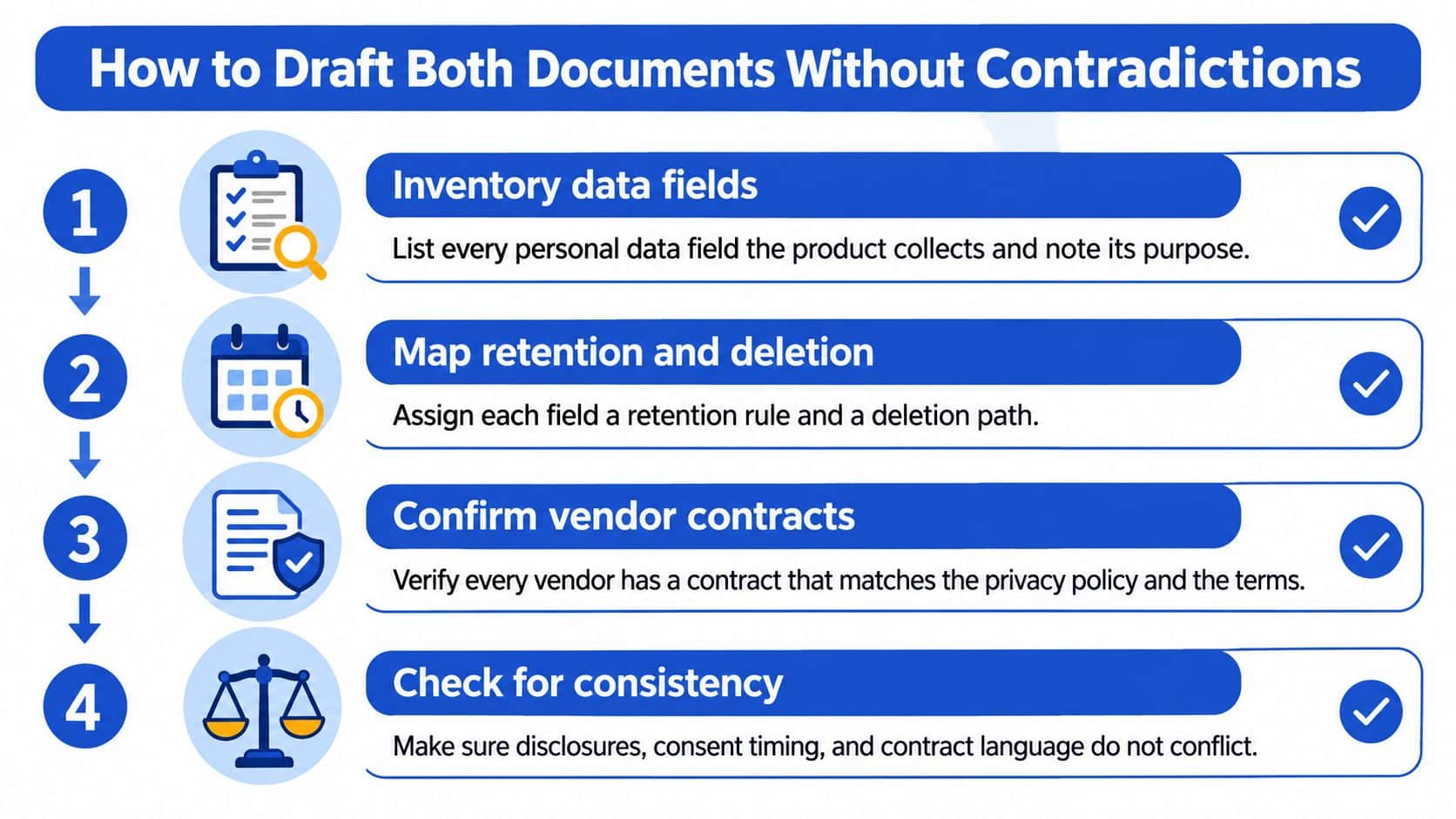
A seven step workflow
- Inventory every field: List each personal data field the product collects and state its purpose.
- Map retention and deletion: Give each field a retention rule, owner, and deletion path that engineering can execute.
- Confirm vendor contracts: Check analytics, payment, hosting, support, and AI vendors against the disclosures they’ll appear in.
- Draft the privacy policy from the map: Write in plain language, keep it printable, and name each recipient category.
- Draft the terms from service scope: Separate contractual acceptance from privacy choices such as optional tracking.
- Cross check product claims: Compare onboarding copy, cookie settings, help pages, and sales decks against both documents.
- Schedule a quarterly review: Reconcile analytics tags, SDKs, forms, AI workflows, and subprocessors against the published policy.
The matrix behind those steps is simple. Each field row records purpose, permission model, retention criterion, access control, processor owner, deletion path, and the exact privacy policy sentence that discloses it. Each customer obligation needs a matching terms provision. Founders unsure how contractual language holds together can ground step five in a walkthrough on how to draft a contract before turning service scope into clauses.
Internal commitments should mirror public ones. By Design Law Firm & Legal Consultancy, PLLC maintains a Privacy Program to ensure compliance with privacy and data protection principles, keeps Personal Information only as long as necessary to comply with legal obligations and the purposes for which it was collected, and requires consultants, suppliers, and vendors to maintain data protections consistent with state and federal data protection laws. Those three commitments translate well. Name an owner, limit retention, and bind vendors in writing.
Consistency rule: Any mismatch between product behavior and either document is a defect, even if the terms were properly accepted.
Enforceability Gaps AI Flows and the Launch Check
Publishing both files doesn’t automatically create valid consent. Terms become a contract only with notice, timing, conspicuous presentation, and assent, and conduct still has to match the statements. The clickwrap and browsewrap comparison matters here because a footer link nobody sees is weak evidence of agreement.
Assent quality is poor in practice. In 2025, 98% of 1,011 U.S. smartphone owners accepted a fabricated consent form that included rights to name their firstborn child, according to Security.org’s digital privacy knowledge study. Yet consumers aren’t passive everywhere. In 2024, 67% of consumers across 12 countries said they had reviewed or updated privacy settings on different apps and platforms during the prior 12 months, according to Cisco’s Consumer Privacy Survey.
Regulators watch the gap between clicks and choice. Connecticut’s 2025 privacy enforcement report described concerns involving consent for sensitive data and the use of dark patterns to obtain consent. Don’t bundle acceptance of terms with optional tracking, marketing, or sensitive processing. Offer a genuine decline that keeps the core service working.
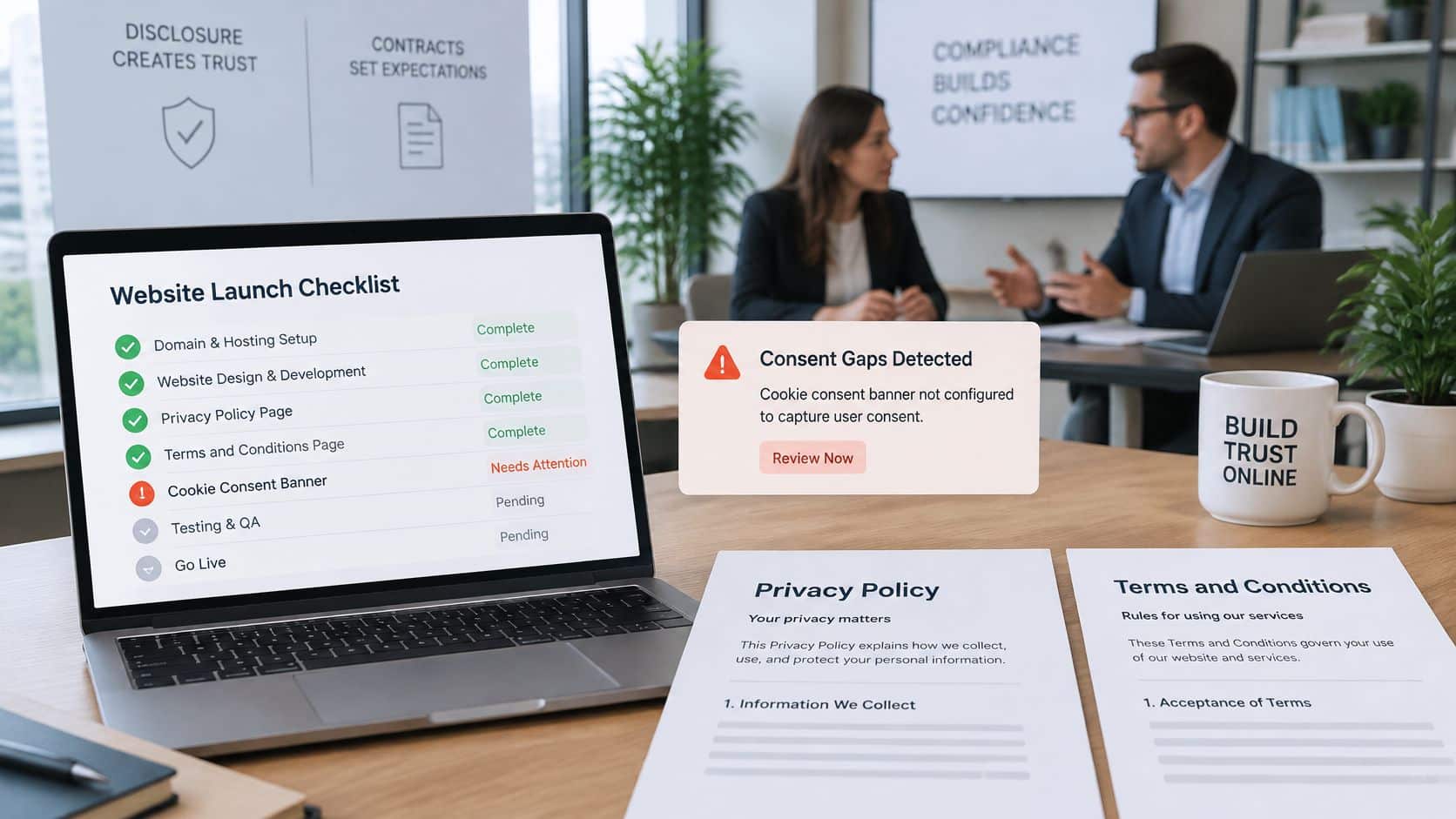
Where each AI issue belongs
Australia’s privacy regulator guidance on training generative AI models states that developers using personal information to train models need an up to date privacy policy explaining collection, including scraping or third party datasets, training purposes, and access or correction mechanisms. It also cautions that a privacy policy alone may not satisfy separate notification duties. Placement should follow function, using risk tiers for agent configurations to separate low risk automation from flows that need tighter disclosure.
- Training permissions: Model improvement rights sit in the terms, while the privacy policy states purpose, retention, and sharing.
- Sensitive data limits: Disclose limits in the policy and restrict inputs in the terms.
- Human review: State in the policy whether people review prompts, outputs, or flagged content.
- Output ownership: Allocate user input licences and output ownership in the terms.
- Model providers: List recipients, transfers, and safeguards in the policy and the vendor contract.
A clause saying data may be used to improve services doesn’t cover scraping, model training, or unexpected secondary use of sensitive information. Launch only if the policy lists each data flow, the terms state each customer duty, and optional choices remain separate from assent. Firm statements show the same discipline. By Design Law Firm & Legal Consultancy, PLLC does not allow third parties to collect Personal Information about users’ online activities over time or across websites for their own purposes, and discloses no Personal Information to unrelated parties outside the firm except in the circumstances listed in its privacy policy. Bring in counsel for Washington health data, training on customer data, sale or sharing opt-outs, or a CCPA request the team can’t fulfil. The firm’s Cyber & Data Privacy Law services include helping with data privacy compliance, from drafting policies to breach responses.
Founders facing a launch, a new AI feature, or a privacy request that current documents can’t support can get both documents drafted as a matched pair, checked against real data flows, vendor contracts, and Washington, CCPA, and GDPR duties. Visit By Design Law Firm & Legal Consultancy, PLLC to discuss privacy policy and terms drafting before the next product release creates a mismatch that’s harder to fix. Contact our law office at (206) 593-1519.