Say a Puget Sound founder launches a signup page on Monday, adds analytics on Tuesday, and asks counsel to draft a privacy policy on Friday. The policy arrives, looks thorough, and goes in the footer. Nobody has checked whether the product collects a birth date it doesn't need, fires an advertising tag before a visitor chooses anything, or keeps support transcripts forever.
That's the gap privacy by design principles are meant to close. The notice describes the system. It doesn't limit the system. A founder who treats the notice as the safeguard has paperwork, not protection, and the legal exposure sits in the product itself.
What Privacy by Design Means Before You Collect
Say the live signup screen asks for name, email, company size, phone, and precise location, although the trial only needs an email to create an account. The extra fields feel useful for sales. They also create data the company must secure, correct, delete on request, and explain to a regulator.
Privacy by design means anticipating harm and building limits into the system before personal information is collected, not investigating after a complaint or breach. The team decides the purpose first, then permits only the fields, uses, access, and retention that purpose requires.

Why waiting for the next law fails
The market isn't standing still while a small team waits for a statute with its name on it. In 2024, 95% of advertising and data decision-makers surveyed expected continued signal loss and/or privacy legislation, according to the Interactive Advertising Bureau and BWG Strategy State of Data report. A product built to collect everything has to be rebuilt every time a platform, browser, or legislature removes a signal.
A Washington startup selling online rarely stays inside one legal box anyway. A Seattle software company can serve California customers, process consumer health information, hire through a vendor, and add an AI assistant in the same quarter. Each step changes what the product may collect and who may see it.
Bolts added after a break-in aren't the same as a floor plan that never puts the safe in the lobby.
Who this test is for
The audience here is Washington and Puget Sound startups and small to midsize businesses shipping websites, apps, analytics, customer databases, and AI features. Size doesn't remove the design question. A five-person team can still default a toggle off, delete a field, or set a retention date before launch.
There are seven foundational principles, and the next section turns each one into a control a team can point to in a build, a screen, or a contract. Founders don't need to memorize slogans. They need to know what each principle forces the product to do on an ordinary Tuesday.
Use one practical test throughout. If a new user does nothing, collection, retention, access, and sharing still stay inside the stated purpose. If protection only starts after the user finds a settings page, unticks a box, or reads a long notice, the design has shifted the work to the person with the least power to do it.
That test also gives direct answers to common founder questions. Does a privacy policy alone satisfy privacy by design? No. Does the product need every field marketing might want later? No. Should optional tracking wait for a choice? Yes.
The Seven Principles and the Control Each Requires
Privacy by Design emerged from work in the 1990s led by Ann Cavoukian, then Ontario's Information and Privacy Commissioner, with a 1995 joint report involving the Information and Privacy Commissioner of Ontario, the Dutch Data Protection Authority, and the Netherlands Organisation for Applied Scientific Research, as the Privacy by Design primer records. That report tied privacy-enhancing technologies to a governance idea that still drives the framework, build privacy in before collection rather than responding only after a complaint, breach, or investigation.
| Principle | What it requires | Minimum control |
|---|---|---|
| Proactive not reactive | Anticipate harm before collection | Pre-launch risk note for each new purpose |
| Privacy as the default | No action still means minimum data | Optional telemetry, ads, and precise location off |
| Embedded into design | Limits live in the system, not only the notice | Field list, blocked queries, and role limits in the build |
| Positive-sum, not zero-sum | The feature still works with less data | Purpose met without extra profile fields |
| End-to-end security | Protect data from collection through deletion | Encryption, access logs, and deletion that includes backups |
| Visibility and transparency | People can see what happens to data | Purpose, recipients, and retention written in plain language |
| Respect for user privacy | Choices change real system behavior | Access, correction, deletion, and opt-out tested in the product |
How to read the table in a product meeting
Each row answers a different release question. Proactive not reactive asks whether anyone looked for harm before launch. Privacy as the default asks what fires when a visitor does nothing. Embedded into design asks whether the schema, API, and roles enforce the limit when an employee is busy or a vendor changes a setting.
The positive-sum row is the one founders most often resist, and it's also the most practical. Say a retailer wants a loyalty program. It can run points, receipts, and rewards on a customer ID and purchase history. It doesn't need a birth date, household income, or continuous location to credit a purchase. The feature works, the customer gets the reward, and the company holds less data that can be exposed. That's not privacy against functionality. That's functionality without surplus collection.
End-to-end security doesn't end when a record reaches the main database. Exports, support attachments, logs, analytics copies, and backups are part of the lifecycle. If the front door uses encryption and role limits while an old spreadsheet circulates by email, the weakest copy defines the exposure.
Where the seven apply
The same seven apply to websites, applications, analytics systems, customer databases, and AI-enabled products. A marketing site decides which tags load. An app decides when to ask for location. A customer database decides which roles can run which queries. An AI feature decides whether prompts become training material.
Washington teams working through collection limits should connect this table to Washington data minimization and purpose limitation duties, because a field without a lawful, stated purpose is difficult to defend whatever the interface says. Minimization isn't a preference for tidy databases. It determines how much personal information exists to be misused in the first place.
Before moving to the legal duties, mark any row with no named owner. An owner isn't a department. It's a person who can say who approved the default, when retention runs, which vendor receives the data, and what test proved deletion worked. If nobody can answer for a row, that principle is still a poster, not a control.
Which Laws Turn the Principles Into Duties
Say a founder is preparing to launch a feature that collects location data. The release decision depends on more than a design preference: the applicable law can require limits on what the feature collects, how it processes the data, and who can access it. Privacy regulators endorsed Privacy by Design as a core protection principle before the GDPR. GDPR Article 25 later made data protection by design and by default a binding duty for controllers.
The infographic traces that shift from principle to legal duty.
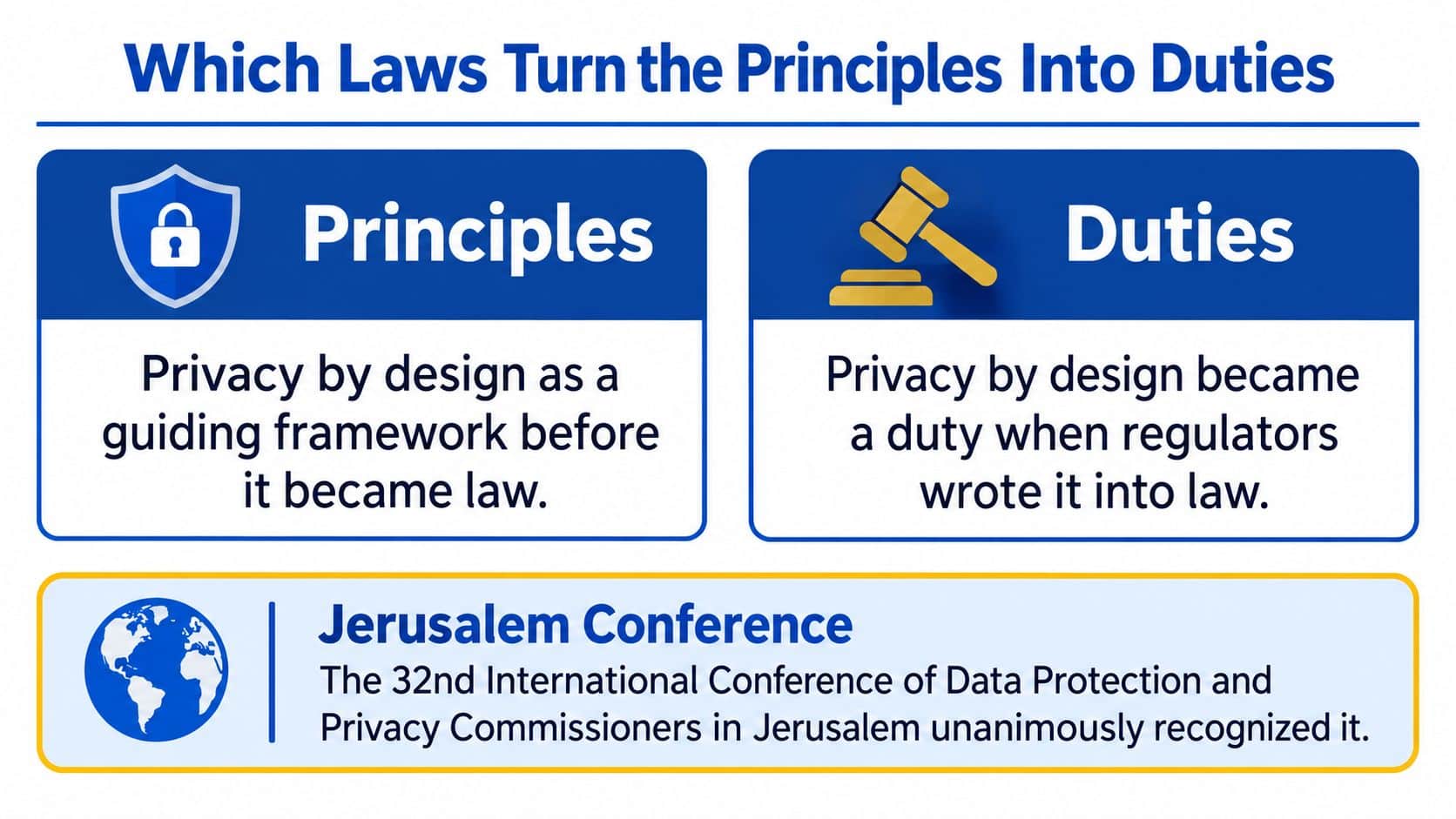
GDPR Article 25 requires appropriate technical and organizational measures so that, by default, only personal data necessary for each specific purpose is processed. The duty covers the amount collected, the extent of processing, the storage period, and accessibility. For the location feature, that means deciding whether location is necessary at all, when it is collected, how long it remains, and which roles can see it.
What Article 25 requires in plain English
The measures must account for the state of the art, implementation cost, context and purpose, and the likelihood and severity of risks to individuals. Pseudonymization is one possible measure, not the entire duty. Replacing a name with a token does not justify collecting unnecessary fields or allowing every employee to access the key.
Design and default apply throughout development and operation. Architecture, interfaces, procedures, and protocols all matter. For a Washington company serving people in the EU, the practical test is whether the system itself processes only what its purpose requires. An approval memo cannot substitute for a product setting that collects too much.
Employment software presents the same legal questions in another setting. Teams building HR workflows can consult GDPR insights from HR Management 365 for background on GDPR duties related to worker information. The product decisions remain concrete: which fields are needed, which roles can access them, and how long the information is retained.
A regime comparison can help a founder identify which legal questions belong on the release checklist.
| Regime | Who it reaches | Design duty |
|---|---|---|
| GDPR Article 25 | Controllers serving or monitoring people in the EU | Measures before and during processing; by default, only necessary data |
| CCPA and CPRA | California businesses above statutory thresholds | Rights to know, delete, correct, and opt out of sale or sharing |
| Washington My Health My Data Act | Entities handling consumer health data in Washington | Consent for collection and sharing; access and deletion rights |
| HIPAA | Covered entities and business associates | Safeguards and minimum necessary use of protected health information |
| GLBA | Financial institutions | Safeguards and privacy notice duties |
| FTC Act Section 5 | Any business making privacy claims | Claims must match actual practices |
| NIST Privacy Framework | Any organization, voluntary | Risk-based governance; not a statute |
A Washington address alone does not settle whether California requirements apply. Founders should review what CCPA compliance requires when assessing the product's scope and the rights its interface must support. The NIST Privacy Framework is voluntary, not a statute, and can give product, security, legal, and engineering teams a shared vocabulary for discussing privacy risks before deployment.
For each proposed feature, ask three questions: Is the company in scope? Which individual rights must the product execute? Which default must be active at launch? The answers should shape the interface, data schema, and retention behavior. If the legal analysis never reaches those product decisions, it has not resolved the release question.
Minimum Controls and the Ship-or-Hold Rule
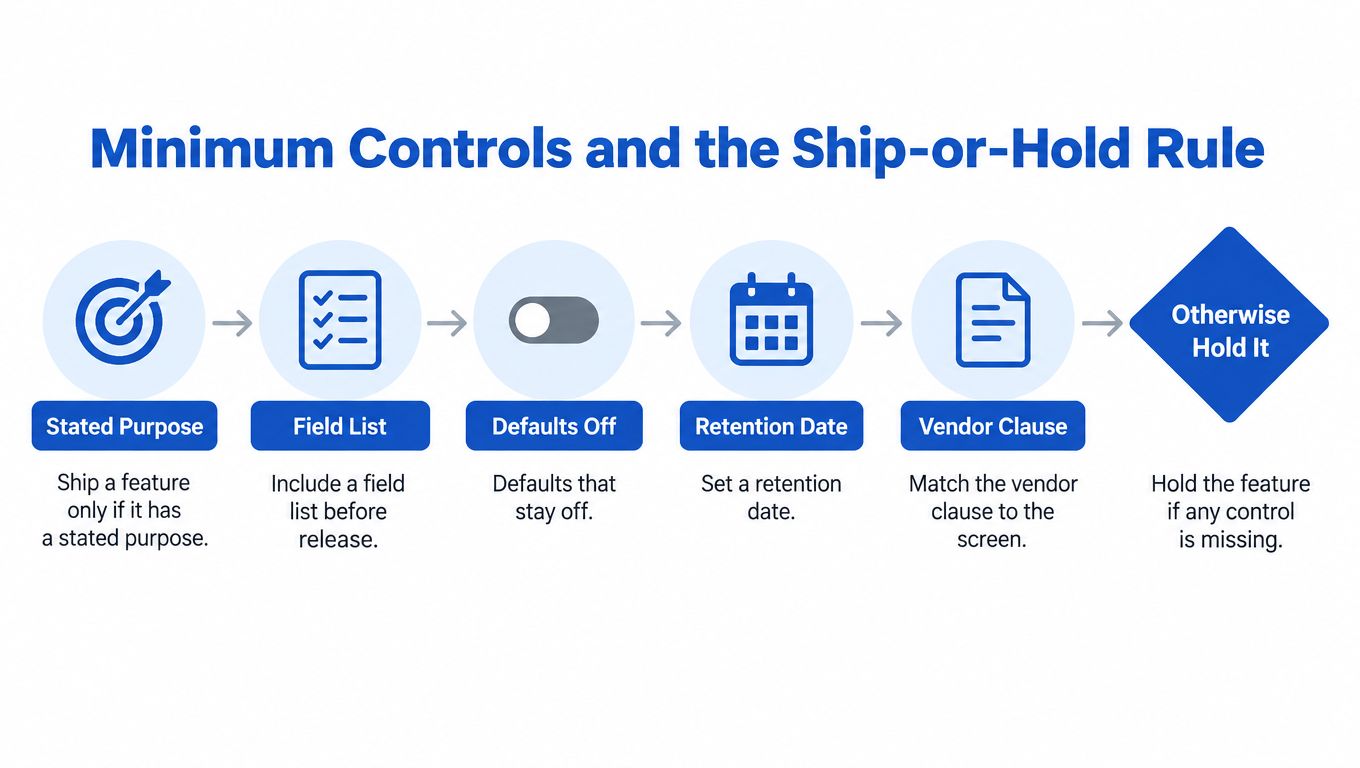
Say a café owner is about to add online ordering. The form asks for a phone number, precise location, and permission to use order history for recommendations. Before release, the founder should be able to explain why each field is needed, what happens by default, and when the data is removed. If those answers are missing, hold the feature.
The flow below turns that rule into release checks a founder can ask about in a meeting.
The European Data Protection Board describes Article 25 as applying to architecture, procedures, protocols, and interfaces. Its summary guidance on data protection by design and default supports translating each purpose into field-level necessity, restricted operations, and protective defaults. It also discusses automated deletion or anonymization when retention ends, and regular checks that safeguards continue to work.
Seven controls with a pass or fail test
-
Write a one-page data inventory before build. Record each purpose, field, reason it is necessary, retention period, authorized role, and approved secondary use. Pass test, every field connects to a stated purpose. If the team cannot explain why it needs a field, remove it or delay the feature.
-
Delete fields that fail the purpose test. Prevent purpose-incompatible queries in the product, rather than relying on staff to remember a restriction. Pass test, a blocked query returns an error. This turns the purpose decision into an engineering control that can be checked before release.
-
Ship optional uses off until opt-in. Analytics beyond what the service needs to operate, ad identifiers, precise location, and model training should start disabled. Pass test, the first session sends no optional tags and creates no unnecessary identifiers. A default that is merely described in a policy, but enabled in the product, does not pass.
-
Set retention as a date or event. Automate deletion or anonymization across production data, backups, and exports. Pass test, a sample record leaves backups on schedule. A retention promise needs a corresponding job, process, or other control that reaches the copies the company holds.
-
Write a short impact assessment for higher risk. Address sensitive data, large-scale monitoring, and automated decisions, and identify who accepted any remaining risk. Pass test, the assessment exists before launch, not after a customer asks. The release decision should account for that assessment rather than treating it as paperwork separate from the build.
-
Limit vendors in writing. Restrict vendor use to documented purposes, and address training, subprocessors, deletion on exit, and audit or evidence rights. Pass test, the signed clause matches the actual data flow. A contract that permits a use the interface does not explain creates a mismatch the team should resolve before launch.
-
Put privacy checks on the release list. Run access, correction, deletion, and opt-out through the live workflow. Pass test, a deletion request removes the information support can see. Include the systems and vendors involved, so a request does not appear complete while a copy remains elsewhere.
Say the team adds an AI persona or chat feature. The same gate applies to prompts, voice, images, and conversation history. Examples that let people control your persona data illustrate why a control must change stored data, not just hide a screen. If deletion leaves a vendor copy untouched, the feature has not passed.
Ship-or-hold rule: No purpose, no field list, no off-by-default setting, no retention date, or no matching vendor clause means the feature waits.
Why fewer fields change the risk
Fewer fields and fewer permitted uses mean less personal data is available for compromise, unauthorized profiling, or accidental disclosure. A database that never collected precise location cannot expose precise location. An API that blocks a query also makes that secondary use harder to introduce unnoticed.
Cloud settings determine whether those limits survive deployment, scaling, and vendor changes. Align the release gate with cloud security compliance controls, then reopen the inventory whenever a field, purpose, vendor, retention period, or role changes. Privacy by design is an ongoing release practice, not an approval stamped on the first version.
For a company starting from zero, use a 30-day order. Inventory the product that collects the most customer data. Turn off nonessential tracking. Set retention for the top five fields. Send one real deletion request through every system that stores the data. Each action tests a control the team can maintain, rather than relying on a general promise to protect privacy.
By Design Law Firm & Legal Consultancy, PLLC takes its name from the concept of “privacy by design and by default” and operates with the goal of preventing privacy issues. Its data privacy attorney is a certified privacy professional, and its Cyber & Data Privacy Law services include help with compliance, from drafting policies to breach responses. That range connects product decisions made before launch with the response needed if a safeguard fails.
Screens Policies and Clauses That Match the Product
A designer is often handed a legal decision after it's made, then asked to make the screen look clear. The result can be compliant on paper and still confuse the person tapping through it. Recent research with UX professionals, summarized in research on privacy design systems and UX practice, found recurring gaps in standardized components, pattern libraries, and internal guidance, with designers structurally excluded when legal or engineering centralizes decisions.
Privacy by design is therefore also a product-design and user-experience problem. Assign one owner for each conflict among legal scope, engineering limits, and user expectation. Record why each default was chosen, so a later redesign does not reverse it for conversion.
Four interface patterns that hold up
- Continue with the minimum. Make the primary action work with only the data the stated purpose needs.
- Separate the optional choice. Put marketing or model training behind its own unticked choice, not inside account creation.
- Never pre-select sensitive options. Precise location, health-related inferences, and sharing require a deliberate act.
- State the current setting plainly. The settings page should use the same words as the policy, so a customer can compare them without translating.
Ban three dark patterns by name in the design system. Confirm-shaming guilts a user for declining. Bundled consent forces unrelated uses into one tap. A reject path longer than accept manufactures consent through fatigue. A screen that produces a click the user didn't mean hasn't respected choice, whatever the consent log says.
Four policy sentences a customer can check
A public policy needs four sentences a customer can test against the product. What's collected. Why it's collected. How long it's kept. How to access, correct, delete, or opt out. Public explanations of how personal data is handled are useful reference points for whether a reader can find those answers without legal training.
App teams should test the same four sentences against store disclosures and in-product settings, using mobile app privacy policy requirements as the drafting check. If the policy promises deletion and the app only deactivates an account, the words and the system disagree.
Clauses that match the screen
Vendor and AI supplier clauses should cover six points. Process only documented purposes. Don't train on customer data unless ordered. Flow the same limits down to subcontractors. Delete or return data within a stated period. Give breach notice. Provide audit rights or evidence of controls.
Sample wording is direct. "Vendor will use Customer Data only for the purposes in Schedule A and will not train any model on it unless Customer instructs in writing."
Say the product is a support chatbot. The clause forbids training. The training toggle defaults off. The policy says transcripts are kept 30 days. Those three artifacts match, and a customer, engineer, or auditor reaches the same answer from any one of them.
Test the wording with real users in each market. Culturally different users can read consent, defaults, visibility, and sharing differently, so a phrase that sounds optional in one place can sound mandatory in another.
Pitfalls Cases and the Audit File
Awareness isn't the main gap. Sustaining controls with limited staff, budgets, and legacy systems is. ISACA's 2025 global privacy survey, reported in the ISACA State of Privacy 2025.pdf), found 67% of respondents said their enterprise practiced privacy by design when building new applications and services, yet organizations that always practiced it were more likely to have larger resources, while others described shrinking teams and budget pressure.
The failure mode is paper practice. Principles sit in a slide deck while consent, deletion, access, and retention fail across SaaS tools and older infrastructure.
| Pitfall | What it looks like | Fix to test |
|---|---|---|
| Notice instead of a default | Analytics or ads run before any choice | Confirm the first session sends no optional tags |
| Deletion that stops at the app | The user row is gone but backups and vendors keep it | Run one request through backups and the vendor |
| Unmapped SaaS | A team tool holds customer data outside the inventory | Add the tool or remove the data flow |
| AI use the notice omits | Prompts or files are reused for model training | Match the toggle, clause, and policy, then retest |
| Legacy retention | Old tables have no delete date | Schedule deletion or record why the law requires keeping it |
Two scenarios founders recognize
Say a Puget Sound SaaS startup adds session replay to reduce support time. The tool captures form fields the team didn’t intend to record, including text a customer typed and deleted. The fix isn’t a longer disclosure. The team turns replay off by default, masks inputs, and cuts retention to 14 days, then records a test session to prove masked fields stay masked.
Say a consumer app collects wellness notes about sleep, mood, and medication reminders, then treats them as ordinary account data. Washington’s consumer health rules can reach beyond a hospital record, so the company has to rebuild consent for collection and sharing and make deletion reach analytics and support copies. The legal category followed the data, not the company’s label for itself.
The audit file to tick this month
- Inventory. Purposes, fields, roles, vendors, and approved secondary uses.
- Default screenshots. Evidence of what a new user gets before choosing anything.
- Retention jobs. Schedules and logs showing deletion or anonymization ran.
- Vendor clauses. Signed limits on purpose, training, subprocessors, and exit deletion.
- High-risk assessment. The record for sensitive data, monitoring, or automated decisions.
- Tested rights request. One access and deletion request run end to end.
- Last change review. The date controls were rechecked after a product or vendor change.
A completed meeting is weaker evidence than a test showing the product honored the user’s choice.
Safeguards can still fail, and no file should promise perfect security. The file should show review, correction, and ownership over time. That’s what separates a living program from a binder assembled after a regulator writes.
Readers facing a live Washington product release, a vendor contract, or an AI feature should get counsel before release, not after a complaint, by calling (206) 593-1519. By Design Law Firm & Legal Consultancy, PLLC takes its name from privacy by design and by default, which is exactly the decision point a founder faces when the ship date is close and the default is still wrong.
By Design Law Firm & Legal Consultancy, PLLC helps Washington startups and growing companies turn privacy by design principles into product defaults, vendor clauses, privacy policies, and release records that match what the system does. Founders preparing a website, app, analytics stack, or AI feature can get the purpose, field list, retention rule, and contract language reviewed before launch through By Design Law Firm & Legal Consultancy, PLLC. Contact our law office at (206) 593-1519.