A business owner usually starts thinking about franchising after proving something important in the market. Customers return, staff can be trained, margins make sense, and a second or third company-owned location starts to look possible. Then the harder question appears. Should the owner keep opening locations, or build a system other people can operate under the brand?
That's the franchising crossroads. Franchising isn't just expansion. It's the conversion of a successful operating business into a regulated distribution model with legal documents, brand controls, training systems, territory rules, and ongoing support obligations. A founder who knows how to run one excellent business still has to learn how to build a framework others can follow without diluting the brand.
The opportunity is substantial. In 2024, U.S. franchise establishments are projected to produce $897 billion in economic output, according to WINI franchise statistics. But that number should be read the right way. It shows the scale of the market, not a promise that any successful local business is ready to franchise.
The Franchising Crossroads From Business Owner to Brand Builder
A single-unit operator controls almost everything directly. Hiring, quality, local marketing, customer service recovery, vendor workarounds, and culture all sit close to the owner. A franchisor operates differently. The franchisor must define the brand's standards so clearly that someone else can execute them without improvising the business into a different concept.
That shift changes the legal risk profile too. Once a business starts offering franchises, the owner isn't just selling access to a name. The owner is selling a package of rights and obligations tied to intellectual property, operating systems, and ongoing support. That makes brand protection central from the start, especially around trademarks, copyrights, and other intellectual property rights.
What changes when a company franchises
Franchising works when the business has three qualities:
- A recognizable brand: Customers know what the business is and what they should expect.
- A repeatable delivery model: The service or product can be produced consistently across locations.
- A teachable method: Someone other than the founder can learn it, run it, and still protect the customer experience.
A lot of owners miss the third point. A great operator often carries a business through instinct, local relationships, and personal oversight. A franchise system can't depend on any of those.
Practical rule: If the concept only works when the founder is physically present, it usually isn't ready to franchise.
What works and what doesn't
What works is disciplined standardization. The brand has documented routines, vendor controls, onboarding steps, and quality standards. The economics leave room for both the franchisee and the franchisor to function.
What doesn't work is trying to franchise a personality-driven shop, a concept with weak margins, or a business that has never translated its daily decisions into replicable processes.
Owners who want to learn how to become a franchisor should think less like store managers and more like system architects. The product still matters. The customer experience still matters. But the primary asset becomes the model itself.
Assessing Franchise Readiness Is Your Business Built to Scale
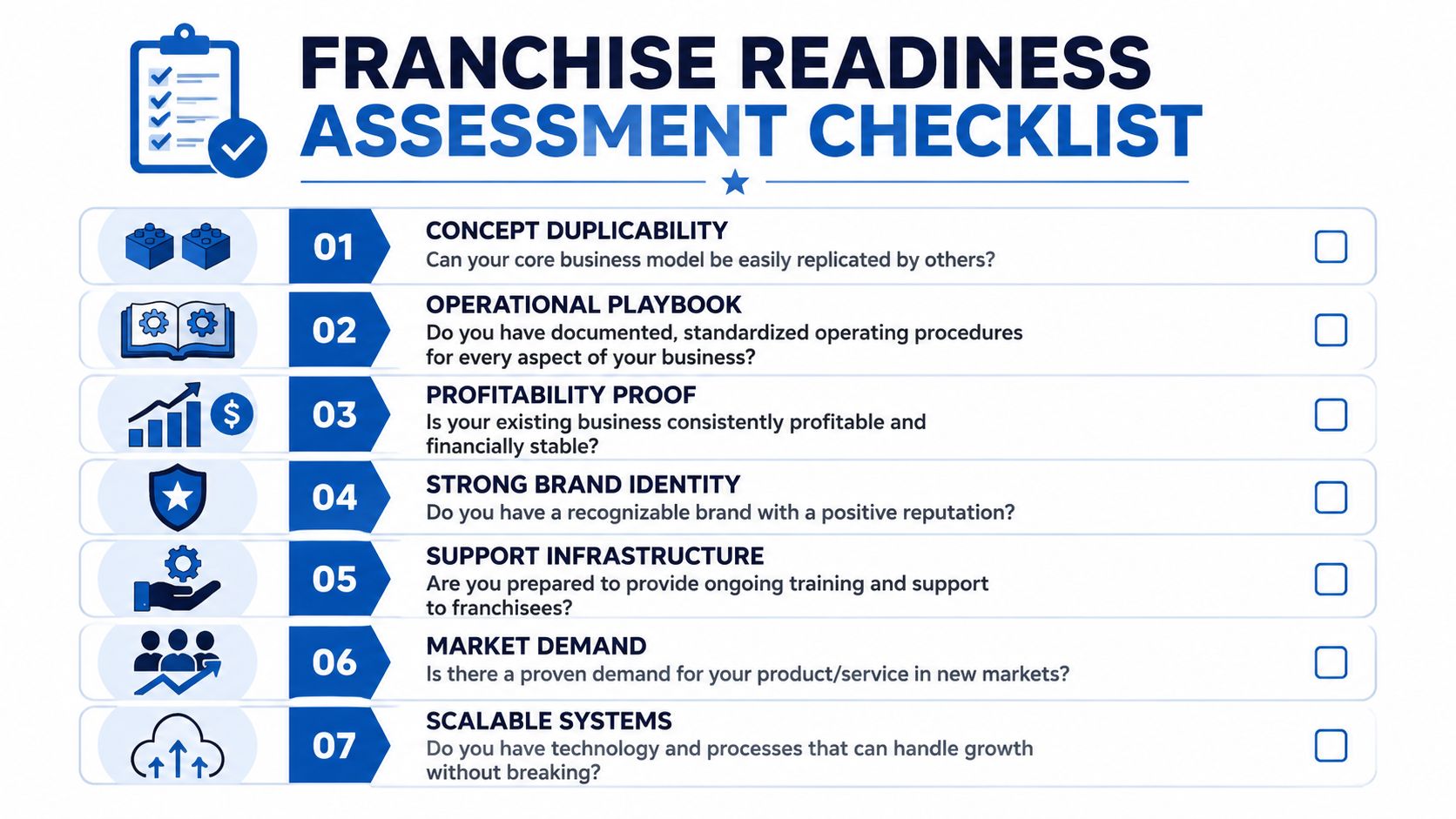
Before legal drafting begins, the owner needs a blunt readiness review. The core question isn't whether customers love the business. The question is whether the business can be duplicated by operators who didn't build it.
Franchise experts commonly recommend about 18 months of “seasoning” before scaling, so the concept can demonstrate stable unit economics and reproducible processes, as discussed in this franchise development video. That benchmark matters because premature franchising creates the same pattern repeatedly: a strong first location, weak documentation, overpromising in sales conversations, then operational drift once the first franchisees open.
Seven readiness questions that matter
Can the concept be duplicated without the founder?
If training a competent operator still requires constant founder intervention, the model isn't portable yet.Are operating procedures written down?
A real system covers opening, closing, staffing, customer service, inventory, quality control, pricing discipline, and local marketing.Do the economics support two businesses at once?
The franchisee must earn enough to stay motivated. The franchisor must earn enough to provide support. If both sides can't work from the same unit model, the structure breaks.Is the brand distinctive enough to protect and scale?
A generic name or weak visual identity becomes much harder to defend across markets.Can support be delivered consistently?
New franchisors often underestimate the need for dedicated staff for training, marketing, and franchisee support. The founder's bandwidth usually isn't enough.Does the concept travel?
Some businesses perform well in one neighborhood because of local relationships or site-specific demand. That's different from a concept with real transferability.Can technology and reporting handle growth?
Franchisors need visibility. If the business lacks usable reporting, basic system oversight becomes difficult.
A short explainer can help business owners think through the scale question from another angle:
A fast self-audit
| Issue | Healthy sign | Warning sign |
|---|---|---|
| Training | New managers learn fast from a documented process | Training depends on shadowing one key person |
| Brand standards | Quality is measurable | Quality is “you know it when you see it” |
| Financial model | Unit performance is understandable and consistent | Profitability depends on owner-specific habits |
| Support | Leadership can coach others systematically | The team is already stretched thin |
Some excellent businesses should open more company-owned units first. Franchising is not a reward for success. It's a separate business model with separate demands.
A business that isn't ready today can still become franchise-ready. But it has to close the gap honestly instead of papering over it with legal documents.
Building Your Legal and Financial Foundation
Once the business is franchise-ready, the next job is legal architecture. Many owners tend to move too quickly at this stage. They ask for franchise paperwork before they've settled the structure of fees, territory, support, intellectual property ownership, and operational obligations. That approach usually creates expensive revisions later.
Start with the brand, not the binder
Trademark protection should be addressed early. If the business name can't be protected, or if another party has superior rights, everything built on top of that brand becomes unstable. A franchisor is licensing core brand assets to multiple operators. That means ownership and control of the brand can't be fuzzy.
After that, counsel typically helps the owner define the deal terms the system will use, including:
- Initial franchise fees
- Royalty percentages
- Territory rights
- Training and opening support
- Purchasing and supplier controls
- Renewal, transfer, and termination terms
These are business decisions with legal consequences. They shouldn't be copied casually from another franchise system.
The two core documents do different jobs
Owners often lump the documents together, but the Franchise Disclosure Document and the franchise agreement serve different functions.
The FDD is the disclosure package. Under the FTC Franchise Rule, first issued in 1979 and amended in 2007, a franchisor must give the FDD to a prospect at least 14 days before any contract is signed or money changes hands, as summarized in Neighborly's discussion of the Franchise Rule. That timing rule is one reason the system must be organized before franchise sales begin.
The franchise agreement is the binding contract. It governs the long-term relationship and spells out what each side must do. Owners evaluating a franchise agreement template should understand that a real agreement isn't just a form. It has to reflect the actual economics and operating rules of the system.
Financial structure needs operational realism
A common mistake is designing fees first and support second. That's backwards. Support obligations drive the economics.
If the system promises extensive opening assistance, field support, technology oversight, vendor management, and marketing guidance, the franchisor needs enough recurring revenue to fund those commitments. That's why strategic owners build a support model before finalizing the fee model.
For finance operations, practical systems matter as much as legal drafting. A useful primer on mastering franchise bookkeeping can help owners think through recurring reporting, royalty administration, and system-wide financial discipline.
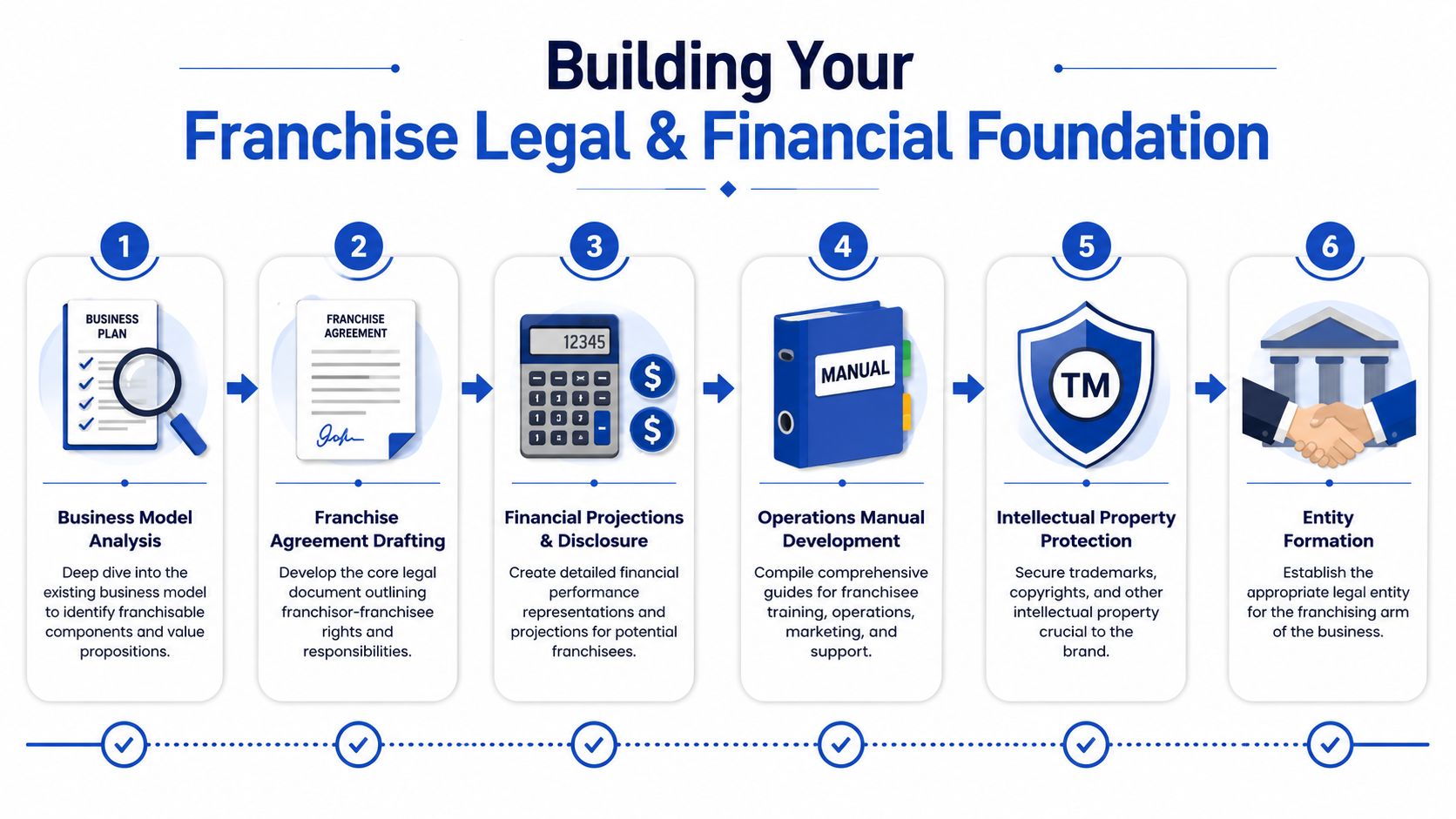
A workable build sequence
- Protect the intellectual property: Confirm the brand can be licensed and defended.
- Define the business terms: Fees, territory, training, supply controls, and support structure come first.
- Draft the agreement and disclosure documents: The documents should capture the actual system, not an idealized version of it.
- Build the manual and reporting structure: Franchisees need operational guidance, and the franchisor needs visibility.
- Create the right entity structure: Many owners separate franchising activities from the legacy operating company, depending on business and liability considerations.
Owners asking how to become a franchisor often expect the legal side to be mostly paperwork. It isn't. The law forces clarity. That's a benefit when the system is built thoughtfully, and a problem when the owner still hasn't made the core decisions.
Navigating Federal and Washington State Compliance
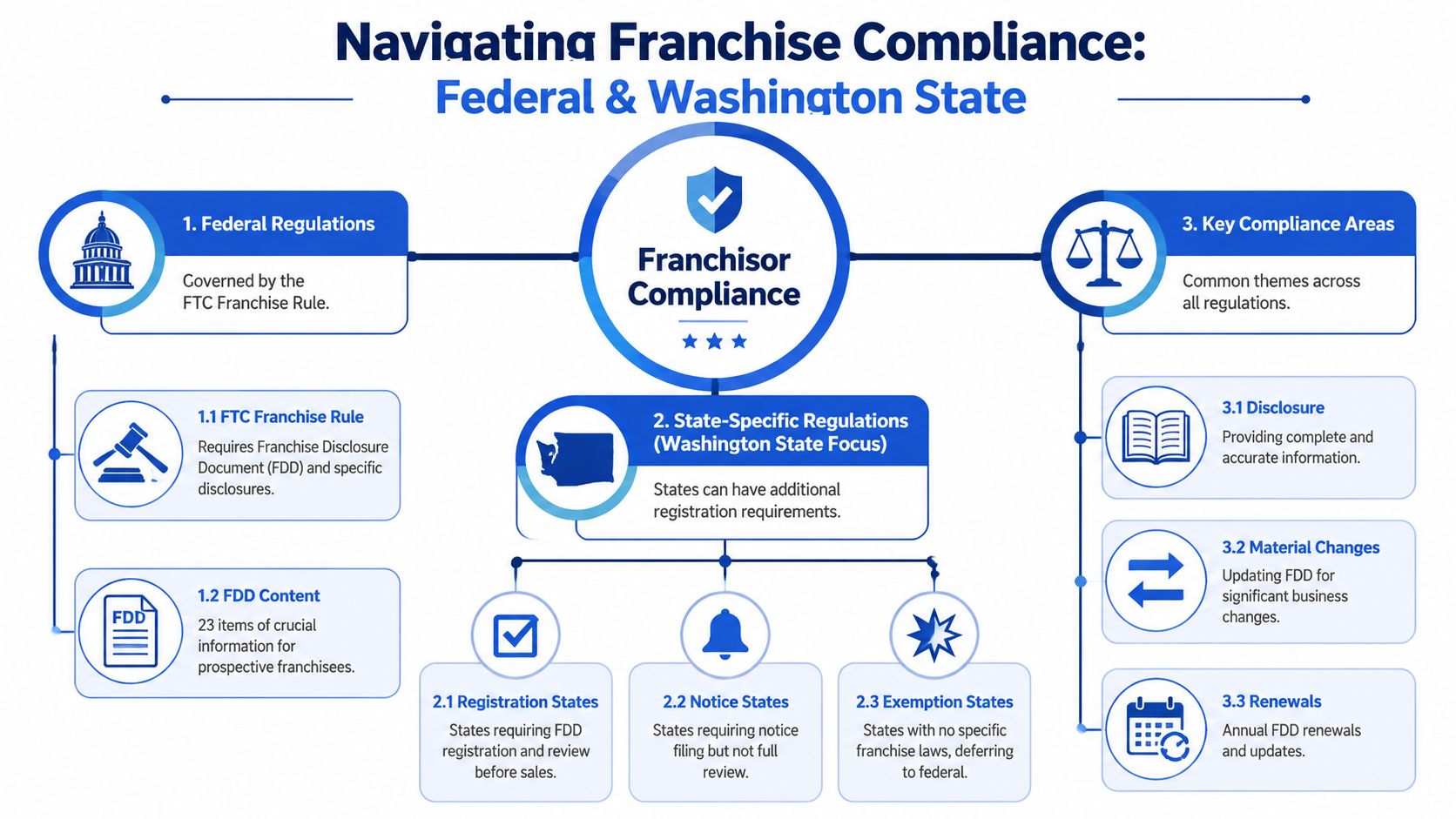
Federal compliance is the floor, not the ceiling. A franchisor can have a well-drafted FDD and still run into problems by ignoring state-level rules.
Federal law controls the offering process
The legally sound sequence is straightforward. Build a repeatable operating model, document it in the franchise agreement and FDD, and only then begin offering franchises. The FTC's disclosure timing makes that sequence mandatory, as outlined in The Hartford's overview of growing through franchising.
That means franchise sales can't start with informal pitches, deposit requests, or “soft commitments” before the documents are ready. Owners sometimes think early interest-gathering is harmless. It often isn't.
A franchisor should treat sales compliance as part of product design, not a last-minute review item.
Washington adds another layer
Washington business owners should pay close attention here. Federal law governs baseline disclosure obligations, but state law may add filing, registration, notice, anti-fraud, and relationship-rule requirements that affect how and when a franchise can be offered or sold.
For a Washington-focused business, this isn't a technical side issue. It affects launch timing, state-specific disclosures, updates, and annual maintenance. The practical result is simple: before offering franchises in or into Washington, the company needs counsel who understands both federal requirements and Washington-specific compliance.
A helpful place to understand the document at the center of this process is this overview of the Franchise Disclosure Document.
Compliance failures usually start small
Many violations don't begin with obvious bad conduct. They begin with ordinary business behavior applied in the wrong context:
- Sales staff speak too freely: They describe expected performance in ways the documents don't support.
- A founder sends materials early: Marketing starts before state compliance is complete.
- The FDD goes stale: Material changes occur, but updates lag behind operations.
- The company expands by geography, not by compliance map: The team assumes one approved document works everywhere the same way.
Washington founders should also keep an eye on the broader regulatory climate. Franchise regulation continues to evolve at the state level, and changes in other states often signal how aggressively regulators are thinking about franchisee protections. That's one reason compliance should be managed as an ongoing function, not a one-time launch task.
Developing Your Operations and Support Systems
A franchisor without an operating system is just licensing a name and hoping for the best. That rarely ends well. Brand consistency comes from documented standards, training, oversight, and measured support.
The operations manual is the system's backbone
The operations manual should translate the business into executable routines. It is where the franchisor captures the details that keep locations aligned.
That usually includes:
- Brand standards: approved marks, signage, tone, customer-facing presentation
- Daily operations: opening and closing procedures, staffing workflows, service standards
- Marketing rules: local marketing permissions, co-op expectations, digital usage rules
- Technology and reporting: required platforms, approved tools, submission timelines
- Purchasing controls: approved vendors, substitute approval rules, product specifications
- Compliance procedures: audits, inspections, corrective action, recordkeeping
The manual should be detailed enough to guide conduct, but practical enough that operators will use it. A bloated manual full of lawyerly abstractions often gets ignored.
Training must produce independence, not dependence
Initial training should prepare a new franchisee to open and operate according to system standards. Ongoing training should help the franchisee improve, adapt, and stay aligned as the system evolves.
A useful training structure often has three layers:
- Pre-opening training for the owner and key managers
- Opening support during launch and early customer acquisition
- Continuing education through refreshers, operational updates, and issue-specific coaching
What works is staged learning tied to actual responsibilities. What doesn't work is compressing everything into a long seminar and assuming knowledge will stick.
The real test of training is whether the franchisee can make the right decision when the manual doesn't provide a word-for-word script.
Protecting know-how matters
Operations manuals, recipes, vendor protocols, pricing methods, and customer handling procedures often contain proprietary information. Franchisors should treat that operational knowledge as protected business property, not informal know-how passed around by habit.
That's where trade secret discipline becomes important. Businesses that franchise should understand the basics of trade secret misappropriation, especially when former employees, vendors, or franchisees have had access to confidential system materials.
Support has to be budgeted and staffed
Support isn't goodwill. It's part of the product the franchisor sells to the franchisee.
A new franchisor should decide early who handles:
| Support function | Typical responsibility |
|---|---|
| Initial training | Franchise operations lead or training team |
| Opening assistance | Field support staff |
| Marketing guidance | Internal marketing lead or approved outside partner |
| Brand compliance | Operations and legal coordination |
| Franchisee communications | Dedicated franchise management |
Founders often want to keep this lean. That makes sense. But lean isn't the same as understaffed. If the first franchisees can't get timely answers, the system's reputation deteriorates before it has a chance to mature.
Launching Your Franchise Sales Onboarding and Long-Term Success
The first franchisees shape the culture of the system. They also stress-test the documents, training, support model, and internal communication habits faster than any planning exercise will.
Sell carefully, not broadly
The FTC's public-facing guidance focuses heavily on what buyers should evaluate in a franchise. That's useful, but it leaves a real gap for founders trying to build the system those buyers will inspect, as reflected in the FTC consumer guide to buying a franchise.
For a new franchisor, that gap matters most during early sales. The right question isn't “How many leads can be generated?” It's “Which candidates can operate this model well?”
Strong early candidates usually show:
- Operational discipline: They can follow a system without constant customization.
- Sufficient capitalization: They understand that underfunding creates pressure from day one.
- Cultural fit: They respect standards and communication protocols.
- Local execution ability: They can hire, manage, and build presence in their market.
The first few deals should be selective. A poor-fit franchisee creates distraction, conflict, and reputational drag across the whole network.
Onboarding needs structure
Once a candidate signs, the relationship moves from sales to implementation. That transition is where many new franchisors look disorganized.
A documented onboarding workflow helps. Even resources outside franchising can be useful here. A practical 5-step playbook for onboarding offers a helpful way to think about sequencing documents, responsibilities, and information collection so nothing critical slips through the cracks.
A clean onboarding sequence usually includes:
- Post-signature document checklist
- Entity, licensing, and formation follow-up
- Site and territory coordination
- Training calendar and required attendees
- Opening-readiness review
Long-term success depends on relationship discipline
Franchise systems don't stay healthy through contract enforcement alone. They stay healthy when the franchisor communicates clearly, updates standards thoughtfully, and applies rules consistently.
That doesn't mean being soft. It means being predictable.
Good long-term practices include a mix of oversight and collaboration:
- Use documented performance reviews: Franchisees should know what metrics and standards matter.
- Update manuals carefully: System changes should be implemented with enough guidance that operators can comply.
- Separate advice from mandates: Operational coaching and enforceable obligations should not blur together.
- Preserve trust in difficult moments: Defaults, transfers, and disputes should be handled with process, not improvisation.
Washington business owners often begin this process thinking the hard part is drafting the franchise paperwork. The harder part is building a business that can sell, train, support, monitor, and evolve a network without losing control of the brand.
That is the difference between a company that sells a few franchises and a company that becomes a durable franchisor.
A business owner considering franchising in Washington usually needs more than forms. The process touches brand protection, business structuring, disclosure drafting, state compliance, contract design, and operational risk management. By Design Law Firm & Legal Consultancy, PLLC advises Washington businesses on those legal foundations, including franchise, intellectual property, business law, and compliance matters that arise when a successful company is preparing to scale.