The packet arrives after the excitement. A founder in Seattle has spent weeks talking with a franchisor, reviewing the concept, and picturing the opening day. Then the legal documents hit the inbox. The Franchise Disclosure Document looks long. The franchise agreement template looks longer, denser, and far more binding.
Most prospective franchisees make the same early mistake. They treat the disclosure package as the main event and the agreement as a formality. That gets the sequence backward. The disclosure package helps a buyer evaluate the offer. The agreement governs how that buyer will live with the deal once the ink dries.
Before You Sign The Dotted Line
A franchise agreement template can look like boilerplate. It rarely is. It is usually the operating rulebook for the entire relationship, and it often controls far more than brand use. It can reach pricing practices, opening requirements, approved technology, financial reporting, vendor rules, training, inspections, insurance, and how the business ends.
The FDD and the agreement are not the same thing
The U.S. Chamber of Commerce guide to franchise agreements explains that the franchise agreement should be read together with the Franchise Disclosure Document, or FDD. The FDD provides pre-sale information, while the agreement states the parties, territory, term, fees, and the franchisor's ongoing support obligations. That division is a defining feature of modern franchise systems.
For a buyer, the simplest way to think about the two documents is this:
- The FDD is the dossier. It gives background information that helps evaluate the system before purchase.
- The agreement is the rulebook. It becomes the enforceable contract that dictates daily operations and long-term rights.
- The mismatch matters. If the sales conversation sounds generous but the agreement is narrow, the agreement usually controls.
A careful review often starts by comparing the agreement against the franchise disclosure document requirements and function. The point isn't academic consistency. The point is practical risk. If the support promises are vague in the contract, if transfer rights are heavily conditioned, or if territory language is softer than expected, the buyer needs to know before signing.
Practical rule: A prospective franchisee shouldn't ask only, “Is this a good brand?” The better question is, “Can this contract support the business that needs to be built?”
Why the size of the document is the warning sign
The size of a franchise agreement is a warning sign because it shows the franchisor’s control over many parts of operations. Longer contracts usually mean tighter rules for how the system runs.
That's why these agreements are often much more detailed than an ordinary service agreement or even a standard commercial lease. A buyer isn't just acquiring permission to use a logo. The buyer is stepping into a managed system, with rules that may affect nearly every operational choice.
For Washington entrepreneurs, that distinction matters because a strong local business instinct can create false confidence. Owning a business and operating a franchise aren't the same thing. In a franchise, the contract often decides where independence ends.
The Core Anatomy of Your Franchise Agreement
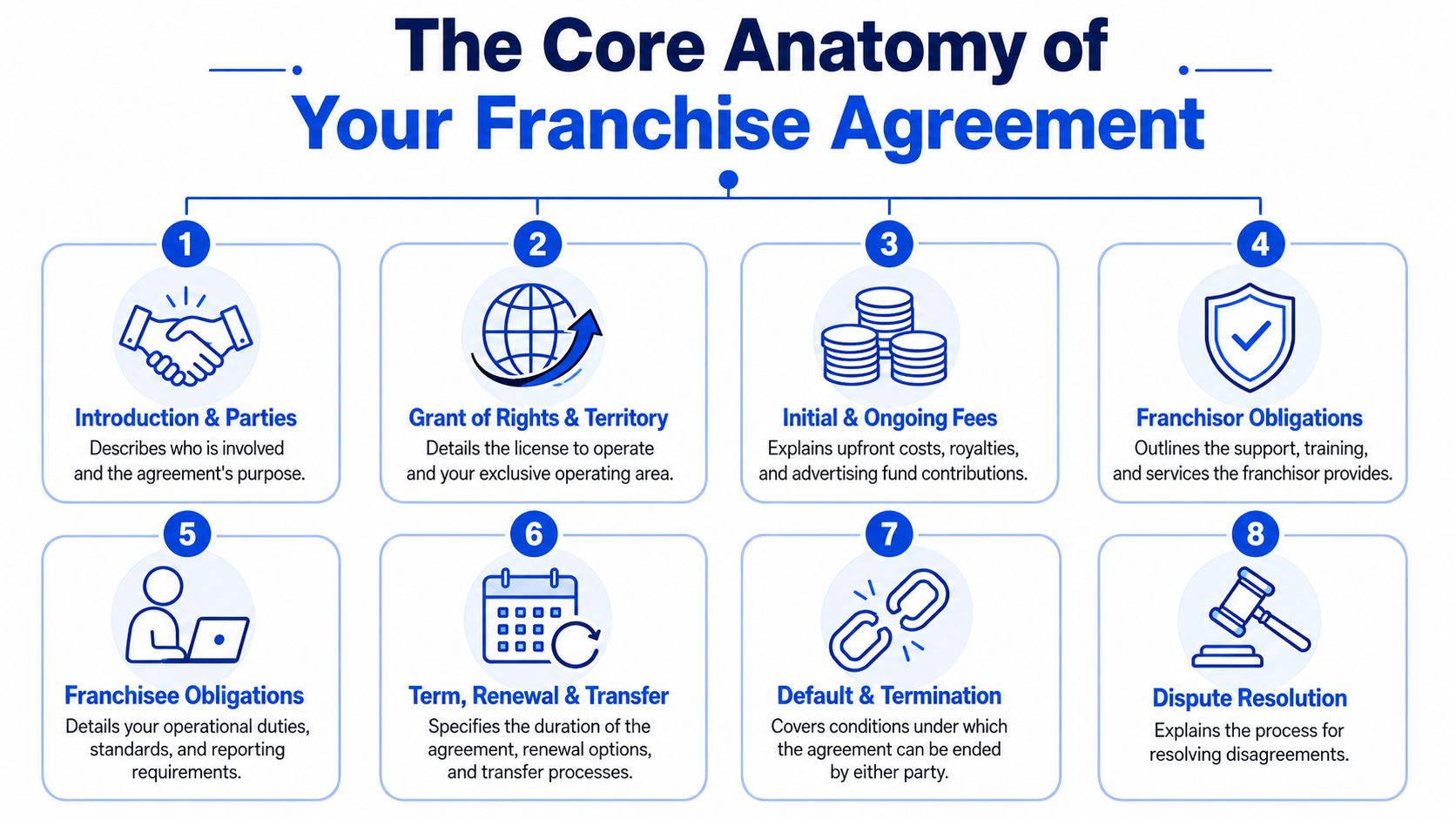
A useful way to read a franchise agreement template is to treat it like a business constitution. It allocates power, defines the territory of each party, and sets the rules that govern conflict. Once that frame is clear, the clauses stop looking random.
Start with the grant and the bargain
The agreement typically serves one main purpose. It grants a license to operate under the franchisor's brand and system, in exchange for fees and compliance with system standards.
That license usually includes intellectual property, operating methods, and access to the franchisor's business model. The intellectual property piece deserves close attention because the franchisee isn't buying the brand. The franchisee is receiving limited permission to use it under stated conditions, which is why a grounding in intellectual property rights and their different forms helps buyers read these provisions more realistically.
The term shapes the economics
One of the most important business variables is the contract term. According to Franchise Creator's discussion of key franchise agreement components, franchise agreements are typically fixed-term contracts, with a commonly cited initial term of 5 to 10 years. That duration matters because it gives the franchisee time to justify startup investment while allowing the franchisor to maintain control over brand standards and operating consistency.
That point sounds abstract until the buyer maps it to actual decisions:
| Contract feature | Business question it raises |
|---|---|
| Initial term | Is there enough runway to recover launch and buildout costs? |
| Renewal conditions | Must the franchisee sign the then-current form of agreement? |
| Brand standards | Can the franchisor require upgrades late in the term? |
| Reporting and compliance | How much administrative discipline will this business require? |
A shorter practical reading is this. A franchisee doesn't just need a profitable concept. The franchisee needs enough time under the contract to turn that concept into a durable asset.
Why operations clauses are so detailed
Operations clauses are detailed because the franchisor wants repeatable customer experience across locations. The clauses set system compliance, brand rules, and financial reporting, so operators do not guess.
A buyer should expect operational rigor in areas such as:
- System compliance: adherence to procedures, approved products, and service standards.
- Brand use: logo rules, marketing restrictions, and signage controls.
- Financial discipline: recordkeeping, audits, and payment reporting.
- Technology adoption: use of designated software, hardware, and system tools.
A franchise agreement works when it is specific enough to preserve brand consistency and clear enough to let the operator run the business without guessing.
What doesn't work is false comfort. A polished franchise agreement template may look organized, but organization alone doesn't make a deal balanced. The anatomy matters because each clause answers a business question: who controls what, who pays for what, and who carries the risk when the relationship tightens.
Decoding Key Clauses in Your Agreement Template
The fastest way to understand a franchise agreement template is to stop reading it as legal prose and start reading it as a set of business levers. Every major clause answers a practical question. Can another unit open nearby? Who decides operating changes? What happens if performance lags? Can the owner sell the business later?
Grant of rights and territory
Many franchisees focus on territory first, and they should. Territory affects revenue potential, future competition, and the resale story. But buyers often assume a franchise grant includes some built-in exclusivity. That assumption can be expensive.
A publicly filed Baskin-Robbins form, available through the SEC filing for the franchise agreement form, states that the franchise is a non-exclusive license to operate the business, with the location and term set in a separate contract schedule. That drafting choice gives the franchisor room to expand and avoids implied territorial promises.
For a franchisee, the key issue isn't whether non-exclusive drafting is fair or unfair. It's whether the agreement clearly says what the franchisee is getting.
A buyer should test territory language against these questions:
- Protected from what exactly? Another full unit, online sales, alternative channels, kiosks, or company-owned outlets?
- Defined how? By radius, zip codes, map exhibit, or a vague market description?
- Conditioned on what? Performance benchmarks, development obligations, or compliance standards?
If the answer to any of those questions is fuzzy, the territory may be weaker than the sales pitch suggested.
Fees and support obligations
Franchise agreements usually describe the economic exchange in two parts. The franchisee pays. The franchisor supports.
That sounds balanced, but the details matter more than the headings. Some support obligations are concrete, such as initial training, designated systems, and limited field support. Others are drafted in broad language that leaves discretion with the franchisor.
A practical way to read this section is by sorting obligations into two buckets:
| Clause type | Better drafting | Riskier drafting |
|---|---|---|
| Training | Clear scope, timing, and who pays travel costs | General promise of “training as determined by franchisor” |
| Marketing support | Defined fund purpose and brand-level use | Broad discretion with no accountability language |
| Technology support | Specific platforms and maintenance responsibility | Required use of changing tools without allocation of costs |
| Supply chain | Approved alternatives or standards process | Single-source lock-in with little flexibility |
The question isn't whether the franchisor promises support. Most do. The question is whether the support language is specific enough to enforce and predictable enough to budget.
The operations manual is where control lives
High-quality franchise templates often incorporate an operations manual by reference. WIPO's guidance explains that the manual may specify what the franchisee must do, what the franchisor provides, and the system's operating methods, including hardware, software, stock requirements, accounting, and banking procedures. That structure lets the franchisor update standards without renegotiating the whole contract.
This is efficient. It also creates one of the biggest hidden risks in franchising.
If the agreement gives the manual legal force but says little about how it may be changed, the franchisor may gain broad power to alter the operating burden after signing. New software, reporting steps, supplier requirements, or customer service protocols can show up through the manual rather than an amended agreement.
The franchise agreement sets the frame. The operations manual often fills in the daily obligations that determine whether the business is manageable.
Restrictive covenants and post-termination duties
Many franchisees spend too little time on the clauses that apply after the relationship ends. Those sections often address de-branding, return of manuals, confidentiality, customer information, and restrictions on soliciting staff or competing after termination.
Related concepts from a non-solicitation agreement overview can help. The issue isn't only whether a restriction exists. The issue is scope. Which employees, customers, or vendors are covered? For how long? In what geography? Under what trigger?
These provisions matter because termination is rarely clean. If the business closes under stress, the former franchisee may still face obligations that limit the next move. A clause that looked routine during signing can become the most painful paragraph in the contract.
Default and cure rights
Default clauses tell the buyer how forgiving the system will be when something goes wrong. Missed reporting, late fees, unauthorized vendors, audit findings, branding lapses, and technology noncompliance can all become defaults.
What works is a structure that distinguishes fixable problems from serious breaches and gives a realistic cure opportunity. What doesn't work is a one-sided default regime where operational slips can stack quickly into a basis for termination.
A franchise agreement template isn't dangerous because it contains these clauses. It's dangerous when the buyer reads the headings, assumes the concepts are standard, and never asks how the clauses play out in a hard month rather than a good one.
Customizing Your Agreement and Spotting Red Flags
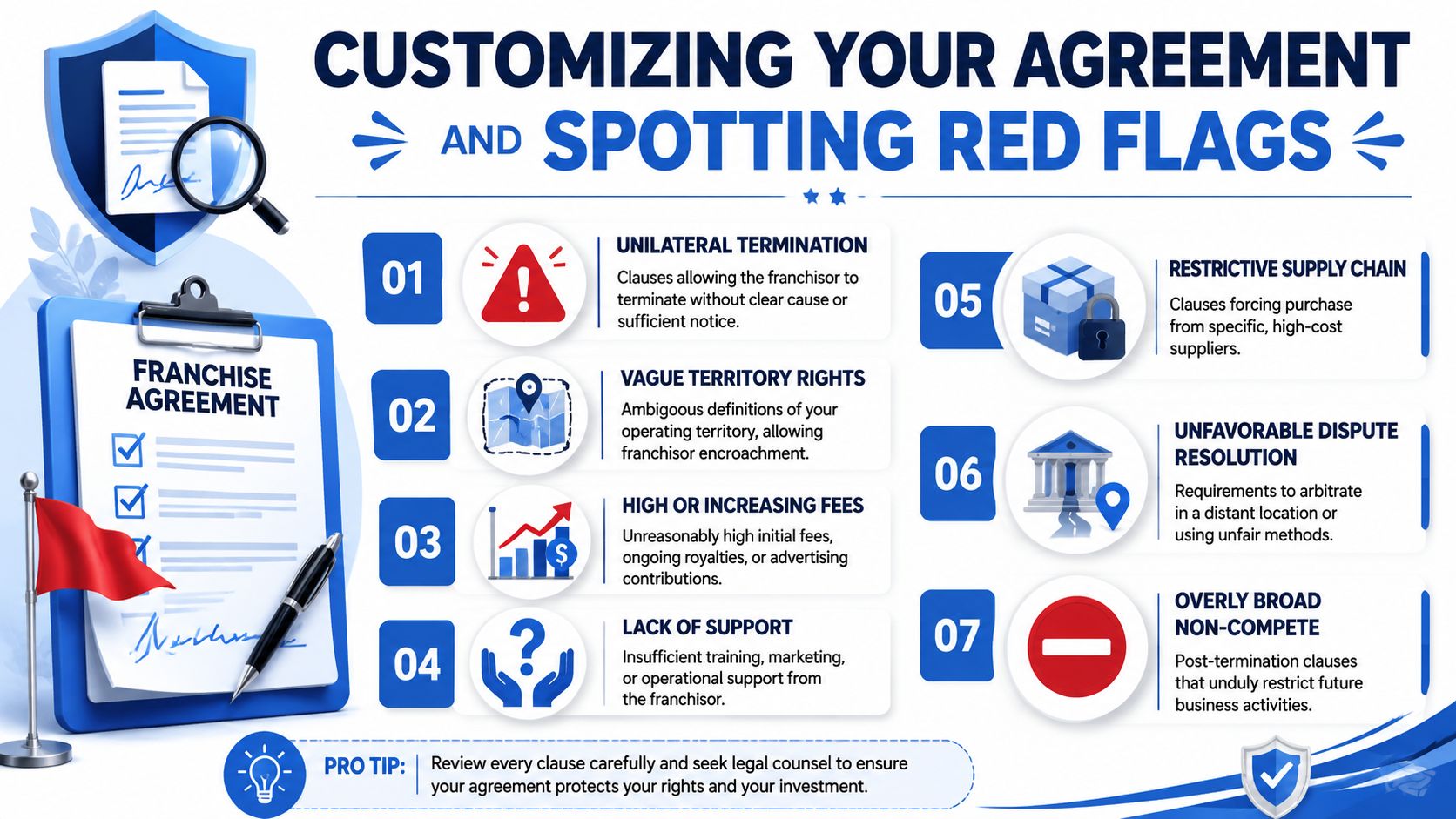
The biggest mistake in reviewing a franchise agreement template is focusing only on opening day. Buyers naturally zoom in on launch costs, training, and branding. The stronger review starts at the other end. How does this relationship renew, transfer, or end?
According to MSA Worldwide's discussion of franchise agreements, a major underserved area in template analysis is the post-term exit path. Many guides discuss fees and intellectual property but give less attention to renewal rights, transfer conditions, and resale clauses, even though those provisions may determine whether the franchisee can sell the business as a going concern.
The exit path often controls the real value
A franchise can look profitable on paper and still become a poor investment if the owner can't exit cleanly. The business value isn't just current cash flow. It's also the ability to transfer the location, obtain franchisor consent, satisfy upgrade conditions, and avoid a forced shutdown at the end of the term.
That's why renewal language deserves the same scrutiny as the royalty clause. If renewal requires signing the franchisor's then-current form, the buyer may be agreeing now to unknown future obligations. If transfer approval is highly discretionary, the buyer's eventual sale may depend more on the franchisor's bargaining power than on the buyer's performance.
Red flags worth challenging before signature
Some clauses are standard. Standard doesn't mean harmless.
- Renewal with hidden reinvestment: If renewal depends on remodeling, equipment replacement, or site changes, the agreement should make the standard clear enough to assess.
- Transfer rights that look available but aren't practical: Broad consent language, mandatory training for buyers, or unresolved lease issues can stall a sale.
- Personal guarantees with broad survival language: Owners need to know which obligations continue even after assignment, transfer, or termination.
- Forum selection and dispute mechanics: A distant venue can change the economics of enforcing rights, even when the legal merits are decent.
- Manual amendment power without guardrails: This can become a backdoor method for changing the operational deal.
A disciplined redline process helps separate fixable issues from hard structural risks. Legal teams that want a practical framework can borrow techniques from this guide for legal teams on redlining contracts, especially for tracking one-sided revisions and unresolved fallback positions.
A short explainer can help frame the review before the markup starts.
What can actually be customized
Not every franchisor will negotiate heavily. Some won't negotiate much at all. But that doesn't mean review is pointless. The practical wins often come from clarifying language, confirming side understandings in writing, tightening ambiguity, or identifying deal-breakers before commitment.
Buyers usually gain more by exposing risk early than by assuming every concern can be negotiated away later.
A smart review of a franchise agreement template asks two separate questions. First, can anything be improved? Second, if it can't, is the remaining risk acceptable? Those are not the same question, and the second one is usually more important.
Modern Compliance Risks for Washington Businesses
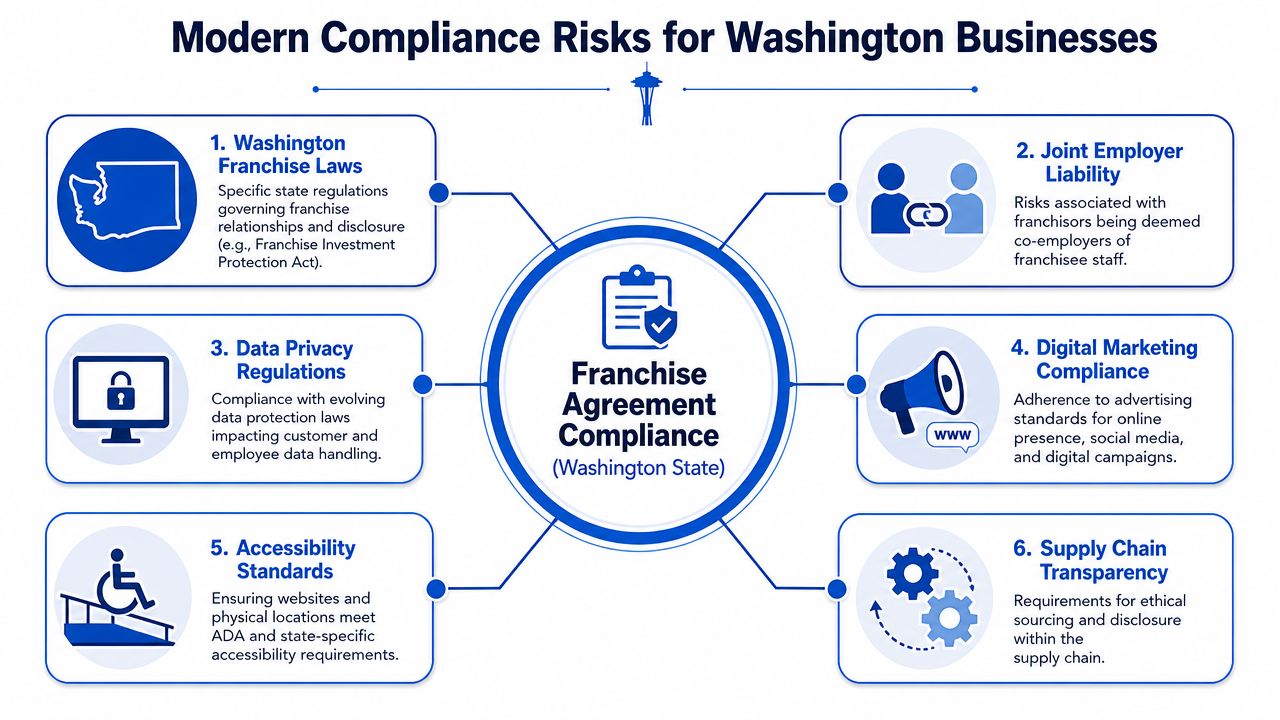
A franchise agreement template drafted as a pure trademark-and-fees document is increasingly outdated. Modern franchise systems rely on point-of-sale systems, customer analytics, digital marketing platforms, loyalty tools, remote reporting, and sometimes AI-assisted workflows. Those tools create legal questions that older templates often ignore.
Data ownership is no longer a side issue
The gap shows up quickly in practice. Who owns customer information collected at the local store? Who can export it? Who can use it for systemwide marketing? If an employee at one location mishandles data, who bears the contract risk?
The Sirion overview of franchise agreements notes that modern franchise agreements are increasingly tested by data privacy, cybersecurity, and AI compliance issues. Standard templates often fail to address basic questions such as ownership of customer data or liability for a breach at a specific location.
For Washington businesses, these aren't edge cases. They affect daily operations across retail, food service, wellness, home services, and location-based consumer brands.
Washington operators should look for operational answers
A buyer in Washington should read the agreement with compliance workflow in mind, not just legal headings. That includes the practical steps people inside the business would need to follow.
- Incident response: Who investigates, who notifies, and who pays if a location-level breach occurs?
- System access: Which party controls credentials, vendors, and software administration?
- Marketing data: Can the franchisor use local customer lists across the network?
- AI tools: May the franchisee use AI for scheduling, customer service, or advertising copy? Can the franchisor require approved tools or ban unapproved ones?
For teams building internal procedures, this broader understanding of contract compliance processes can be useful because franchise compliance now extends beyond fee payment and brand standards into technical governance.
Why Washington-specific review matters
Washington businesses also need to connect contract language to local obligations. A franchisee may be the first party that hears about a security incident at the location level, even if the franchisor controls central systems. If the agreement is vague, response obligations can become confused at the worst possible moment.
That's why a Washington operator should compare the franchise agreement against practical state-level breach response expectations, including the framework discussed in this guide to Washington data breach notification laws. The goal isn't to turn the franchisee into a cybersecurity lawyer. The goal is to make sure the contract assigns responsibility before an incident happens.
A modern franchise relationship doesn't just allocate royalties and trademarks. It allocates digital risk.
The same point applies to AI. If a franchisor wants consistency, it may want tight control over customer-facing automation, hiring tools, or staff monitoring systems. If the agreement is silent, conflict can arise later when the franchisee adopts a tool that seems efficient locally but creates systemwide legal or brand exposure.
Why a Template Is Not a Substitute for Legal Counsel
A franchise agreement template is useful for orientation. It helps a buyer recognize major clauses, compare structures, and prepare questions. It is not a safe substitute for legal review.
Templates can't evaluate the interaction between the agreement, the FDD, state law, operational reality, and the buyer's actual business plan. They also can't judge where ambiguity is harmless and where it creates real power against the franchisee. A line that looks ordinary to a non-lawyer may be the clause that controls transfer approval, post-term restrictions, manual amendments, or dispute posture.
What legal review adds that a template cannot
A qualified franchise attorney does more than summarize clauses.
| Template use | Attorney review |
|---|---|
| Identifies common sections | Tests whether the wording creates unusual risk |
| Helps with basic vocabulary | Compares promises across the agreement and FDD |
| Suggests generic questions | Spots state-specific issues and negotiation points |
| Gives a sample structure | Assesses enforceability, leverage, and lifecycle risk |
That distinction matters most where the contract is silent or deceptively broad. Silence around data incidents, AI use, customer information, successor rights, or operational changes can be just as important as an aggressive clause.
The real cost of skipping review
The legal fee for review is visible. The cost of signing blind usually isn’t visible until later.
It often appears when the owner wants to sell, renew, dispute a default, resist a forced upgrade, challenge a territory issue, or respond to a compliance event that the agreement never allocated clearly. By then, the advantage has shifted.
The prudent view is simple. A franchise agreement template is an educational tool. The signed franchise agreement is a long-term operating contract. Those are different things, and treating them as if they were interchangeable is where avoidable mistakes begin.
Entrepreneurs in Washington who are evaluating a franchise opportunity, reviewing an FDD, or negotiating a franchise agreement can work with By Design Law Firm & Legal Consultancy, PLLC for practical, business-focused legal guidance. The firm advises clients on franchise, contract, technology, data privacy, and risk issues with a clear eye on how the deal will function in real operations, not just on paper. Call us today at (206) 593-1519.