A buyer has narrowed the search to one franchise brand. Discovery calls went well. The sales team was polished. Then the franchisor sends over a dense PDF that feels closer to a litigation file than a business brochure. That document often decides whether the deal is sound or whether the buyer is walking into years of expensive regret.
For Washington founders, investors, and emerging franchisors, the Franchise Disclosure Document is where the foundational work starts. It doesn't replace business judgment. It doesn't tell anyone whether a concept fits a given neighborhood, operator skill set, or capital plan. What it does provide is a structured record of the franchisor's system, legal history, fees, restrictions, financial disclosures, and outlet data that can be tested against reality.
Most articles stop at “read Item 19 and call franchisees.” That advice is too thin. A useful review looks at how the disclosures fit together, where Washington law adds extra friction, and which contract terms may still be negotiable even in a system built on standardization.
What Is a Franchise Disclosure Document and Why It Matters
The Franchise Disclosure Document exists because franchise sales involve an information gap. The franchisor knows the system, the economics, the disputes, and the weak points. The buyer usually knows the brand story. Those aren't the same thing.
Under federal law, the modern U.S. Franchise Disclosure Document is a 23-item disclosure that a franchisor must give to a prospective franchisee, and the FTC requires delivery at least 14 days before any agreement is signed. A typical FDD is often 200–400 pages, with the core 23-item disclosure portion usually around 80–150 pages and the balance made up of exhibits such as the franchise agreement, territory maps, financial statements, and franchisee lists, as described by Franchise Business Review's overview of the FDD.
That length matters for a practical reason. The most important terms are rarely concentrated in one place.
Why the document carries so much weight
The document carries so much weight because the FDD must prove what the franchisor disclosed and whether the deal can work for the buyer. A strong review checks both legal risk and day to day operating terms.
A strong review treats the document as both a legal file and an operational file. The legal side asks whether the franchisor has disclosed risk. The operational side asks whether the deal can work in the buyer's market, with the buyer's capital, and under the buyer's management capabilities.
Practical rule: The FDD is not reading material for a weekend. It's the core due diligence file for a long-term commercial relationship.
Why standardization helps buyers and new franchisors
The 23-item structure creates comparability. A buyer looking at two different franchise systems can review the same categories in the same order. That doesn't eliminate spin, but it reduces chaos. It also forces new franchisors to organize their own house before expanding.
For a buyer, the document is a shield against omission. For a franchisor, it is a discipline tool. If a system's economics, support model, supplier structure, or dispute history can't be explained clearly in the FDD, the system usually isn't ready for healthy growth.
In Washington, that baseline disclosure function matters even more because state law can add another layer of scrutiny before a franchise is offered or sold.
Deconstructing the 23 FDD Items
A buyer who reads the FDD in order, cover to cover, can still miss the business story. The better approach is to sort the items into functional groups and read for connections.
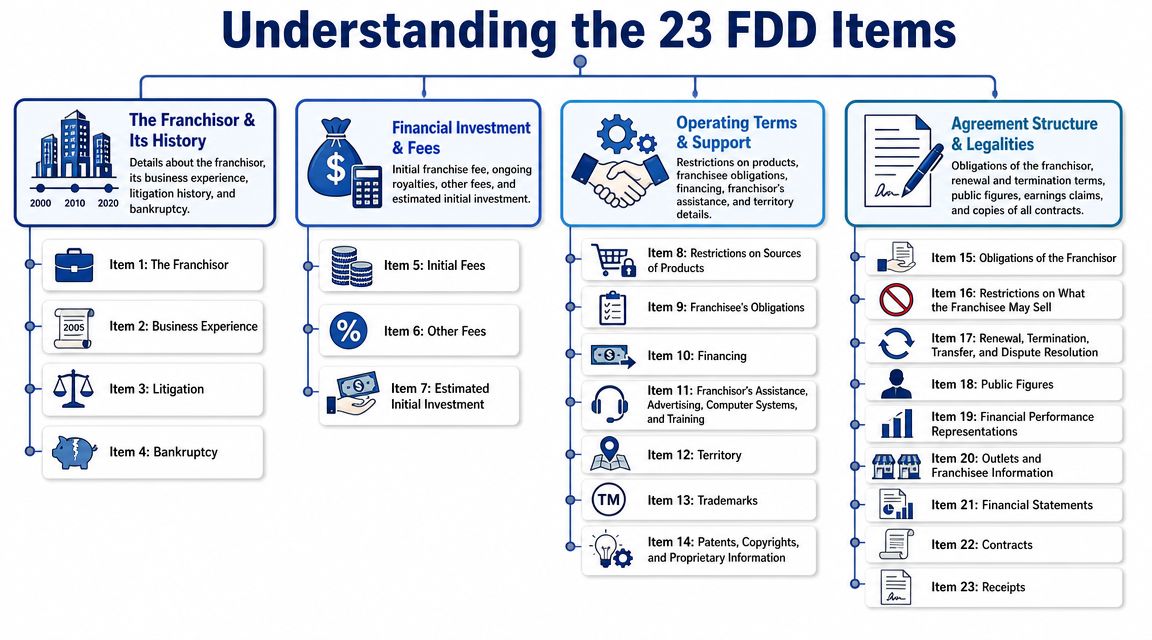
The franchisor and its history
Items 1 through 4 answer a basic question. Who is asking for the investment, and what has happened around that business before now?
- Item 1 matters for structure. It identifies the franchisor and related entities. That helps a buyer see whether operations, licensing, supply, and ownership sit in one company or are split across affiliates.
- Item 2 is about management credibility. It shows the business experience of key executives. A buyer should compare those backgrounds against what the system claims to offer in support and execution.
- Item 3 is where legal conflict becomes visible. Litigation isn't automatically disqualifying. Repeated disputes over the same subject, though, deserve close attention.
- Item 4 covers bankruptcy history. This item can signal prior distress involving the franchisor, affiliates, predecessors, or principals.
A useful read here is comparative, not isolated. One lawsuit may not mean much. A pattern of disputes involving franchise sales practices, earnings discussions, or system support is different.
The money sections
The next cluster is where many buyers focus first, and rightly so. Items 5 through 8, plus Items 19 and 21, shape the economic picture.
| FDD item | What it tells you | Why it matters |
|---|---|---|
| Item 5 | Initial fees | Shows what must be paid up front and when |
| Item 6 | Other fees | Reveals royalties, marketing contributions, transfer fees, renewal fees, and similar continuing costs |
| Item 7 | Estimated initial investment | Frames the startup budget and capital burden |
| Item 8 | Supplier restrictions | Shows how much purchasing freedom the franchisee actually has |
| Item 19 | Financial performance representations, if included | Indicates whether the franchisor has chosen to make earnings-related disclosures |
| Item 21 | Audited financial statements | Helps assess the franchisor's financial condition |
These items should be read together, not separately. A modest initial fee can still be paired with heavy ongoing obligations. A broad earnings presentation in Item 19 may look attractive, but it has to be tested against the franchisor's financial condition in Item 21 and the unit-level churn reflected elsewhere.
A clean Item 19 by itself doesn't answer the real question. The real question is whether the operating model behind that representation is durable.
The rules and restrictions
Many buyers underestimate the operating terms because they're less exciting than revenue discussions. That's a mistake. Day-to-day control usually lives here.
Items 9 through 17 cover obligations, training, advertising, territory, intellectual property, transfer limits, renewal terms, termination rights, and dispute resolution mechanics. In practice, these items answer questions such as:
- How much discretion does the franchisee really have
- What support is promised versus discretionary
- Whether the territory is exclusive, protected, or more limited than expected
- What happens if the owner wants to transfer the business
- What defaults can trigger termination
- Where disputes must be resolved and under what procedures
Washington buyers should review this part with a sharper eye because many “standard” franchise terms are drafted from the franchisor's national perspective, not from the standpoint of a local operator dealing with staffing, real estate, and regional competition.
The system's track record
If one section tends to reveal what the sales process smooths over, it's Item 20.
Item 20 requires franchisors to disclose statistical information in five FTC-prescribed tables. Those tables report the number of franchised and company-owned outlets at the start and end of each of the last three fiscal years, transfers, status changes, openings, closures, projected openings, and current franchisee contact information, according to Franchise Law's explanation of Item 20.
That matters because Item 20 lets a buyer separate growth from recycling. A brand may look like it's expanding, but the tables can show whether apparent momentum is really being driven by transfers, closures followed by resales, or uneven geographic performance.
A better way to read the document
A disciplined review usually follows this sequence:
- Start with Items 5 through 7. Confirm the capital picture.
- Move to Items 9, 11, 12, and 17. Understand the operating constraints.
- Read Item 19 carefully, if present. Note assumptions, groupings, and exclusions.
- Then read Item 20. Check whether outlet movement supports the growth narrative.
- Finish with Item 21 and the agreement exhibits. Assess financial stability and contract risk.
That order tends to surface the practical issues faster than a straight read-through. It also prepares the buyer for the most important next step, which isn't more reading. It's verification.
Navigating Federal and Washington State Disclosure Laws
A franchise sale in Washington sits on two legal layers. Federal law supplies the baseline disclosure regime. Washington may add state-specific requirements that change timing, filing, and sale procedures.
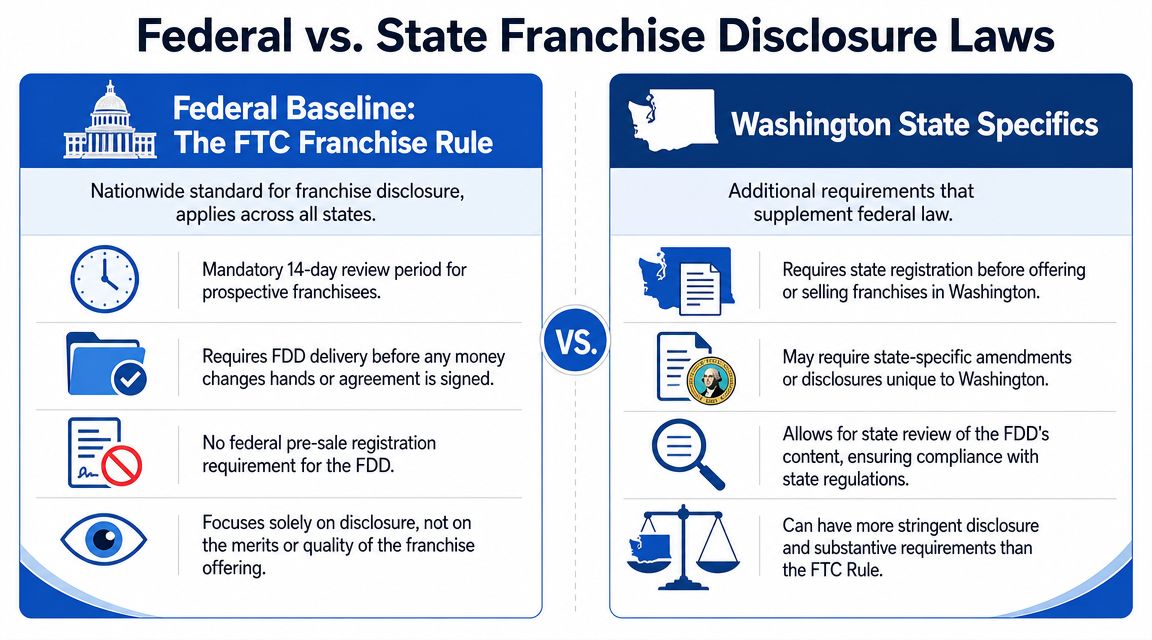
The federal baseline
Under the FTC Franchise Rule, the FDD is a standardized compliance packet that must be delivered at least 14 calendar days before the prospect signs or pays anything tied to the franchise purchase. That timing rule creates a pre-commitment due diligence window and limits a seller's ability to rush execution, as explained in Sirion's summary of the FTC timing rule.
That federal rule is disclosure-focused. It doesn't function as a government endorsement of the franchise opportunity. It also doesn't test whether the franchise is a smart fit for the buyer.
That distinction is easy to miss when buyers assume that legal compliance means business quality. It doesn't. Disclosure and suitability are different questions. The same caution shows up in consumer law discussions outside franchising, including explanations of mandatory review periods such as this overview of the FTC's cooling-off rule.
How Washington changes the analysis
Washington is not a state where an out-of-state franchisor should assume federal compliance is enough. In practice, Washington often requires closer attention to registration status, state-specific disclosure language, and the exact mechanics of offering and selling franchises in the state.
That changes the risk calculus for both sides.
For franchisors, Washington can slow a launch if the offering documents and filing strategy aren't prepared early. For franchisees, state-level review can provide another checkpoint, but it shouldn't create false comfort. State review is not an endorsement of profitability or operator fit.
The comparison that matters most
| Issue | Federal baseline | Washington practical impact |
|---|---|---|
| Disclosure timing | Required review window before signing or payment | Timing still matters, but state compliance issues can affect whether the offer should be made at all |
| Government review | No federal pre-sale registration review | Washington may require state-level filing or review before sales activity proceeds |
| Focus of regulation | Standardized disclosure | Additional state compliance steps and state-specific risk points |
| Buyer takeaway | Read the document carefully | Confirm both document content and Washington sale compliance |
Washington buyers should ask a threshold question early. Was this franchise properly cleared to be offered in Washington at the time discussions moved from general marketing to an actual sale process?
What works in practice
The cleanest process is front-loaded. Franchisors should confirm Washington compliance before active solicitation. Buyers should ask for the current FDD, the state-specific addenda if any apply, and a clear explanation of the proposed sale timeline.
What doesn't work is treating Washington as an afterthought. That approach tends to create avoidable delays, amended paperwork late in the process, and pressure on the buyer to review revised documents under a tighter commercial timeline.
The Franchisor's Guide to Preparing and Managing the FDD
For a new franchisor, the Franchise Disclosure Document isn't just a legal requirement. It's the written operating blueprint of the franchise offer. If the system is still improvising fees, training, supplier controls, or territorial policy, that lack of discipline usually shows up in the drafting process.
This visual summarizes the lifecycle at a high level.
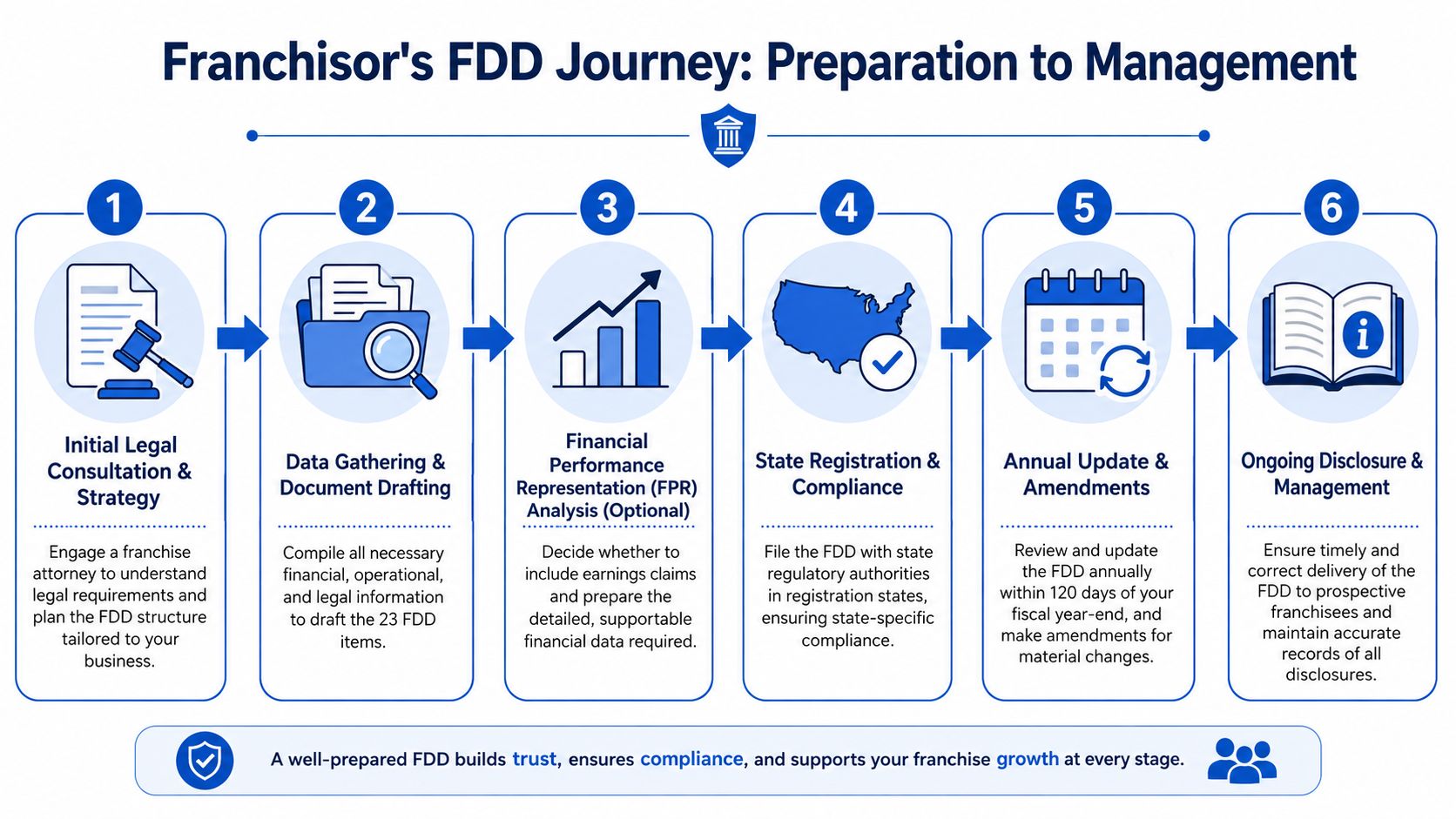
Build the business case before drafting
A franchisor should start with decisions, not templates. The legal drafting comes after the business model is coherent enough to disclose accurately.
That means confirming issues such as:
- Unit economics approach. Whether the system will make a financial performance representation and, if so, what support exists for it.
- Operational control model. How training, field support, software, brand standards, and supplier approvals will function.
- Expansion structure. Whether the system will use single-unit grants, area development, master arrangements, or a narrower approach at launch.
- Entity and governance structure. Who owns the intellectual property, who signs the franchise agreement, and how related entities interact.
A founder who also operates through an LLC should make sure internal governance is clean before scaling. Even outside franchising, internal ownership and management discipline matters, as explained in this discussion of why a Washington LLC needs an operating agreement.
Draft the FDD from actual operations
The draft should reflect how the system works in practice, not how the founder hopes it will work later. Buyers and regulators tend to find inconsistencies quickly when sales language outruns operational reality.
The highest-risk drafting gaps usually involve:
- Support promises that are broader in conversation than in the FDD
- Supplier restrictions that aren't yet organized
- Territory language that sounds exclusive in sales calls but is narrower in the agreement
- Informal earnings messaging that isn't properly handled in Item 19
- Financial statements that don't line up with the franchisor entity making the offer
A short educational resource can help management teams understand the framework before counsel takes the lead:
Manage delivery and updates as a compliance system
An FDD shouldn't live as a static PDF on someone's desktop. It should be part of a repeatable compliance process with controlled versions, documented delivery, and internal sales training.
Operational advice: The fastest way to create franchise exposure is to let the sales team say more than the FDD supports.
A workable process includes:
- Version control so the correct FDD is delivered every time
- Sales guardrails that prevent off-script earnings talk
- State tracking for where registration or notice requirements apply
- Material change monitoring so the document is amended when needed
- Annual refresh discipline so disclosures remain current
What works is alignment between legal, finance, and sales. What fails is treating the FDD as a filing project that ends once the first registration is complete.
A Prospective Franchisee's Guide to Analyzing the FDD
A prospective franchisee shouldn't read the FDD like a student trying to finish an assignment. The better posture is investigative. The document contains facts, but the buyer still has to assemble the story.
FTC guidance makes the key point clearly. The FDD is a disclosure document, not a suitability test. It contains critical data, but buyers still need to ask the right questions, and the most important risks often sit in the gaps between Items 19, 20, and 21, making franchisee interviews and independent analysis essential, as the FTC explains in its deep dive on the Franchise Disclosure Document.
Start with the gaps, not just the disclosures
Many buyers open to Item 19 first. That's understandable, but the sharper first question is whether Item 19 exists at all.
If the franchisor makes no financial performance representation, that doesn't mean the system is weak. It does mean the buyer has less standardized performance data to review within the document. In that setting, franchisee calls, local market modeling, and lender conversations become even more important.
Then compare that with Item 20 and Item 21. A buyer should ask:
- Does the unit movement look stable or unsettled
- Are transfers frequent enough to suggest churn rather than growth
- Does the franchisor's audited financial picture support the support obligations it is promising
- Do the economics implied by Item 19 fit the fee structure elsewhere in the FDD
Item 20 is where validation starts
Item 20 gives current and former franchisee contact information and outlet movement details. That list is not a courtesy. It is one of the most useful diligence tools in the entire package.
A productive interview list usually includes three groups:
| Who to call | What to ask | Why it matters |
|---|---|---|
| Current franchisees | How the launch went, whether support matched expectations, and what surprised them | Tests onboarding and operating reality |
| Former franchisees | Why they left, whether exit was voluntary, and what they wish they knew earlier | Surfaces issues the sales process won't emphasize |
| Recent transferees | Why the unit changed hands and what condition the business was in at transfer | Helps distinguish growth from turnover |
A buyer in Washington should also ground the diligence in local business realities. Entity structure, licensing, and state registration steps matter before the operator ever opens doors. A practical starting point is understanding the local setup process described in this Washington business registration guide.
Negotiation leverage buyers often miss
Many franchise systems present the agreement as having set terms. Often, the core form is standardized. That doesn't mean nothing moves.
The negotiation factors usually depend on the buyer's profile, market, timing, and unit count. Common areas for discussion include:
- Development schedules for multi-unit commitments
- Opening deadlines tied to permitting or site conditions
- Territory clarifications where maps or exclusivity language are vague
- Transfer terms that could affect long-term exit value
- Cure periods for operational defaults
- Personal guaranty scope for owners and spouses, where applicable
- Site approval timing and conditions tied to local real estate realities
If a franchisor says nothing can change, the buyer should still ask which business terms have ever been clarified by addendum. The answer often tells more than the form agreement itself.
Questions worth asking on franchisee calls
Not every useful question is broad. Better questions are specific and grounded in what the FDD already disclosed.
- On support: “Which parts of training and opening support were most useful, and what did the business still have to build on its own?”
- On fees: “Which recurring charges felt predictable, and which ones appeared larger in practice than expected?”
- On territory: “Has the territory performed the way you thought it would when you signed?”
- On supplier control: “How much flexibility do you have with vendors and substitutions?”
- On economics: “What assumptions would you challenge if you were underwriting this unit again today?”
- On exit: “If you wanted to transfer the business, how cooperative is the franchisor likely to be?”
The buyer's job isn't to collect reassurance. It's to reduce uncertainty. The most useful calls are often the ones that are candid rather than enthusiastic.
Common Compliance Mistakes and Mitigation Strategies
Most FDD problems are not dramatic. They start as shortcuts. A salesperson sends the wrong version. A founder talks loosely about potential revenue. A buyer assumes legal review can wait until after the site is chosen. Those choices can become expensive quickly.
Franchisor mistakes that create avoidable exposure
The first recurring problem is poor disclosure control. If the franchisor can't prove which FDD version was delivered and when, the compliance story weakens immediately.
The second is earnings talk outside Item 19. Sales teams often drift into “what other operators are making” or “what this market should do.” That kind of unscripted messaging can create serious risk if it isn't handled properly within the disclosure framework.
The third is misalignment between the FDD and operations. A support program described one way on paper but delivered another way in practice invites conflict. The same is true for supplier restrictions, technology requirements, or local advertising expectations.
Mitigation works best when it is procedural, not aspirational:
- Lock the sales process down with approved scripts, approved materials, and centralized delivery records.
- Train anyone who speaks to prospects on what cannot be said casually.
- Review system changes promptly so legal documents don't lag behind actual operations.
- Use one source of truth for agreement forms, exhibits, and state-specific changes.
Franchisee mistakes that weaken diligence
Buyers make a different set of errors. The most common is reading the FDD as if it were self-executing. It isn't. The document gives data. The buyer still has to test assumptions, compare sections, and investigate what the document doesn't answer.
Another frequent mistake is over-focusing on startup excitement and under-focusing on restrictions. Territory, default provisions, transfer controls, and required suppliers tend to shape daily life more than many buyers expect.
A third mistake is failing to build a local business plan that reflects Washington conditions. A franchise isn't a substitute for entity formation, employment planning, lease review, permit work, or capital discipline.
Practical mitigation on both sides
| Risk | Who faces it | Mitigation |
|---|---|---|
| Improper timing or delivery | Franchisor | Use tracked delivery, standard workflows, and approval controls |
| Loose earnings discussions | Franchisor | Limit financial statements to approved, documented disclosures |
| Surface-level FDD review | Franchisee | Cross-check Items 19, 20, 21, the agreement, and franchisee interviews |
| Underestimating operational restrictions | Franchisee | Read territory, supplier, transfer, and default terms early |
| State-specific compliance gaps | Both | Confirm Washington requirements before treating the deal as ready to close |
A franchise dispute often starts long before the opening date. It starts when one side thinks the relationship means something the paper doesn’t actually say.
What works is early friction. Hard questions, slower review, careful call notes, and documented clarification requests feel cumbersome in the moment. They are still much cheaper than fixing a bad deal after signing.
How Franchise Lawyers Streamline the FDD Process
A franchise lawyer does more than “review the document.” Its primary value is translation. Legal language gets converted into business consequences, negotiation strategy, and compliance procedure.
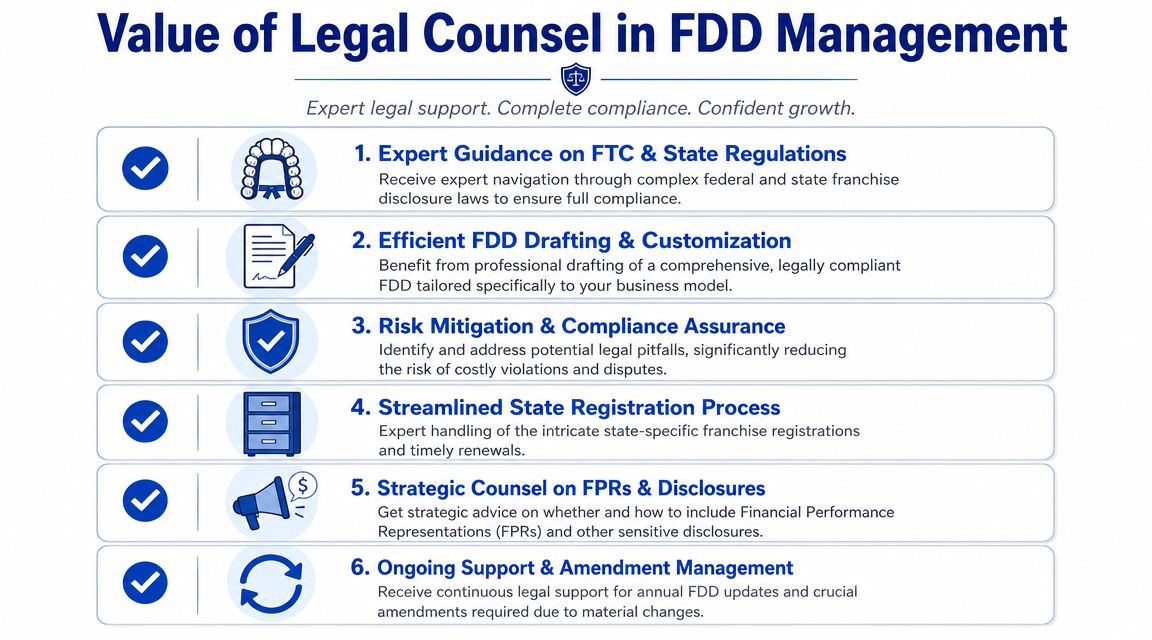
For a prospective franchisee, counsel can test whether the agreement matches the buyer’s risk tolerance and operating plan. That review usually focuses on territory language, transfer rights, default triggers, dispute resolution, supplier controls, and whether side conversations with the franchisor created expectations not reflected in the paper.
For a franchisor, counsel helps build a system that can be effectively sold and defended. That means drafting disclosures that fit the business, aligning state compliance steps with expansion goals, and reducing the mismatch between marketing, onboarding, and the legal file.
A useful legal review typically covers:
- Document alignment between the FDD, franchise agreement, addenda, and sales materials
- Washington-specific sale issues that may affect timing or registration posture
- Negotiation points that are worth raising and those that are mostly symbolic
- Disclosure controls for franchisors managing future prospects
- Contract architecture beyond the FDD itself, including the supporting agreements a business needs as it grows, such as those discussed in this guide to essential contracts for business owners
The strategic benefit is speed with discipline. Buyers get clearer decision-making. Franchisors get cleaner execution. Both sides reduce the odds that a “standard document” will produce non-standard problems later.
A practical checklist is simple. Confirm compliance. Compare the items against each other. Interview the people the FDD identifies. Mark every clause that affects control, cash flow, or exit. Then decide based on the actual legal and business fit, not the sales momentum.
By Design Law Firm & Legal Consultancy, PLLC helps Washington businesses, founders, and brand owners handle franchise, corporate, contract, and regulatory issues with clear, strategic counsel. For guidance on franchise disclosure documents, Washington franchise compliance, or broader business structuring and contract review, contact By Design Law Firm & Legal Consultancy, PLLC. Call us today at (206) 593-1519.