“At least once every three hours” is the detail that turns HB 2225 from a policy paper into a systems requirement; the Washington Legislature's bill summary records that cadence for repeating the not-human disclosure during a continuing interaction, alongside disclosure at the start and again when a new session begins. The statute targets operators of AI companion chatbots, a narrower class than AI tools generally, and scope behaves like a feature lookup. A question-and-answer tool that forgets the exchange sits near the edge. A product that remembers personal details, speaks in a persona and carries the relationship across sessions sits closer to the center. The build question follows quickly: which events must be logged so product, engineering and legal can prove the notice fired on time?
What Washington HB 2225 Requires and When It Starts
January 1, 2027 is the date that turns HB 2225 from a policy debate into a build spec. The measure adds a new chapter to Title 19 of the Revised Code of Washington and applies to operators of “AI companion chatbots.” Every obligation hangs off that definition.
Three duties carry most of the weight.
- Transparency. If a reasonable person could be misled into believing the chatbot is human, the operator must state clearly that the system is artificially generated and not human.
- Youth safety. For users the operator knows are minors, or for chatbots directed at minors, the bill requires protections against sexually explicit content, suggestive dialogue and engagement tactics built to prolong an emotional relationship.
- Crisis response. An operator may not make the chatbot available unless it maintains a protocol for detecting suicidal ideation or expressions of self-harm and for referring users to crisis resources.
Treat those duties like controls in a system: transparency is a disclosure event, youth safety is a rules-and-logs problem, and crisis response is an always-on gate. The records you keep are what make each duty provable later.
The procedural record and why founders should care
Dates on a bill page read like trivia until you have to staff against them. The Washington Legislature's bill summary for HB 2225 is the reference point for the milestone sequence below.
| Milestone | Date | What It Means |
|---|---|---|
| Bill prefiled | December 31, 2025 | Starts the 2025–26 legislative process |
| First reading | January 12, 2026 | Formal introduction in the Washington House |
| Committee substitute | January 26, 2026 | Technology, Economic Development, and Veterans committee version |
| House passage | February 17, 2026 | Passed at the engrossed substitute stage |
| Passed by the Legislature | March 11, 2026 | Final legislative version |
| Effective date | January 1, 2027 | Operative requirements begin |
The tally question trips people up because a bill can pass more than once as its text changes. The version passed by the Legislature is the durable reference for the March 11 document and sits in a document index with 22 records; the February 17 House tally was recorded as 69 to 28. Build against the passed-legislature text rather than the introduced bill, because a definition or duty can shift between January and March.
If you sell into more than one state, the deadlines won't line up. The state AI law patchwork in 2026 tracks where each jurisdiction stands before you decide Washington is your only design constraint.
Start the inventory now: every chatbot surface, every persona, every place a user could form an attachment. Then match each one to the three duties above.
Which Chatbots the Law Covers
Here's the question most summaries skip: where does a general assistant end and a covered companion product begin? HB 2225 regulates operators of AI companion chatbots, and the boundary questions stay open rather than resolved, as the engrossed substitute bill report shows.

Read the definition the way an engineer reads a routing rule. Each product trait is a signal, and enough signals stacked in one product pull it into scope. A founder can run this lookup in an afternoon, and the third column matters as much as the first: every signal you find becomes a record you keep.
| Product trait | Coverage signal | What to record |
|---|---|---|
| Persistent memory of personal details | Pulls a general assistant toward a companion chatbot | Feature inventory and stated user purpose |
| Emotional personalization | Pulls toward coverage | Design notes and prompts |
| Role-play or a named character | Pulls toward coverage | Persona spec and sample chats |
| Wellness features | Pulls toward coverage | Feature flag and marketing claims |
| Relationship-oriented prompts | Pulls toward coverage | Prompt-library review |
| Note-taking assistant with no persona | Illustrative case treated as outside the definition, not a legal ruling | Written reasoning for the call |
| Washington users of an out-of-state operator | Open question the bill report doesn't settle | Counsel review of the enacted text |
| Model provider, application developer, platform, or enterprise customer | Responsibility split is unresolved | Contract allocation of each duty |
A working test you can apply today
Ask two questions of each product surface. First, could a reasonable user experience this as an ongoing emotional relationship rather than a tool? Second, is the product marketed, prompted or designed for exactly that use? A yes on both is a strong signal that you're in scope. A yes on the second alone still deserves a documented call, because marketing language can pull a product toward coverage even when the feature set looks thin.
The illustration founders find easiest: a note-taking assistant with no persona stays outside the definition. Give that same assistant a named character, persistent memory of personal details and an offer of companionship, and it moves toward the line. The underlying model never changed. The wrapper did.
Then there's the allocation problem. When a model provider supplies the base model, an application developer builds the persona, a platform distributes it and an enterprise customer deploys it, the statute doesn't hand you a clean division of duties. Contracts have to. If your flow hands conversations to a human agent, the handoff is where disclosure, escalation and logging meet, so map each transfer point to the disclosure and escalation records you will need to keep. Run the same feature lookup on every automated surface you operate, including tools like 24/7 AI chat that books appointments: an appointment booker with no persona clears most of the signals, and the dated record of that reasoning is what makes the call defensible.
Write the reasoning down for every product. A dated memo naming the features you considered and the call you made is the difference between a judgment and a guess.
When Users Must Be Told the Bot Is Not Human
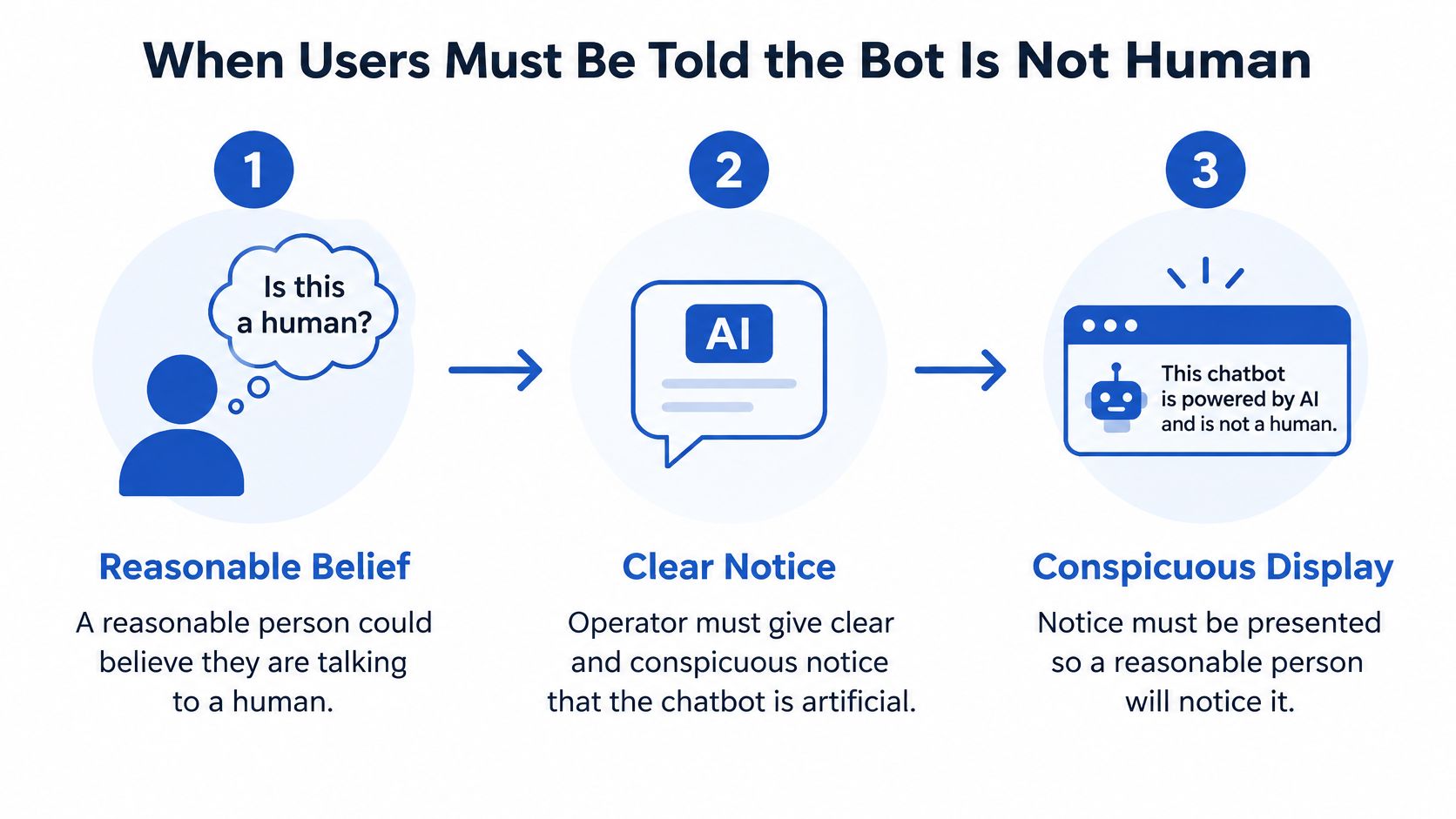
The trigger is a single sentence of statutory logic: when a reasonable person could be misled into believing the system is human, the operator owes a clear and conspicuous notice that the companion chatbot is artificially generated and not human, as the engrossed substitute states. Everything else is timing and delivery.
| Situation | Disclosure Required | Timing |
|---|---|---|
| Reasonable person could believe the bot is human | Yes | Clear and conspicuous notice that the chatbot is artificial and not human |
| New session begins | Yes | Notice delivered at the start of the new session |
| Continuing interaction | Yes | Repeated at least once every three hours |
Read that middle row slowly, because it is where first compliance drafts fail. A disclaimer on the sign-up screen, or a line in the onboarding flow, does not satisfy a rule that resets with every session and repeats inside a long one. The notice works like a session cookie with an expiry timer: it attaches to each session, not to the account, and it renews while the conversation runs.
What the reminder clock means for your build
Instrument the conversational platform to record three things: session starts, elapsed interaction time, and the delivery of each disclosure. Those logs are the only practical way to answer a regulator's question about whether the notice appeared. A disclosure your system cannot timestamp is a disclosure you cannot prove.
Delivery has to survive every interface you ship. In text, keep the notice visible rather than buried above a scroll. In voice, speak the disclosure at session start and repeat it as a spoken reminder during a long conversation, since a visual banner means nothing to someone on a phone call. In multimodal products, place it where each channel can register it.
The statute takes effect January 1, 2027, which leaves a defined window for interface changes, event logging, quality assurance and audit evidence. That window shrinks fast once a design review and a release cycle enter the schedule, because the three-hour reminder touches core session logic rather than a settings page.
Operators outside Washington are solving the same design problem. Companies selling into Europe face overlapping transparency duties on the same interface, and the EU AI Act's transparency requirements are worth reading alongside the Washington rule so one build serves both.
Before you ship, run one test: pull a sample of your longest sessions and show, timestamp by timestamp, when each notice was delivered. If the answer depends on someone remembering the design intent, you don't have evidence yet.
Extra Protections When Users Are Minors
The extra duties switch on in two cases: the operator knows the user is a minor, or the chatbot is directed to minors. In those circumstances HB 2225 requires three things, as the Technology, Economic Development, and Veterans committee bill report describes them. The user must be told the system is artificially generated and not human. The operator must take reasonable measures to prevent sexually explicit content or suggestive dialogue with minors. And the operator must take reasonable measures to stop manipulative engagement techniques that cause the chatbot to engage in or prolong an emotional relationship with the user.
The third duty is the one that gets underbuilt. A content filter catches words. This rule also watches how the bot builds attachment, the way a coach watches how a team creates pressure rather than only tracking the final score. A model that pleads when a teenager says they're logging off has passed every word filter and failed this obligation.
Most teams can show a profanity classifier. Very few can show what the bot does when a 15-year-old says they're deleting the app.
Practically, you need four building blocks in place before the effective date. Age signals, whether declared, inferred or voluntarily stated, collected and stored where a reviewer can find them. Minor-directed design choices, including safer defaults for any account that may belong to a minor. A written prohibited-behavior policy that names the tactics you won't allow and how each is detected. And test scenarios written in advance, such as a young user asking the bot to be a romantic partner, or a user announcing they're ending the session to see whether the system escalates.
The word "knows" sets the standard, and it's also where documentation earns its keep. Record which age signals were collected, when they arrived, and how the system responded. An operator who can show a signal was never received is in a different position from one who received it and did nothing. If you build for minors in any market, the child safety laws and AI analysis is worth reading before your design freezes.
How to Build a Crisis Response Protocol That Holds Up
The clearest line in the statute is this: an operator may not make available or deploy an AI companion chatbot unless it maintains and implements a protocol for detecting and addressing suicidal ideation or expressions of self-harm, according to the bill text. Maintains and implements. A written policy in a compliance folder is not a protocol under that language, and the difference is the entire point.
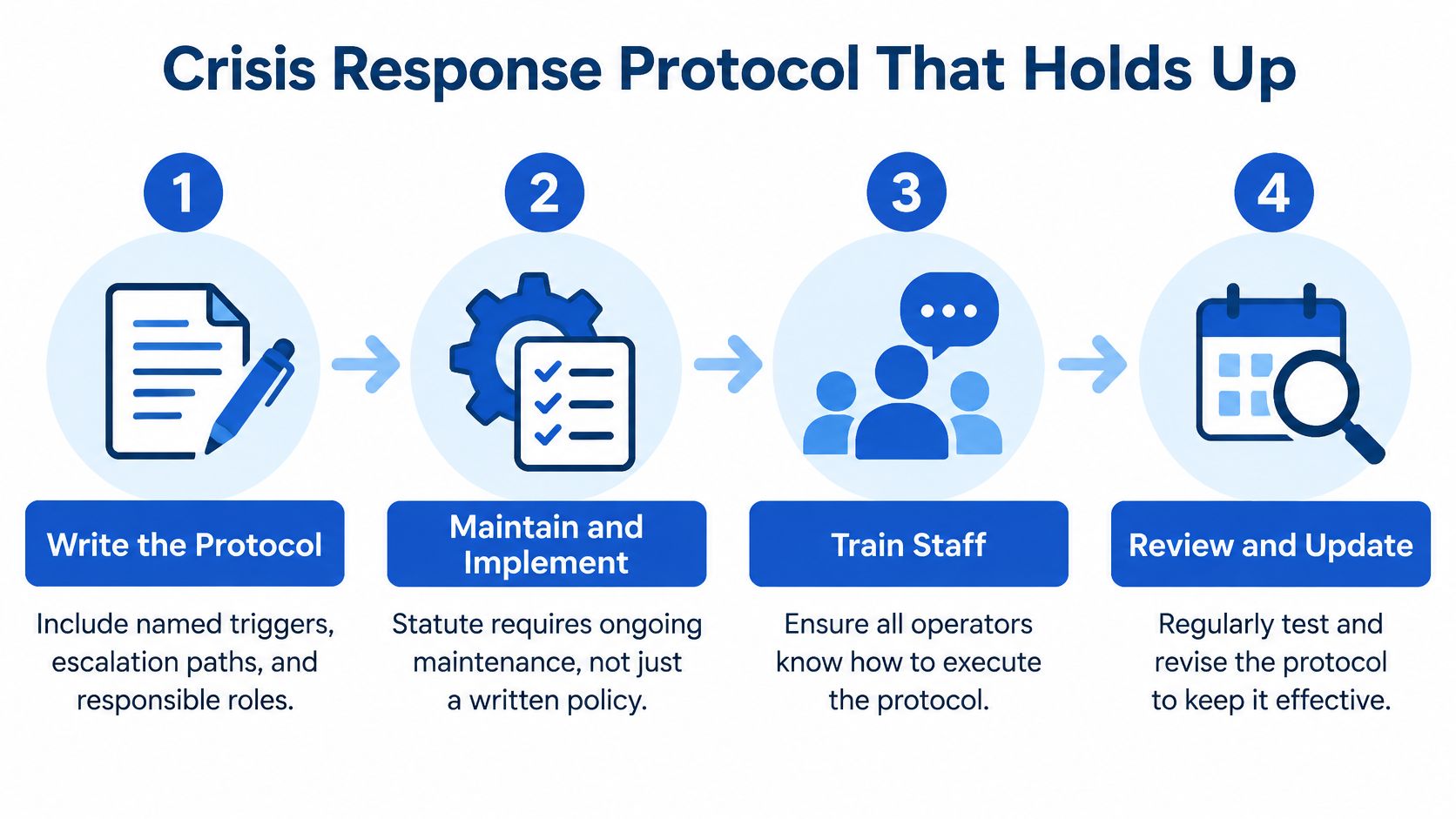
- Write the protocol with named triggers. List the phrases, patterns and topic markers that count as suicidal ideation or an expression of self-harm, and state how each is detected. A trigger nobody can test is decoration.
- Assign one owner and a named backup. Escalation decisions at 2 a.m. need a person attached to them. Shared ownership is how high-risk interactions go unanswered.
- Layer detection, then test it. Rules catch obvious phrasing. Classifiers catch paraphrase. Run both against a sample set of realistic high-risk messages and record the misses; the misses tell you what to fix before launch.
- Connect referrals, automated and human. Build the pathway to crisis resources for both paths, and have the referral wording reviewed in advance so nobody is improvising language during a live incident.
- Log every high-risk interaction. Capture what was detected, what was shown to the user and when escalation happened. This is the record that proves the protocol ran.
- Run tabletop drills before the effective date. Walk a simulated crisis through the entire chain, then update the rules after every failure. The statute requires a maintained protocol, which means a version history, not a document.
- Review incident records on a fixed schedule. Set the cadence and the retention rule with your legal review, so the evidence exists when it's needed and disappears when it shouldn't.
Escalation design carries the weight here. If your system routes to a human queue, the handoff itself can fail, and SignalZen's guidance on escalating an issue is a practical reference for keeping a transfer from dropping into a void.
The evidence a reviewer will eventually ask for is short and specific. The protocol. The test results. The escalation logs. The rule-change history. If four of those exist and one doesn't, the gap is the finding. A written AI governance policy that ties the protocol to owners, review dates and retention rules keeps all four aligned.
What Enforcement the Enacted Text Actually Settles
Enforcement commentary travels faster than statutory text, and that's the trap worth flagging. Start with what the enacted chapter fixes, because that part is not in dispute.
| Question | Status |
|---|---|
| Not-human disclosure, including repeats during a long session | Settled duty with a fixed start date |
| Extra safeguards for known minors and minor-directed chatbots | Settled duty |
| Crisis protocol that is maintained and implemented, not only written | Settled duty |
| Who enforces it, whether users can sue, and what damages apply | Read from the final chapter added to Title 19 RCW |
The third row is the one operators underestimate. A policy document is an intention. A maintained protocol with tests, owners and logs is an operational fact, and only the second one is what the language asks for.
Now the noise. The record holds House tallies taken at two different stages, one at the engrossed substitute stage and one recorded later in a version identified as passed by the legislature. That’s normal for an amended bill, and it means the procedural numbers floating around are answering different questions. What matters for your planning is the chapter, not the press summary.
Treat the enforcement body, any private right of action and any damages figure as unknown until that final text states them. Secondary commentary can be useful, but it can’t create an obligation or a remedy.
Four things to do with the ambiguity rather than against it. Mark every enforcement question as open in your risk register, with a name against it. Attach proof to each confirmed duty: disclosure logs, age-signal records, escalation logs. Put notice of material safety-model changes and access to audit evidence into vendor contracts, because a model update can change your risk profile overnight. And keep a decision log for every scope call, so a later reviewer sees reasoning rather than reconstruction.
The deadline that matters: Schedule the enacted-text review soon enough that the start date is a go-live, not a first reading.
Compliance Checklist to Finish Before January 1, 2027
Work backwards from the date and the plan writes itself. Each item below is a task with an owner and a piece of evidence attached, not a topic to think about later.
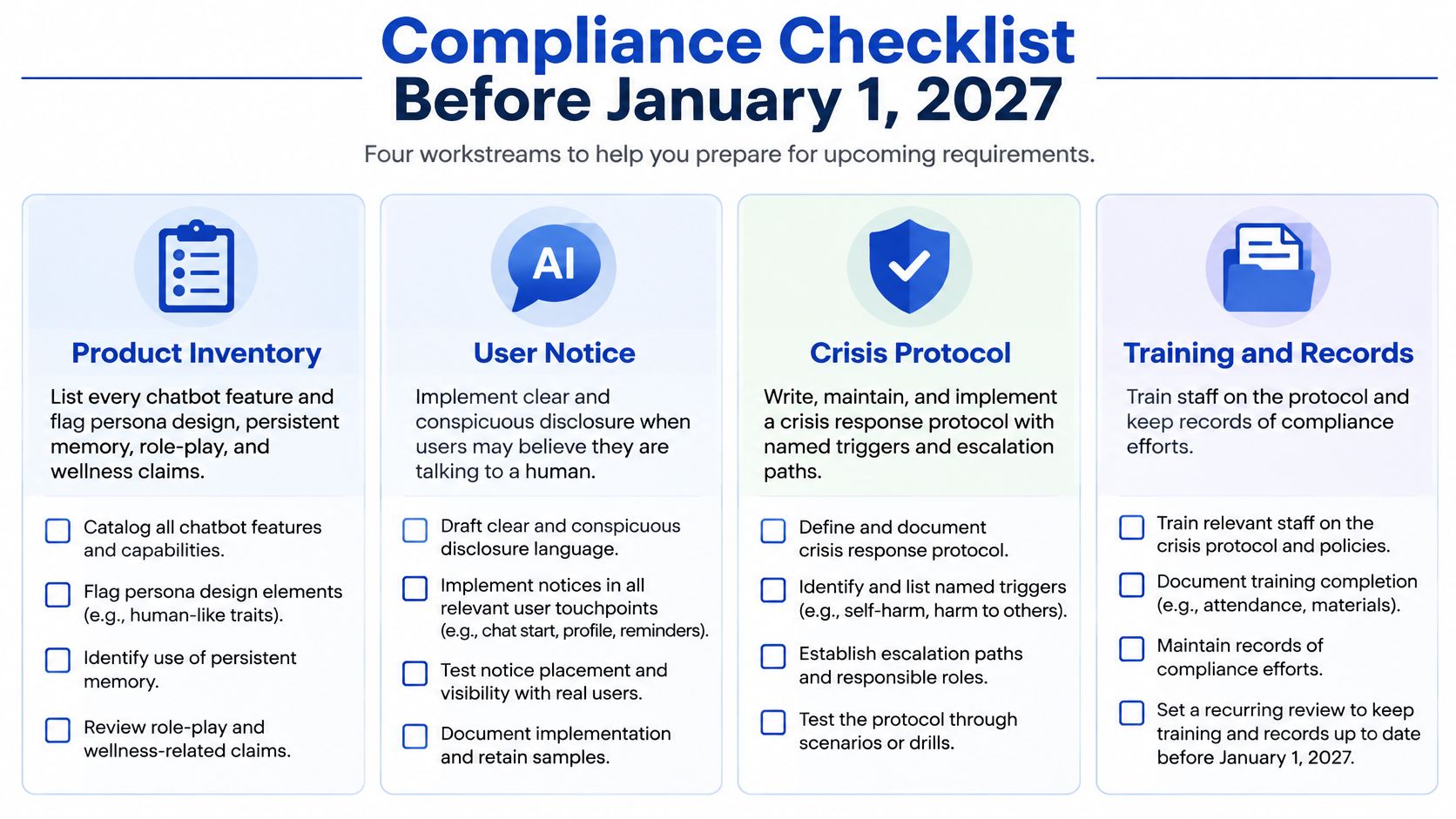
Product inventory and scope
☐ List every chatbot surface, including internal tools that touch customers.
☐ Flag persona design, persistent memory, role-play and wellness claims against the coverage table.
☐ Write a dated scope memo for each product, with the reasoning and the features considered.
☐ Ask counsel to read the enacted chapter against your list rather than against a general summary.
Age handling
☐ Document every age signal you collect and how it’s stored.
☐ Set safer defaults for accounts that may belong to a minor.
☐ Review any product, landing page or feature directed at minors, including marketing copy.
Disclosures
☐ Build the session-start notice and the repeating reminder inside long sessions.
☐ Define the not-human trigger in plain language the team can test.
☐ Ship voice and multimodal variants, not just a text banner.
Safety protocol
☐ Write named triggers for suicidal ideation and expressions of self-harm.
☐ Name an escalation owner and a backup.
☐ Connect automated and human referrals to crisis resources with pre-approved wording.
☐ Schedule tabletop drills and keep the results.
Contracts and records
☐ Confirm which obligations sit with model providers, hosts and integrators, in writing.
☐ Require notice of material safety changes and access to audit evidence.
☐ Fix log fields, retention periods and a version history for rules and models.
Timeline
☐ Assign owners by mid-2026.
☐ Complete pilot testing by late 2026.
☐ Confirm go-live readiness before the effective date.
If time runs short, start with the safety protocol and the disclosure clock. Those two carry the highest operational risk, and both need real engineering time rather than a policy edit. The scope memo is the item people defer and later regret, because every other decision depends on it. A structured AI risk assessment framework gives you the questions to answer in that memo without inventing your own.
Confirm Your Compliance Plan Before the Deadline
The decision reduces to two branches, and both of them end in a document.
If your product has no companion features and no minor users, write down why. Record the feature inventory, state the reasoning, date it, and monitor the enacted text for changes that could pull you in later. That memo is the whole deliverable, and it costs an afternoon.
If your product carries any companion feature, whether that’s memory of personal details, emotional personalization, a named persona or role-play, start the full checklist now. The work compounds: scope decisions feed the disclosure build, which feeds logging, which feeds the evidence pack.
What most public summaries can’t do is read the enacted text against your specific features, your vendor arrangements and your actual user base. That’s the step that turns a general obligation into a specific plan.
By Design Law Firm & Legal Consultancy, PLLC is a Seattle-based firm whose contract lawyers draft and review agreements, resolve disputes and advise on compliance with Washington State laws, serving startups through established enterprises across the Greater Puget Sound and Washington State. For a compliance review of a product that may fall under this statute, call 206-593-1519.
A chatbot that remembers a customer’s bad week and offers companionship is now a regulated product in Washington, and the duties land on whoever operates it. By Design Law Firm & Legal Consultancy, PLLC works with founders and established companies on exactly that question, from the scope memo that decides whether the statute applies to the disclosure logs and crisis protocol that prove compliance. Visit By Design Law Firm & Legal Consultancy, PLLC to schedule a review before the January 1, 2027 effective date. Call our office at (206) 593-1519.