The designer has delivered the final logo. It looks sharp on the website, the product packaging, and the pitch deck, and the founder is ready to file it with the U.S. Patent and Trademark Office. The assumption is understandable: registering that image should mean owning the artwork and every recognizable variation.
But trademarking an image starts with a portfolio decision, not a file upload. A brand name, a black-and-white logo, and a logo with claimed colors protect different aspects of a business. Choosing among them before paying a filing fee can prevent an expensive mismatch between the registration and the brand the company uses.
What an Image Trademark Covers and Which Versions to File
An image can function as a trademark in the United States when customers recognize it as identifying the source of particular goods or services. Drawing an original picture doesn't automatically make it protectable as a trademark. Trademark registration also doesn't replace copyright protection for the artwork.
The USPTO's explanation of trademarks recognizes designs alongside words, phrases, symbols, and combinations of those elements. An image-only logo, or a logo combining graphics and wording, generally uses a special-form drawing. The drawing identifies the mark being claimed; a separate specimen shows how customers encounter it in commerce.
That distinction changes the filing question. The founder isn't buying ownership of a picture in the abstract. The application concerns a particular source identifier associated with identified goods or services.
Choose the portfolio before the file
-
Protect the distinctive brand name in standard characters. When the wording qualifies for protection, a standard-character registration addresses the name without tying it to a particular font or color. For a startup still refining its visual identity, the name may be the more durable asset.
-
Select a black-and-white master logo. The strongest candidate is a stable design that matches the branding customers see. Filing without a color claim can preserve palette flexibility, although it doesn't turn the registration into protection for unrelated layouts or redesigned artwork.
-
Add a color claim when color distinguishes the brand. A precise color presentation can matter commercially. But including colors just because they appear in the current style guide can make the claimed mark more specific than the company's long-term needs justify.
-
Treat secondary graphics as separate business decisions. Social-media crops, seasonal stickers, and product badges don't all deserve applications. A separate filing makes more sense when the variation independently functions as a source identifier, rather than merely decorating a campaign.
The USPTO's mark-drawing guidance explains the difference between standard-character and special-form marks and the need for correspondence between the drawing and marketplace use. A materially rearranged lockup or added wording may require a separate application rather than a revision to the original filing.
Separate brand recognition from artwork ownership
Say a Seattle software company uses a distinctive name beside a mountain icon. Its name protection, icon protection, and rights in the commissioned illustration involve different questions. A competitor's confusingly similar software branding presents a different problem from someone copying the illustration into an unrelated art print.
The distinction among trademark, copyright, and patent protection helps founders identify which right addresses which risk. The useful portfolio follows the business's actual assets, not the number of files delivered by the designer.
The sharpest image file is not automatically the broadest registration.
How to Clear an Image Before Filing
A word search isn't enough for a logo. A competing mark can create a concern through its imagery, stylized lettering, or overall commercial impression even when its wording differs.
The USPTO Trademark Case Files Dataset contains approximately 12.7 million applications filed or registrations issued from October 1870 through March 2024; the agency also received 787,795 application classes in fiscal year 2022, approximately 7% above fiscal year 2020 and about 20% below the fiscal-year 2021 peak. The filing-volume figures count classes, not unique logos or businesses. Their practical significance is scale: a casual glance isn't clearance.
The clearance routine should connect visual similarities to the products and services customers encounter.
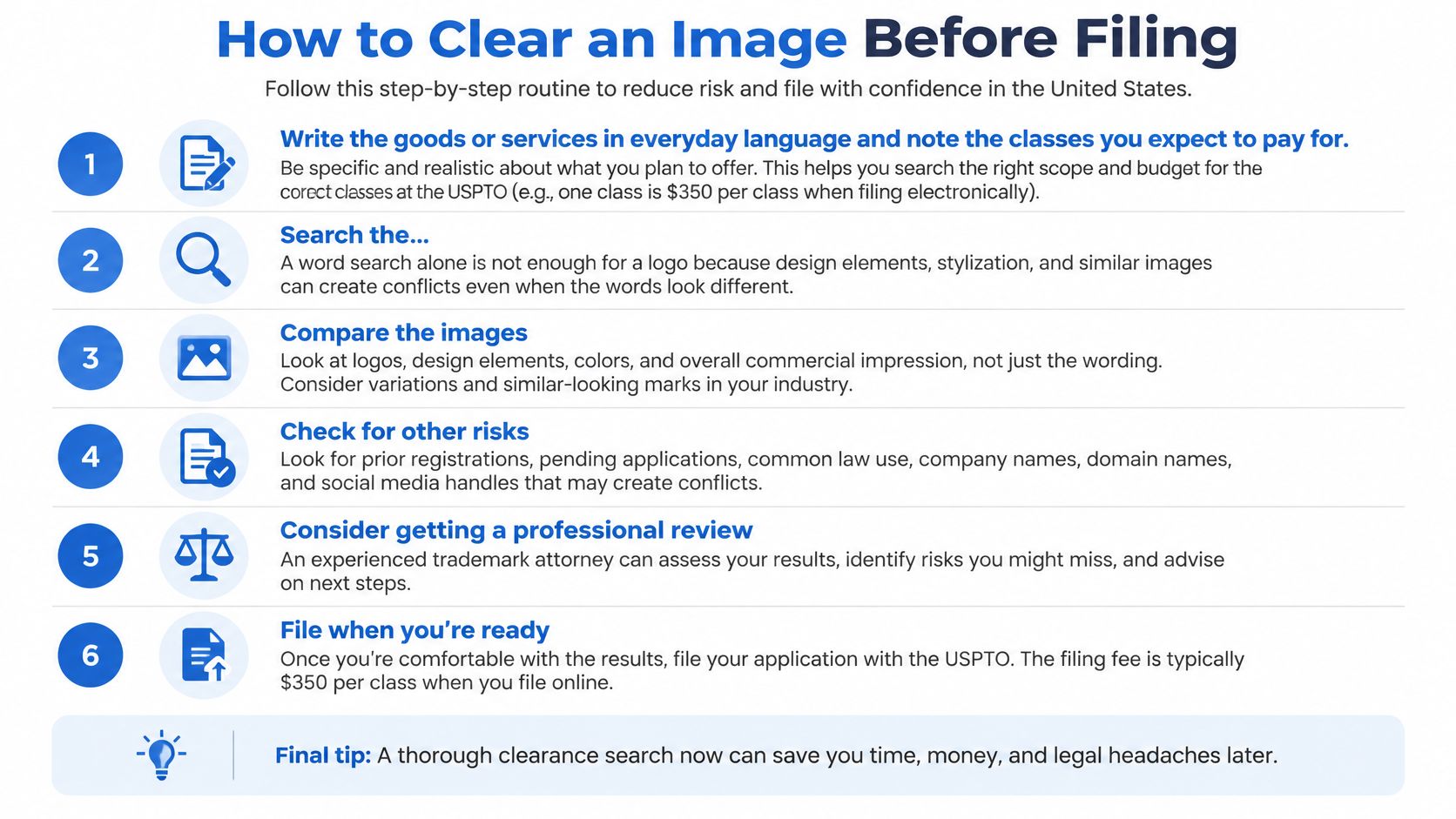
Follow a documented search routine
-
Describe the commercial activity. Write the goods or services in everyday language and identify the classes likely to be relevant. A downloadable application and a hosted software service shouldn't be treated as interchangeable descriptions.
-
Search active and inactive federal records. Include applications and registrations, not just registered word marks. Use design searches and inspect the actual images.
-
Expand beyond identical pictures. Look for related shapes, icons, lettering treatments, and arrangements. A bird silhouette deserves more than a search for the business name printed beside it.
-
Read the commercial context. Compare the listed goods, customers, and ways the products reach buyers. Similarity matters differently for competing fitness applications than for businesses operating in remote commercial fields.
-
Test distinctiveness. Ask whether consumers would perceive a brand or merely a descriptive picture, familiar symbol, or decorative treatment. A coffee-bean illustration on coffee packaging needs careful scrutiny.
-
Check the wider marketplace. Review business names, domains, online stores, and obvious commercial uses. A federal database result doesn't answer whether someone continues using a similar image outside a registration.
Make a go-or-pause decision
Packaging can introduce additional concerns beyond the logo itself. A review of trade dress and brand identity helps distinguish a graphic-mark question from a broader presentation issue.
For legal teams turning clearance lessons into recurring client education, NewsletterAsAService's editorial support for legal newsletters is a resource for presenting those distinctions consistently. Newsletter explanations should remain separate from an individualized clearance conclusion.
Proceed when the search supports a defensible distinction, such as unrelated commercial fields. An inactive record may also be less concerning after investigation confirms no continuing use or live-owner issue. Pause when a live, similar design appears on related goods, and don't treat an abandoned application as automatic permission.
Fees Classes and Drawing Specs Before You File
Image trademark fees and drawing limits
| Item | Figure | What it means |
|---|---|---|
| Base application fee | $350 per international class, under the USPTO Registration Toolkit | Each additional class adds another base fee |
| Extra fees | Added for specified filing problems | Free-form identifications and other issues raise the total |
| Drawing file | JPG, 5 MB max, filename under 256 characters | No TM, SM, or registration symbol in the image |
| Scan and size | About 300 to 350 dpi and 250 to 944 pixels per side | Keep surrounding white space minimal |
| Color claim | RGB image plus the claimed colors and their locations | More specific than a drawing without a color claim |
| Timing | Check the current USPTO processing-time dashboard | Processing times move with workload |
The fee is assessed by class, not by logo. For a hypothetical application covering the same image in two classes, the base-fee calculation is $350 multiplied by two, or $700, before extra-fee issues. Separate applications for different marks create separate filing decisions.
Typical startup categories include Class 25 for apparel, Class 9 for downloadable software, Class 41 for education or entertainment services, and Class 42 for software-as-a-service and technology services. Those examples aren't a substitute for reviewing the actual offering. A technology company's merchandise, downloadable product, and hosted platform may require different treatment.
Match the identification to the business
The identification of goods or services describes the commercial activity tied to the mark. It should match actual use for a use-based application, or the intended offering when the filing basis permits future use. Selecting a broad-sounding class doesn't grant ownership of every commercial activity associated with that class.
A sloppy free-form identification can create extra fees and examination problems. Searching for suitable wording before submitting the application is more useful than treating the description as marketing copy.
Prepare a filing export, not a brand presentation
The drawing should contain the mark, not a designer's presentation board. Extra margins, alternative lockups, status symbols, and decorative backgrounds can obscure what the applicant seeks to register.
Black-and-white or grayscale is appropriate when color isn't claimed. A color claim calls for an RGB image and a description identifying the colors and their locations. Technical cleanliness matters, but it doesn't cure a weak mark or a conflict with another owner's rights.
Budget rule: The filing fee buys examination of the identified mark in each paid class, not a guarantee of registration.
For planning purposes, founders should consult the current USPTO processing-time dashboard rather than attach a fixed month count to a filing calendar. Product launches and financing milestones shouldn't depend on an assumed registration date.
How to File the Drawing and Specimen
The drawing and specimen perform different jobs, and a successful filing keeps them aligned. The USPTO's electronic-filing guidance provides the technical drawing specifications summarized in the fee table. Its practical consequence is simple: the application needs a clean depiction of the claimed mark, not merely a polished marketing asset.
The filing path begins after clearance and selection of the mark.
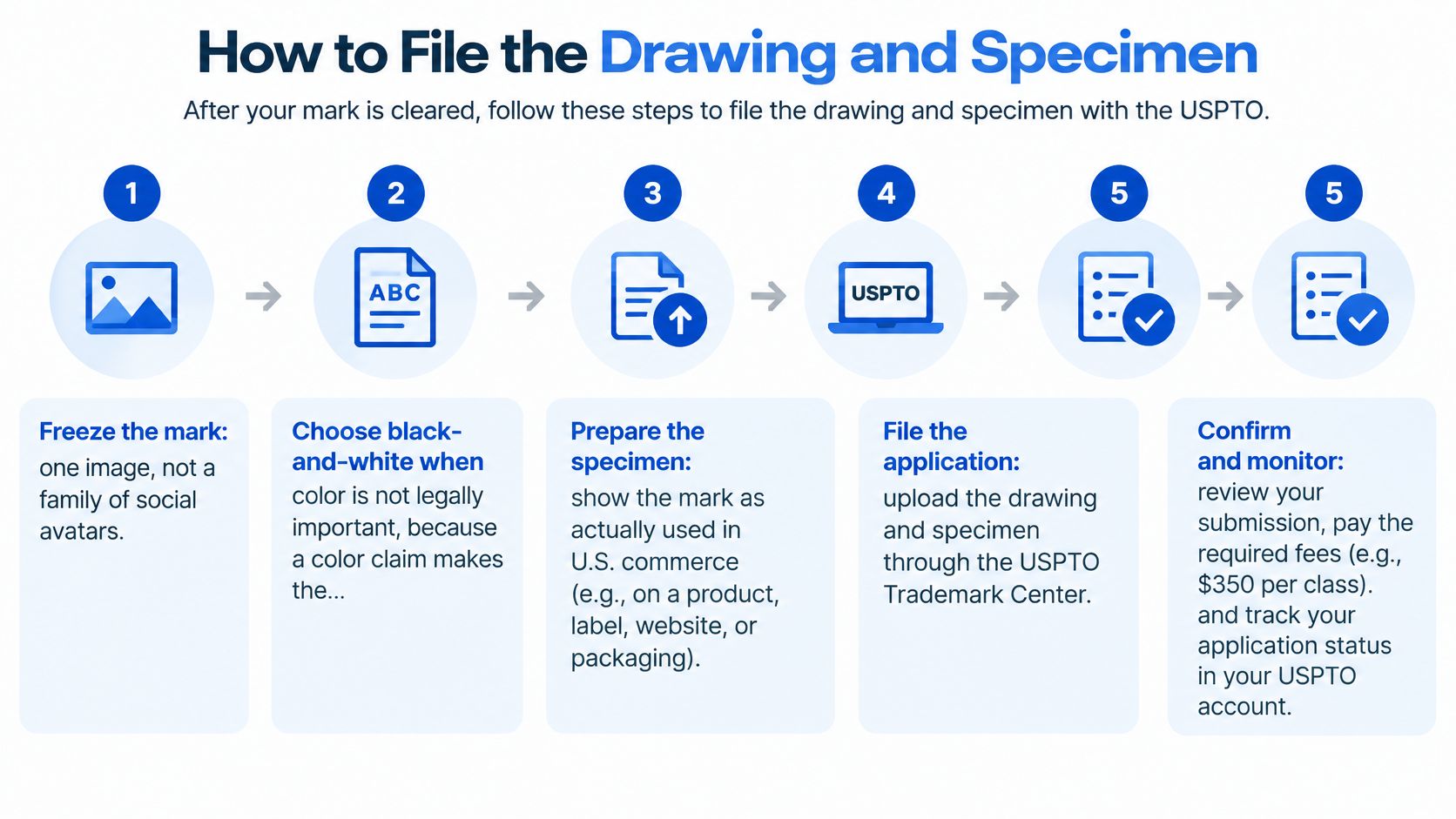
Assemble the application in sequence
-
Freeze the mark. Choose the actual image being claimed, not a collection of avatars or alternative arrangements. Keep a controlled master file so the application isn't assembled from inconsistent exports.
-
Resolve whether color matters legally. A drawing without a color claim can accommodate palette changes more readily. That decision shouldn't become an excuse to file a design that differs from the mark in use.
-
Describe claimed colors accurately. When color is part of the claim, the RGB drawing and written description should identify each color and where it appears.
-
Export the JPG within the fee table's file limits and without status symbols.
-
Compare the drawing directly with the specimen. For a use-in-commerce application, the drawing must be a substantially exact representation of the mark shown in real use. Proportions, wording, layout, and major design elements deserve a side-by-side check.
-
Select evidence appropriate to the offering. Goods may use the product, packaging, labels, or hangtags. Services may use advertising or a webpage that directly associates the mark with the services; webpage specimens should include the URL and access date.
-
Exclude manufactured evidence. Mock-ups, digitally altered images, press clippings, and purely decorative appearances aren't substitutes for qualifying marketplace use.
-
Match the identification to real use, sign the application, and pay the applicable per-class fees.
The USPTO's drawings-and-specimens guidance explains why actual use matters. A specimen isn't proof that the logo exists. It must connect the mark to the identified goods or services in a way customers encounter commercially.
Compare a product specimen with a service specimen
For a coffee business, a photograph of a hangtag attached to a coffee bag can show the logo functioning as a brand on the goods. The photograph should capture actual packaging, not a digital rendering of packaging the company plans to order.
For a software service, a homepage screenshot can work when the logo appears with a clear description of the hosted service and a way to access or obtain it. A logo placed only inside a blog hero image, without an adequate connection to the offered service, may fail to establish the necessary association.
A visual explanation can help teams distinguish the filing components.
A last-minute redesign can undermine otherwise usable evidence. Changing the wording or a major graphic element between the drawing and specimen isn't a cosmetic correction. Before submission, the founder, designer, and application preparer should approve the same mark and retain the underlying evidence.
Office Actions and Specimen Fixes
Image mark refusals and practical fixes
| Problem | Why it happens | Practical fix |
|---|---|---|
| Merely ornamental | Image looks decorative | Show it as a brand on a label, hangtag, or service page |
| Specimen mismatch | Drawing differs from real use | Submit a qualifying specimen if the mark matches; otherwise, evaluate a new application |
| Descriptive or commonplace | Design doesn't point to one source | Narrow the identification where appropriate or establish acquired distinctiveness where available |
| Likelihood of confusion | Similar design appears on related goods or services | Evaluate narrowing goods, consent, or a different image |
| Color claim defect | Claimed colors or locations are missing | Amend the statement or drop the claim if permissible |
| Mock-up or altered image | Evidence doesn't show actual commerce | Submit qualifying real packaging or a dated webpage tied to the offer |
An office action is a deadline-driven examination letter, not necessarily a final rejection. The applicant should calendar the stated response deadline immediately and identify every issue requiring a response. An argument addressing only the most upsetting refusal can leave another defect unresolved.
Build the response around the actual problem
An ornamental refusal asks whether customers perceive decoration rather than branding. A large graphic across a shirt’s front may communicate a message without identifying its maker. Qualifying evidence of the same mark on a brand label or hangtag may address that issue, provided the evidence satisfies the applicable use requirements.
A mismatch requires a different analysis. The applicant should determine whether an acceptable specimen already shows the applied-for mark, rather than editing an image to manufacture agreement. A materially different replacement logo may require a new application.
For a descriptive or commonplace design, narrowing the identification doesn’t automatically create distinctiveness. The response must address why consumers would perceive a source identifier, or whether an available distinctiveness route fits the evidence.
Separate correctable details from commercial risk
A confusion refusal involves an earlier mark and related commercial activity. Narrowing the goods may help only when the resulting identification accurately reflects the business and meaningfully addresses the conflict. A consent arrangement can be worth evaluating, but a small design change or a confident explanation of the founder’s intentions isn’t necessarily enough.
Color defects require precision about what was claimed and what amendments are permissible. Applicants shouldn’t assume they can remove a legally significant feature without changing the mark materially.
Response principle: Evidence and a legally appropriate amendment matter more than the design budget, creative effort, or founder’s attachment to the image.
Filing step 7 supplies the screening rule for mock-ups and press clippings. The response task is to locate qualifying evidence, verify when it was used, and explain how it satisfies the objection.
If commercial use hasn’t begun, the applicant shouldn’t invent a specimen. An intent-to-use basis, where available, requires a later allegation of use supported by genuine qualifying activity. The appropriate response may be a basis change, a narrower claim, or a decision to stop pursuing that image.
Timeline From Filing to Registration
Trademark registration follows procedural stages, not a guaranteed countdown. The current USPTO processing-time dashboard is the appropriate planning reference for the examination queue. The application’s own record controls its deadlines and status.
Track the stages separately
-
Filing receipt. The USPTO assigns a serial number when the application enters its system. The applicant should preserve the receipt and check that the owner, drawing, and goods or services are correct.
-
Examination. An examining attorney reviews the application, including the drawing, identification, classes, and any required specimen. The queue can change, so a launch plan shouldn’t assume immediate review.
-
Office action, if issued. The letter identifies the response deadline and any available extension procedure. Missing the applicable deadline can result in abandonment.
-
Publication. An approved mark proceeds to publication for opposition. Another party may challenge registration, so approval by the examining attorney isn’t always the last substantive event.
-
Registration or further use requirements. A qualifying use-based application can proceed toward registration after publication when no unresolved opposition prevents it. An intent-to-use application still requires the necessary use filing before a registration certificate can issue.
-
Maintenance. Registration creates continuing obligations, including required use declarations and renewals. Those deadlines belong in a durable company calendar, not solely in a founder’s inbox.
Budget for events, not just elapsed time
The base application fee is paid at filing. Additional filings, permitted extension requests, and responses involving substantive legal work can increase the overall cost. An application that encounters a conflict follows a different path from one that proceeds without objections.
A practical understanding of what trademark registration involves helps founders distinguish a pending application from an issued right. A filing receipt isn’t a registration certificate, and a favorable examination result doesn’t eliminate the publication stage.
The USPTO’s Trademark Status and Document Retrieval system, commonly called TSDR, provides the live record. The responsible person should inspect the status and documents, confirm that responses were received, and save important correspondence. Ownership changes and staff turnover make that recordkeeping especially important for growing companies.
Enforce the Mark and Decide Your Next Filing
Registration should lead to a usable brand-protection routine, not a forgotten certificate. The business should maintain consistent use on the identified goods or services and retain dated evidence. The registration symbol should be used only after registration issues and appropriately in connection with the registered mark.
Monitoring should focus on new applications and marketplace uses that could confuse customers. Class numbers help organize searches, but related goods and services can matter even across class boundaries. A measured enforcement position follows the actual registration, commercial use, and suspected conduct.
Distinguish copying from source confusion
An assessment of trademark infringement should address whether another party’s branding creates actionable confusion. Visual resemblance alone doesn’t make every image an infringement.
AI-generated remixes make that distinction practical. A generated graphic used to suggest a competing product comes from the registered brand raises a different question from unauthorized copying of artwork or a vendor’s breach of a design contract. The relevant claim may involve trademark, copyright, contract, or a combination, depending on the conduct.
- Preserve evidence. Save dated screenshots, product photographs, seller details, and the relevant offers before seeking removal.
- Match the response to the right. A demand should identify the protected mark and the specific confusing use, rather than claim ownership of an entire visual idea.
- Maintain the registration. Calendar use declarations and renewal obligations, and retain evidence supporting them.
By Design Law Firm & Legal Consultancy, PLLC’s team has hands-on experience in intellectual property law. The useful next decision remains concrete: protect the distinctive word mark, the stable black-and-white logo, or both, and confirm the goods and services before filing. A color claim should follow a deliberate branding reason, not the default export settings.
By Design Law Firm & Legal Consultancy, PLLC helps secure trademarks, copyrights, patents, trade secrets, and franchise rights, and can draft licensing agreements and work with the USPTO. Founders with a live logo, planned rebrand, or potentially conflicting filing can visit By Design Law Firm & Legal Consultancy, PLLC to discuss clearance, filing strategy, and the evidence needed to support the chosen mark. Contact our law office at (206) 593-1519.