A New York HR manager opens a background check file on a Tuesday afternoon and sees a conviction history that raises two questions at once, can the company hire the applicant, and what, exactly, can be disclosed in the process? That single file can trigger confusion about Privacy Consent Disclosures, Article 23-A, and whether a notice, an authorization, or a full individualized assessment is required before anyone says yes or no. The risk is not just a mistaken hire decision. It's also avoidable privacy over-disclosure, a sloppy paper trail, and a policy that looks fair on paper but falls apart when a regulator asks how the decision was made.
New York employers and licensing bodies often need to treat conviction history as a legal and human judgment, not a checkbox. That means understanding the difference between the law's reintegration purpose and the privacy rules that govern how information is collected, explained, and retained. Federal and cross-border privacy standards matter too, because consent disclosures have to be freely given, specific, informed, and unambiguous under the modern GDPR-based standard, and privacy information should be delivered at key points in the user experience rather than buried in dense policies (consent and disclosure guidance under GDPR). For readers who also handle medical or employee health data, a practical companion resource is Orbit AI's guide on understanding HIPAA privacy notices, because the same plain-language discipline helps across disclosure regimes.
The practical stakes are easy to see. Consumer-trust data shows that about 75% of consumers will not buy from companies they do not trust with their personal data, and roughly 48% have stopped buying because of privacy concerns, while about 63% believe most companies are not transparent about personal information use (privacy statistics compilation). Those numbers sit alongside enforcement pressure, including GDPR fines exceeding EUR 4 billion since May 2018 and about EUR 2.1 billion in 2024 alone in the same compilation. For a New York employer, the lesson is blunt. Weak consent disclosures and weak hiring disclosures both create legal and reputational exposure.
A useful policy lens comes from a broader privacy and compliance resource from By Design Law's data privacy and compliance page, because Article 23-A works best when hiring, privacy, and recordkeeping are aligned instead of handled as separate silos. The pages that follow walk through the statute's purpose, coverage, individualized assessment standards, practical policy language, federal overlap, and multi-state issues that HR teams keep running into.
Understanding Article 23-A Statutory Purpose and Text
New York Correction Law Article 23-A exists for a simple reason, to reduce the way conviction records can block access to work and licenses when the record does not meaningfully relate to the job. The statute is built around a balancing act. On one side sits public safety and the legitimate interest in protecting people, property, and regulated services. On the other side sits the public policy of reintegration, which assumes a conviction history should not automatically end a person's chances.
The statute's practical text matters because HR teams often mistake it for a vague fairness principle. It is not vague in operation. It requires decision-makers to evaluate whether the prior conduct has a direct relationship to the job or license, and whether granting the opportunity would involve an unreasonable risk to property, safety, or welfare. That means the analysis is contextual, not automatic, and it turns on the duties involved rather than a moral reaction to a record.
Core concepts that shape the statute
Three terms do much of the work in daily hiring and licensing decisions. Conviction history is the fact pattern that triggers the analysis. Employment covers ordinary hiring and other work relationships, while licensing authority reaches agencies and boards that decide who can practice or operate in regulated fields. Those terms matter because the decision-maker changes the legal process, even when the underlying record is the same.
Practical rule: if the record is being used to decide access to work or a license, the analysis should start with the statutory purpose, then move to the job-specific risk, not the other way around.
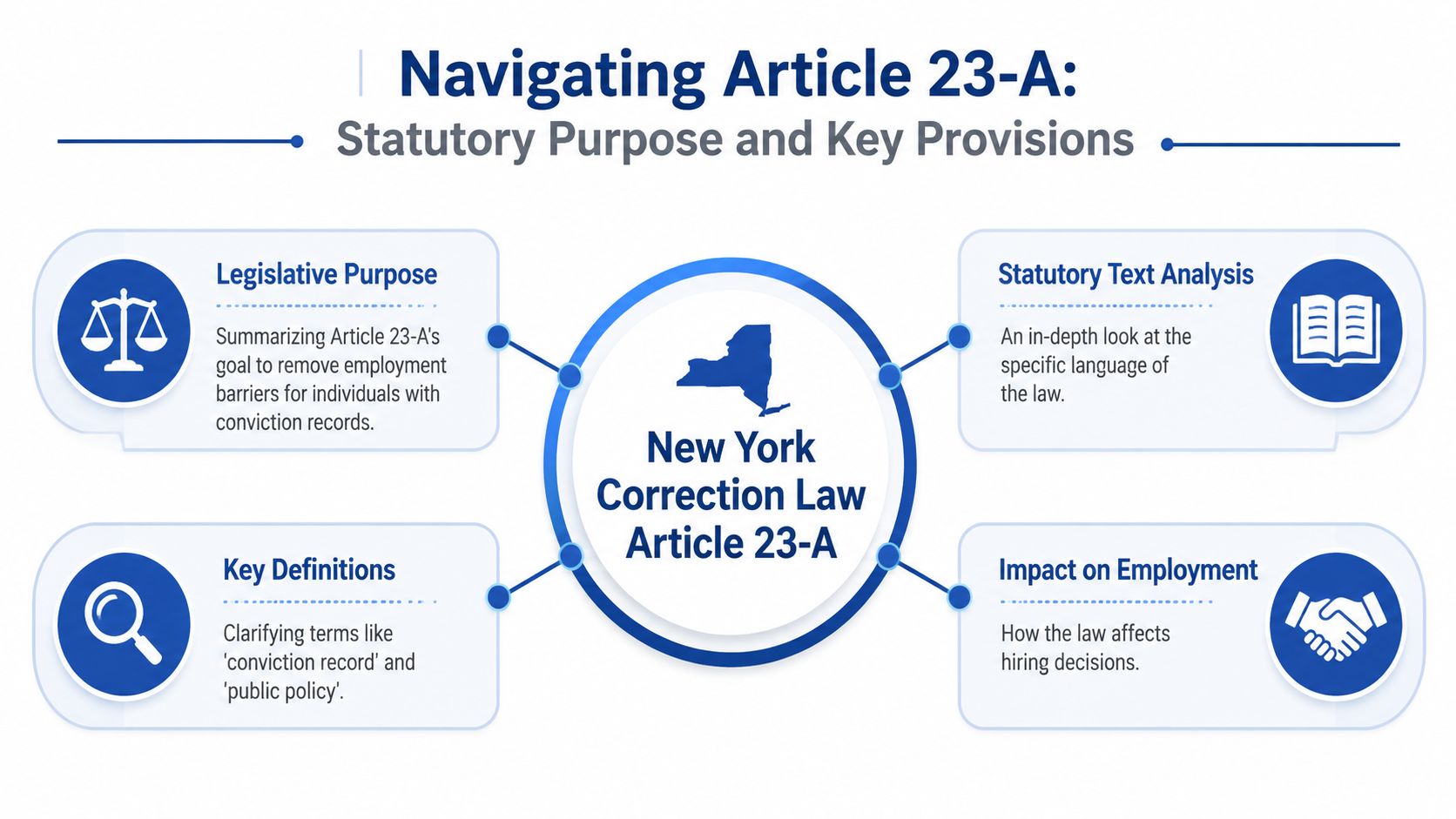
The concept map above makes the structure easier to remember. The statute is not just a list of forbidden questions. It's a framework for deciding when a record matters, how much it matters, and whether the law favors access to work despite the record.
A clean way to think about the text is this: Article 23-A does not erase conviction history; it limits how heavily that history can weigh when the person's actual job duties are the primary concern. That distinction is why disclosure language, policy language, and adverse-action language all need to stay tightly aligned.
A short video explanation can also help teams absorb the structure before they draft policy.
Which Employers and Licenses Article 23-A Covers
A job applicant can move through a hiring form, a licensing form, and a vendor screen in the same week, yet each step may trigger a different Article 23-A question. That is why the statute reaches farther than many HR teams first expect. It applies in private hiring, public hiring, and licensing decisions made by state or municipal authorities, so a single intake process can raise both employment and privacy issues when the person is shifting between a direct job offer and a regulated credential.
The common error is assuming the law only matters when an employer asks about criminal history at the front end. The statute does not work that way. The analysis can matter whenever conviction history is used to screen an applicant or decide whether a license should issue, be renewed, or remain in force. That includes formal licensing bodies and employers whose roles are regulated through permits or occupational approvals.
Coverage in practice
A food service permit, a teaching license, or another regulated credential can each call for a separate Article 23-A review if conviction history is part of the decision. The same record can also create privacy disclosure issues if a form asks for more information than the law requires. Consent language needs to match the purpose of the collection, like a label on a file folder that tells staff what belongs inside and what does not. The business should explain what is being collected, why it is being collected, and who will receive it, without turning the form into a dumping ground for every conceivable data point.
Screening vendors add another layer. A background report may contain more material than the legal decision requires, and poor handling of that report can affect the process before anyone reaches the merits. An initial verification step such as an SSN trace can help confirm identity before the employer reviews a fuller report, which makes it easier to separate matching problems from the later legal analysis. A useful reminder appears in this resource on how an inaccurate background report can hurt you.
A simple way to sort the issue:
- Private employers: treat conviction information as relevant only after a job-related assessment, not as a blanket exclusion.
- Public employers: apply the same core discipline, while also checking any agency-specific procedures.
- Licensing authorities: map the conviction to the actual licensed activity, not to a generalized risk label.
- Regulated permits: verify whether a permit decision functions like a license for Article 23-A purposes.
The question is rarely whether a record exists. The real question is whether the decision-maker can justify using it for this job, this license, and this moment in time.
The usual confusion comes from blending the record itself with the process used to review it. A conviction history may be lawfully considered in one setting and not in another. That is why forms, notices, and policy language should identify the decision context plainly, instead of using one generic disclosure for every applicant and every license.
Individualized Assessment Factors and Legal Standards
Article 23-A pushes decision-makers away from reflexive screening and toward an individualized assessment. That means the reviewer has to look at the person, the offense, the job duties, and the assessed risk, then explain the decision in a way that can be documented later. The point is not generosity. The point is reasoned judgment.
For HR professionals, the hardest part is usually not the legal wording. It's turning a legal standard into a repeatable review. If the same conviction can matter differently depending on the role, the organization needs a consistent way to compare records instead of letting each manager improvise.
The six factors in plain English
The required factors are the seriousness of the offense, the time elapsed, the age at offense, evidence of rehabilitation, the legitimate interest in protecting property or safety, and New York's public policy favoring employment. Those factors are not a scoring game. They are prompts for analysis.
- Seriousness of offense: what happened, and how closely does it connect to the actual duties?
- Time elapsed: how old is the conduct, and has life moved forward since then?
- Age at offense: was the person very young at the time, which may affect maturity and judgment?
- Evidence of rehabilitation: are there concrete signs of change, stability, or responsibility?
- Legitimate interest: does the role involve access to cash, vulnerable people, sensitive systems, or physical safety?
- Public policy: New York still favors employment and reintegration, so exclusion needs a reason, not a reflex.
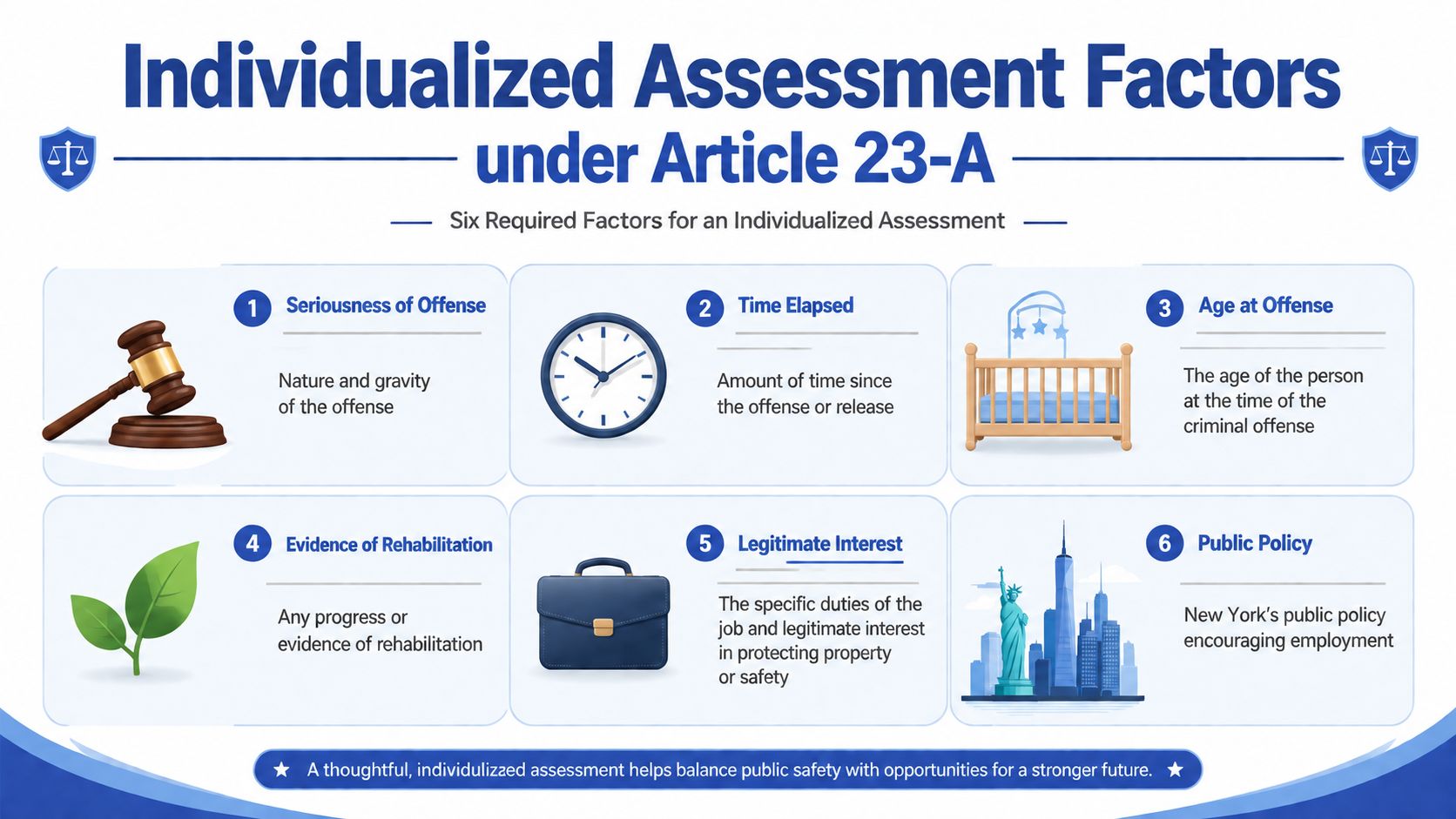
The review should be written down in a way that shows the decision-maker weighed the factors, rather than just checking boxes. That written trail matters because an unsupported exclusion looks arbitrary even if the manager believes it was fair. It also matters because privacy and background-screening disputes often turn on what the applicant was told and what the employer kept.
A good comparison point is federal discrimination thinking, where neutral-looking rules can still create unequal outcomes if they are used without justification. The New York process is more specific than a general fairness standard, but the logic overlaps, use the record only when it relates to the role and can be defended as a real risk assessment.
Documentation tip: the strongest file usually shows the conviction, the job duty at issue, the factor analysis, and the final decision in one place, instead of scattering the reasoning across emails and intake notes.
For organizations that want a broader policy lens, it helps to pair the Article 23-A review with the same careful record discipline used in privacy programs. A useful reference on that point is how retention policy templates support defensible recordkeeping, because if a decision can't be reconstructed later, it becomes much harder to defend.
Compliance Roadmap with Sample Policy Language
A hiring file under Article 23-A works best when the privacy team, the recruiter, and the business owner are all reading from the same page. Start by reviewing the current forms, notices, screening questions, and adverse-action templates. If any of them treat conviction history like a simple yes-or-no screen, they need to be revised before the next hiring cycle.
Training comes next. Recruiters and managers should understand that they cannot ask for more detail than the process allows, and they cannot treat a conviction record as a blanket stop sign. That training should also cover the disclosure side, because a notice that is too vague can create the same problems as a notice that reveals too much.
Sample policy and notice language
An internal policy can say, in plain terms, that conviction history will be reviewed only to the extent relevant to the position or license, and only after the organization has considered the required statutory factors. It should also say that applicants will receive clear notice of what information is being requested, why it is being requested, and how the information will be used. That language becomes easier to manage when teams also maintain a broader online privacy agreement, because the Article 23-A notice should stay specific instead of drifting into general website-style privacy language.
A workable adverse-action template can stay short and direct:
- Decision summary: the organization is not moving forward based on a conviction-related review tied to the job or license.
- Reason stated plainly: the specific duties present a concern that the organization cannot resolve on the current record.
- Review reference: the organization considered the required factors before making the decision.
- Follow-up option: the applicant may request any review or appeal process the organization provides.
The language should never suggest that conviction history automatically disqualifies the applicant. It should also avoid overexplaining sensitive details that the decision-maker does not need to disclose.
For organizations building the process from scratch, a practical policy set can include internal procedures, internal templates, and vendor workflows. It can also include outside counsel review when the team needs help aligning the disclosure, the assessment, and the final letter. As a reference point for recordkeeping structure, retention policy templates that support defensible records can help show why the file needs to be organized before any decision is challenged.
Useful standard: if the notice cannot be read aloud in one breath without confusion, it probably needs simplification.
The last step is periodic review. Hiring channels, screening vendors, and license applications change over time, so the language needs to be checked regularly. Record retention, version control, and workflow ownership matter most at that stage.
Federal EEOC and Title VII Interaction with Article 23-A
New York's Article 23-A and federal Title VII guidance are often trying to solve the same problem from different angles, which is why HR teams get tangled. Both frameworks push decision-makers away from blanket exclusions and toward job-related analysis. Both also worry about facially neutral screening rules that fall hardest on certain groups without a strong business reason.
The key difference is that Article 23-A gives a state-law framework for the decision itself, while Title VII focuses on whether a hiring practice creates unlawful disparate impact. That distinction matters because a policy can look neatly written and still create risk if it produces uneven exclusion without clear justification. HR teams should treat the two systems as overlapping guardrails, not separate silos.
How to harmonize the two frameworks
A harmonized policy should do three things. First, limit conviction inquiries to the point where they are needed. Second, require a documented individualized assessment before any final exclusion. Third, make sure managers do not add informal screens, like blanket “no record” preferences, that the written policy never authorized.
For teams that want a practical lens on selection-rate fairness, understanding the four fifths rule can help explain why screening patterns matter even when the form looks neutral. That idea is useful here because a policy that filters out too many applicants from one group can trigger scrutiny long before anyone argues about the merits of a single candidate.
A compliant training script should say that managers may review only the information they are allowed to use, may not improvise extra exclusion rules, and must send questionable cases back for review. If a background vendor or intake form pushes more data than the decision requires, the organization should narrow it instead of expanding the decision to fit the data.
The safest policy is the one that makes the human reviewer ask, “Does this record actually change this job decision?” before any denial goes out.
A final practical point is disclosure control. Employers should not over-disclose the conviction details to supervisors who do not need them. Title VII analysis and Article 23-A analysis both become cleaner when access is limited to the people who have a real role in the decision.
Enforcement Risks Case Law and Cross State Considerations
Enforcement risk under Article 23-A usually starts with ordinary mistakes, not dramatic misconduct. A manager skips the individualized review, a template letter gives the wrong explanation, or a screening process treats conviction history as an automatic bar. Those errors matter because they show the organization did not apply the statute as a process, only as an afterthought.
The cross-state problem can be just as difficult. New Jersey, California, and Washington State all approach conviction-history screening differently, so a national template can become a liability if the same form is reused everywhere. A policy that works in one state may over-disclose in another, or may miss a local timing rule, notice rule, or assessment requirement.
Practical enforcement lessons
A useful way to manage risk is to separate the policy layers. One layer should describe the company-wide principles, such as job-related review, documented assessment, and narrow access to conviction information. A second layer should handle state-specific add-ons for New York, New Jersey, California, Washington, and any other jurisdiction where the company hires or licenses workers.
A timeline view helps reinforce how these issues evolve.
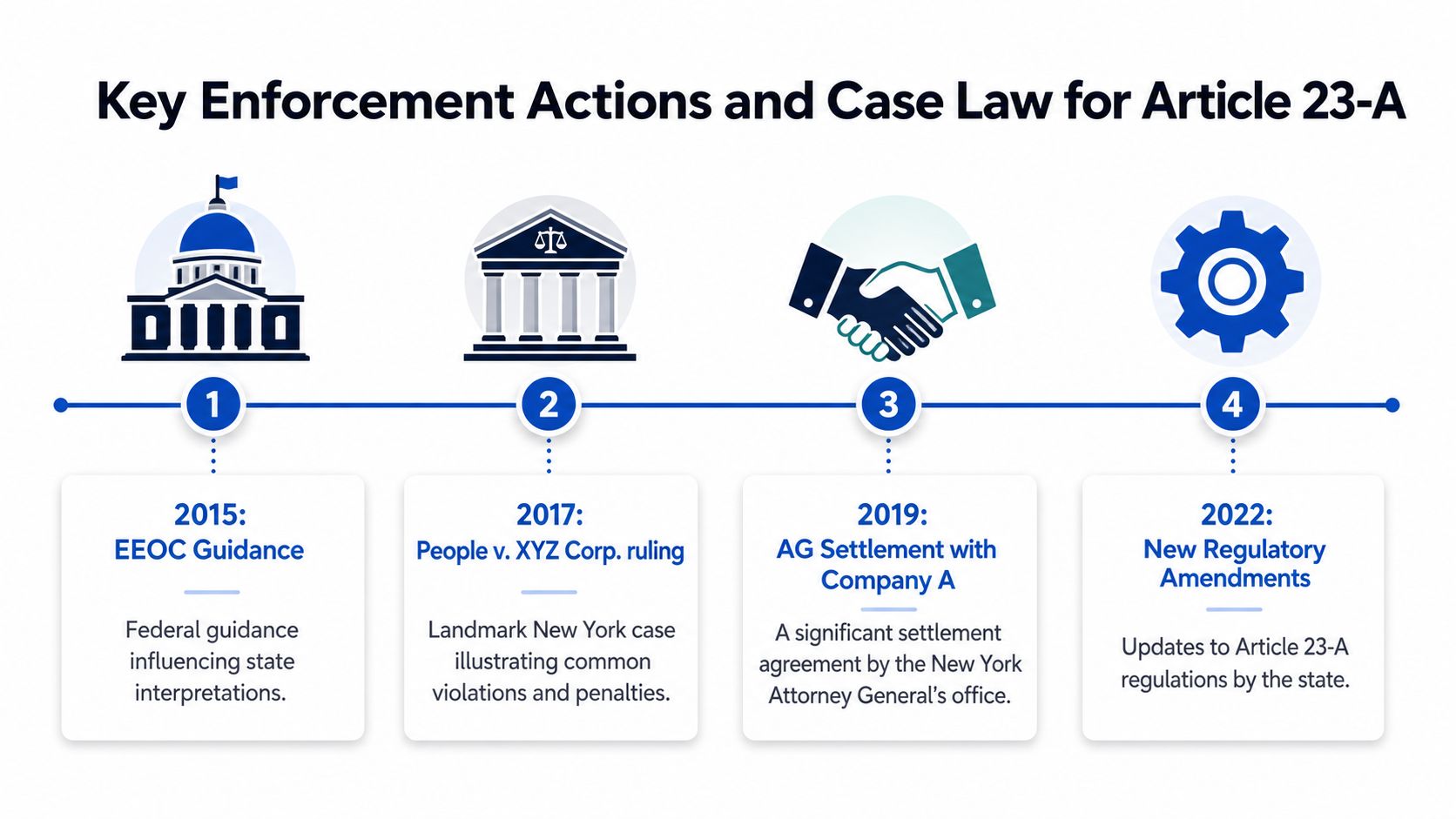
Cross-state compliance usually fails in the gaps between systems. One recruiting platform screens by default, another state form asks a broader question, and the adverse-action letter never gets localized. The fix is less glamorous than a new policy binder. It's a controlled intake process, state-specific templates, and a review step before any denial leaves the company.
Businesses operating in multiple states should also keep a license matrix. That means identifying which roles are licensed, which agency reviews them, which background disclosures are required, and which privacy notices apply. The matrix does not need to be ornate. It just needs to stop teams from reusing the wrong form in the wrong jurisdiction.
For employers, licensing teams, and HR leaders that want a cleaner review process, the next move is to audit current forms, tighten the disclosure language, and make the individualized assessment mandatory before any conviction-based denial. If a team needs help translating Article 23-A into policy language, adverse-action templates, or multi-state hiring procedures, reach out to By Design Law Firm & Legal Consultancy, PLLC and ask for a compliance review specific to your hiring or licensing workflow.