A founder signs a managed services agreement expecting predictable support, stronger security, and fewer operational distractions. The contract looks polished, the monthly fee is attractive, and the provider's sales team describes the relationship as a partnership. Months later, a production outage exposes a different reality: the SLA measures ticket acknowledgment rather than restoration, the liability cap offers little protection against a serious incident, and an offshore security operations center has access to endpoints without clear subcontractor obligations.
That surprise rarely comes from one defective sentence. It comes from a contract that was treated as a purchasing form instead of the operating framework for a continuing dependency. A sound managed services agreement makes responsibilities measurable before the first outage, breach, renewal discussion, or exit dispute. It connects service scope to security controls, remedies, pricing, intellectual property, and transition obligations.
When a Signed Contract Surprises You
Consider a growing software company that has outsourced endpoint management, monitoring, backup administration, and security response. During a ransomware recovery, the company discovers that the provider promised only “commercially reasonable efforts” for incident response. The liability cap is tied to a narrow slice of fees, the SLA requires rapid acknowledgment but says little about restoration, and the security operations center handling the endpoints is a subcontractor with no explicit customer-facing flow-down obligations.
The founder expected the provider to own the problem. The contract allocated fragments of the problem across exclusions, dependencies, service descriptions, and liability provisions. Those fragments may have looked manageable during procurement. Under pressure, they become the difference between a coordinated response and a dispute over who was supposed to act.
Practical rule: A managed services agreement should answer what happens on the worst operational day, not merely describe what the provider does on an ordinary day.
A managed services agreement is an ongoing commercial and operational framework between a customer and a managed service provider. It normally governs recurring services, payment, access, reporting, performance standards, security responsibilities, intellectual property, confidentiality, liability, renewal, and termination. The service-level agreement may sit inside the MSA or operate as a document incorporated into it.
The contract must also reflect the provider's delivery model. A customer comparing providers can use resources such as top managed IT in Atlanta to understand the market, but vendor selection is only the beginning. The signed agreement determines whether the selected provider's promises are specific enough to enforce.
The central drafting question is simple: who must do what, by when, using which evidence, and with what consequence if performance falls short? Every later clause should reinforce that answer.
What a Managed Services Agreement Actually Is
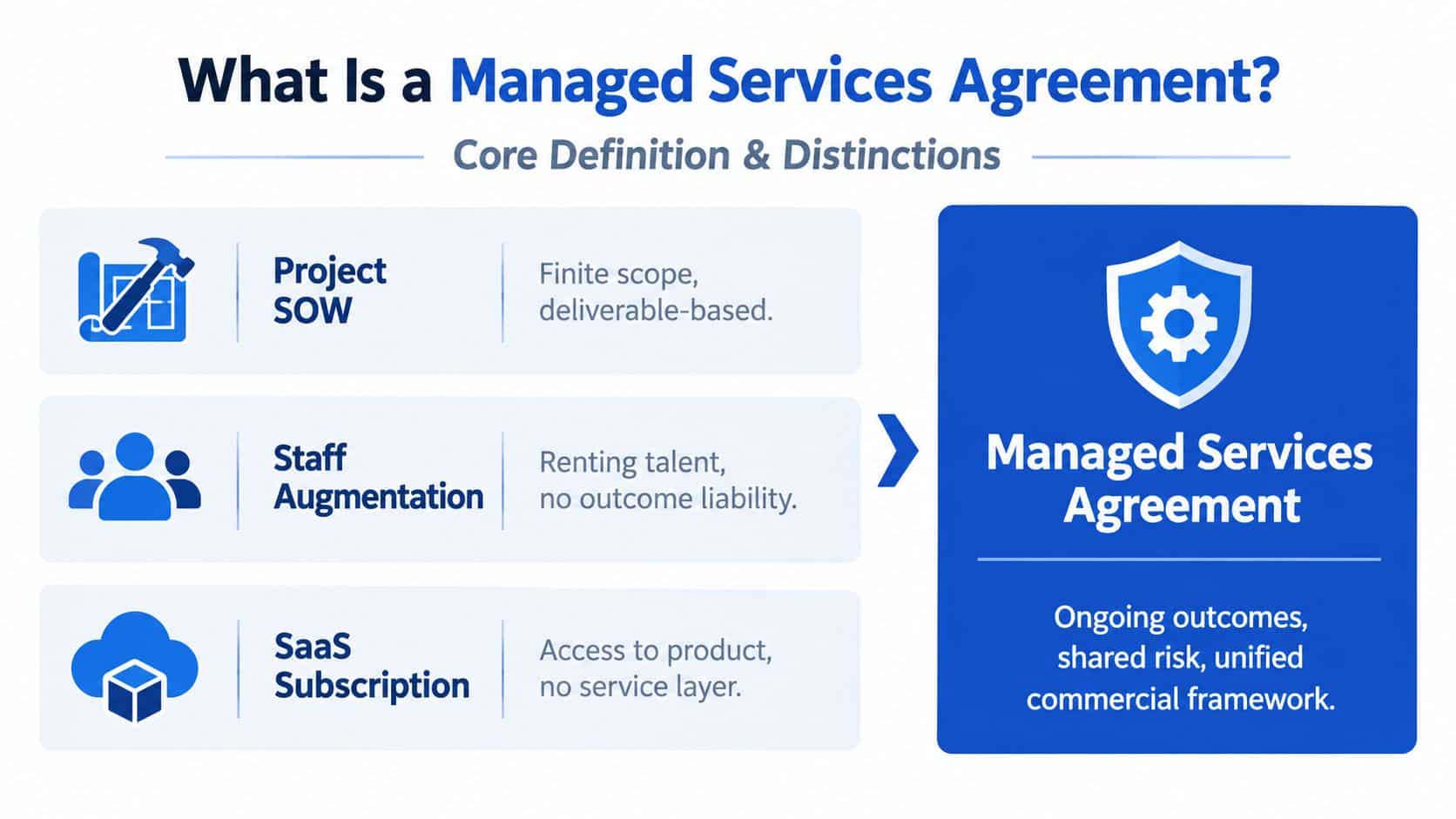
A project statement of work describes a finite assignment, such as a migration, implementation, or assessment. Staff augmentation supplies personnel, usually without transferring responsibility for a defined business outcome. A SaaS subscription provides access to a product and its associated terms, but it may not include hands-on administration, incident response, or operational accountability.
A managed services agreement sits across those categories. It establishes an ongoing service relationship in which the provider assumes continuing responsibility for defined technology or business functions. The agreement may incorporate separate statements of work for projects, but the recurring service obligations should remain clear even when no project is underway.
The operating framework
A foundational 2005 study of 194 organizations involved in IT outsourcing found that 87 respondents, or 48%, benchmarked performance after making the outsourcing decision, while 93 respondents, or 52%, did not. The study concluded that detailed SLAs improved both cost and service outcomes, and that benchmarking during the life of the contract had the strongest relationship with outsourcing success, explaining 10% of the variance in a success measure covering strategic, technical, cost, service, satisfaction, and value outcomes (PACIS study).
That finding matters because an MSA isn't static paperwork. It needs mechanisms for reporting, benchmarking, review, escalation, and renegotiation. The same research reported better results where clients met vendors more frequently to renegotiate service levels.
The risk-allocation document
A useful MSA brings together four layers:
- Service scope: The provider's included services, exclusions, assumptions, dependencies, and change process.
- Performance rules: Availability, response, restoration, reporting, escalation, and remedies.
- Legal allocation: Confidentiality, data protection, intellectual property, indemnity, liability, insurance, and dispute provisions.
- Relationship mechanics: Term, renewal, pricing changes, governance meetings, transition assistance, and data return.
A vendor template often describes the first layer and generalizes the other three. That structure benefits the provider because ambiguity preserves operational discretion. The customer needs the opposite. The agreement should make discretion visible, bounded, and reviewable.
The Core Clauses That Shape Every MSA
An MSA works as a system. A detailed SLA cannot repair a scope clause that excludes the systems the provider manages. A strong security schedule cannot solve a liability clause that makes the security commitment commercially meaningless. The clauses below should be negotiated together, not reviewed as isolated boilerplate.
| Clause | What It Governs | Common Negotiation Gap |
|---|---|---|
| Scope of services | Included systems, users, tasks, assumptions, exclusions, and change control | The provider can exclude legacy systems, onboarding work, or security response without a clear service boundary |
| SLA | Availability, response, restoration, reporting, escalation, and remedies | The SLA measures ticket handling but not service restoration or business impact |
| Pricing and invoicing | Recurring fees, variable charges, expenses, taxes, increases, and disputed invoices | Extra work, onboarding, after-hours support, and user changes are priced ambiguously |
| Term and termination | Initial term, renewal, convenience rights, breach cure, and exit process | The customer can terminate on paper but lacks practical transition rights |
| Liability and indemnification | Loss allocation, caps, exclusions, defense obligations, and third-party claims | A low general cap applies to data incidents, confidentiality breaches, and gross misconduct |
| Intellectual property | Pre-existing materials, deliverables, tools, licenses, and customer content | The provider claims ownership of configurations or deliverables the customer needs to operate |
| Confidentiality | Permitted use, disclosure restrictions, compelled disclosure, personnel, and survival | Confidentiality language omits subcontractors or lacks a workable compelled-disclosure process |
| Data protection | Access, processing, security controls, return, deletion, audit, and incident cooperation | The MSA refers to a privacy policy without assigning operational responsibility |
Scope must prevent silent expansion
The service description should identify the systems, environments, accounts, support channels, coverage hours, maintenance duties, backup responsibilities, monitoring functions, and security activities included in the recurring fee. It should also state what isn't included, such as unsupported platforms, project work, unapproved applications, customer-side failures, or services requiring a separate statement of work.
The provider may need customer dependencies. Those should be specific. “Customer must maintain a secure environment” is too broad to allocate responsibility. The agreement should identify the customer action, its timing, and the consequence of nonperformance.
Liability should follow loss exposure
The annual contract value is an easy reference point for a liability cap, but it isn't necessarily a sensible measure of the harm the provider can cause. The negotiation should distinguish ordinary service failures from data breaches, confidentiality violations, intellectual-property infringement, fraud, gross negligence, willful misconduct, and obligations that cannot reasonably be capped.
Vendors often resist uncapped exposure. A practical compromise may use a general cap, a higher security or confidentiality cap, and carefully defined exclusions from the cap. The customer should also examine the consequential-damages waiver. If it excludes breach-related remediation, investigation, notification, restoration, or regulatory response costs, the customer may lose the very losses the security provisions were intended to address.
For another practical review of red flags in managed IT contracts, the customer should compare the vendor's template against the operational model rather than accepting the document's labels at face value.
Intellectual property needs separate buckets
The agreement should distinguish the provider's pre-existing tools, reusable know-how, third-party materials, customer data, customer-owned configurations, and deliverables created specifically for the customer. A customer may not need ownership of the provider's platform, but it may need a durable license to configurations, reports, scripts, documentation, and other materials required to operate or transition the environment.
Turning SLAs Into Measurable Performance
An SLA should replace marketing language with observable obligations. “Prompt support,” “high availability,” and “commercially reasonable response” don't tell a customer when the provider must act or what happens if the service remains unavailable.
Availability requires a reproducible calculation. The standard formula is:
Monthly uptime percentage equals total minutes in the measurement period minus qualifying downtime, divided by total minutes in that period.
The agreement must define qualifying downtime, the monitoring source, the measurement window, scheduled maintenance, exclusions, and the party responsible for maintaining evidence. A provider shouldn't be able to argue that downtime began only when a customer opened a ticket if the provider's monitoring system had already detected the degradation.
Use severity tiers
A useful SLA separates the initial acknowledgment from investigation, workaround, restoration, and final resolution. A single blanket promise such as “24-hour response” can leave a production outage and a minor service request competing under the same language.
| Severity | Definition | Response Target | Resolution Target | Service Credit |
|---|---|---|---|---|
| P1 | Full outage affecting a production-critical system | Defined urgent acknowledgment and escalation | Defined restoration or workaround target | Credit tied to the affected service and breach threshold |
| P2 | Degraded core function with material operational impact | Defined priority response | Defined restoration or workaround target | Credit tied to the affected service |
| P3 | Non-urgent defect with a business process still available | Defined standard response | Defined correction or planned-update target | Credit where the agreed threshold is missed |
| P4 | Routine request or low-impact issue | Defined service-desk response | Defined fulfillment target | Credit only if the schedule provides one |
Service credits are useful because they create a straightforward financial consequence. They are rarely a complete remedy for a serious outage, breach, or repeated failure. The MSA should state whether credits are exclusive or coexist with termination rights, damages, indemnities, or other contractual remedies. A customer should preserve termination for chronic SLA breach rather than accepting credits as a substitute for an exit right.
The SLA should require periodic performance reports, incident summaries, root-cause analysis where appropriate, and access to the underlying measurement records. A service level agreement template can help organize the discussion, but the final schedule must reflect the customer’s systems, coverage needs, dependencies, and risk tolerance.
Cybersecurity and Data Protection as Contract Specs
Cybersecurity shouldn’t appear only as a promise to use “reasonable security.” For infrastructure, software administration, customer data, or privileged access, security controls should become enforceable contract specifications.
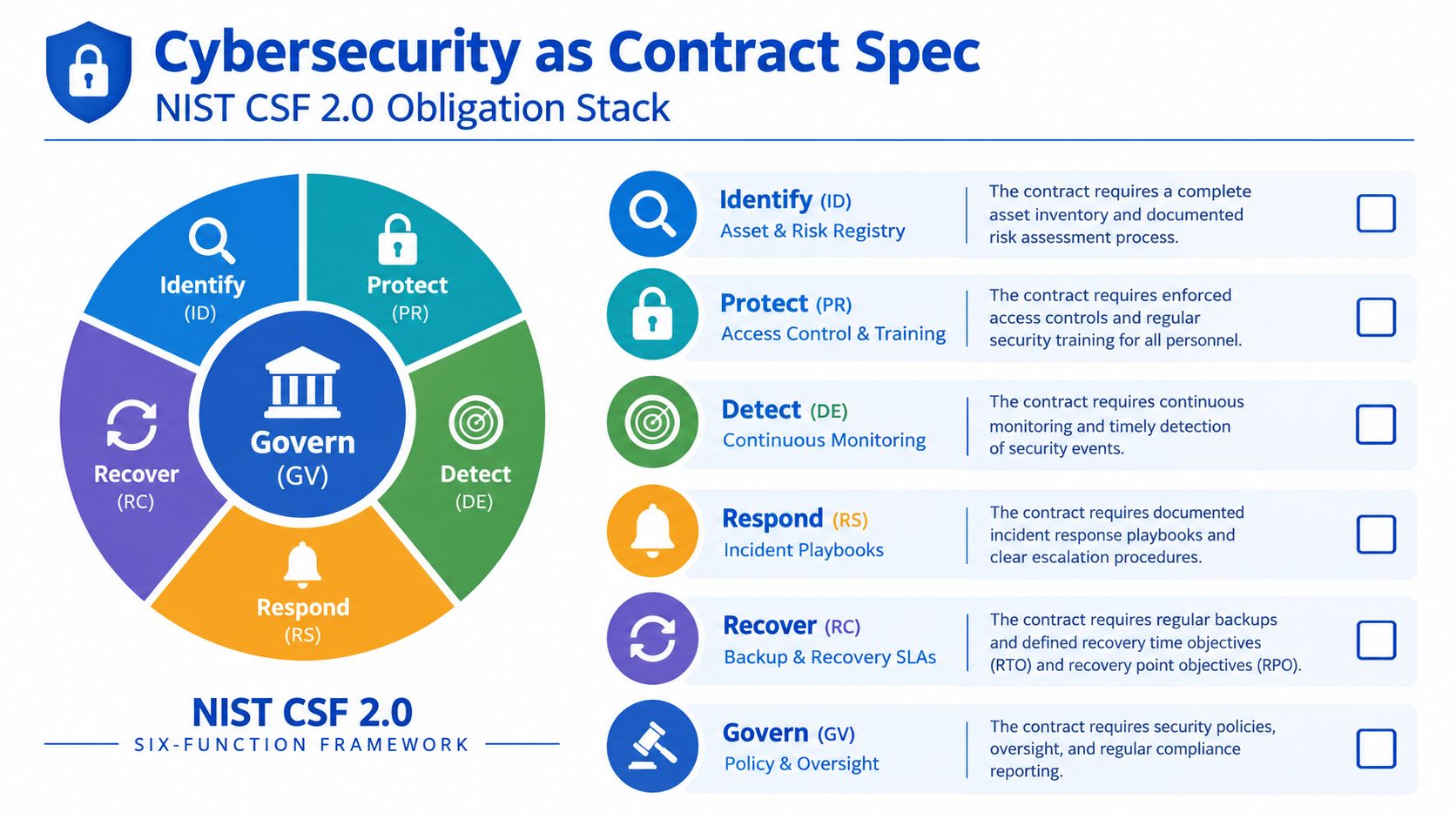
The obligation stack can follow the six functions of the NIST Cybersecurity Framework, Govern, Identify, Protect, Detect, Respond, and Recover, while the agreement assigns each control to the provider, the customer, or both. NIST guidance supports minimum security-program requirements, incident and breach notification procedures, encryption, data-disposal commitments, and annual contract reviews to identify missing requirements (NIST security requirements).
Assign access and evidence duties
The security schedule should identify authorized systems, administrative accounts, authentication requirements, MFA expectations, logging, monitoring, retention, and audit rights. Least privilege should limit provider access to the systems and duration necessary for the work. Logs should show who accessed an account, for how long, and what actions were taken.
The contract should also address:
- Incident response: Identify the provider’s monitoring, triage, containment, investigation, evidence-preservation, and outage-support duties.
- Notification: Set a contractual deadline, required content, escalation contacts, and update cadence.
- Remediation: Define acceptance criteria for patches, configuration changes, restoration, and corrective actions.
- Backups: Specify secure storage, access restrictions, testing, restoration support, and responsibility for recovery decisions.
- Data segregation: Require controls preventing one customer’s data or credentials from being exposed to another customer.
- Subcontractors: Require disclosure, approval where appropriate, security due diligence, flow-down obligations, and continuing provider accountability.
- Exit: Set data-return formats, deletion procedures, retention limits, and evidence of deletion.
The CISA guidance for MSP customers supports defining incident-response responsibilities, remediation acceptance criteria, secure backup storage, access logs, data segregation, and least-privilege controls in the customer relationship (CISA MSP guidance).
A shared-responsibility model doesn’t mean shared ambiguity. The MSA should name the party responsible for identity management, patching, vulnerability handling, backups, incident notification, regulatory cooperation, evidence preservation, and secure deletion. The customer should also understand whether the provider acts as a service provider, processor, subcontractor, or another legally relevant role, because those roles can change the applicable obligations.
A data processing agreement may supplement the MSA, but it shouldn’t be used to hide operational gaps. The documents should cross-reference one another and identify which terms control if they conflict.
Governing AI Tools and Automation Inside the MSA
Many MSA templates still describe human-delivered services while providers increasingly use automated monitoring, remediation, support, and analysis. The question isn’t whether a provider may use automation in the abstract. The question is what the provider may do with customer data, credentials, code, and production systems when an automated tool makes or recommends an action.
A 2026 MSP report identifies AI and automation as the top client IT or service need for 48% of MSPs, ahead of security at 42% and backup at 36% (Kaseya 2026 MSP report). Separately, current MSP research reports that 84% of providers manage clients’ cybersecurity infrastructure or their combined IT and cybersecurity estate (CyberSmart MSP survey). Those facts make AI governance part of the service-risk analysis, not a side letter for a future technology project.
Define permitted use
The MSA should require affirmative disclosure of AI tools, agents, models, hosting providers, and subprocessors that touch customer data, customer content, source code, credentials, tickets, or production systems. The provider should identify whether data is retained, used for training, transferred to another service, or combined with information from other customers.
The customer should reserve approval rights for high-risk uses, including:
- Autonomous remediation that changes production configurations.
- Customer-facing chatbot decisions that affect access, support, or service outcomes.
- Code generation or code changes placed into production.
- Automated security actions that disable accounts, isolate systems, or delete data.
- Model processing involving regulated, confidential, or highly sensitive information.
The agreement should require logs of prompts, outputs, model versions, tool calls, agent actions, approvals, overrides, and resulting system changes where technically available. It should also require notice before a material change to an automated tool, model, hosting location, or data-use practice.
The contract should give the customer a disable, sandbox, and human-review right before an automated action becomes an operational fact.
Responsibility should cover hallucinated outputs, unauthorized changes, prompt injection, model or vendor outages, and failure to follow approval thresholds. The customer shouldn’t assume that a low service fee limits the sensitivity of the risk. The provider’s access to credentials, personal data, source code, or regulated information may justify stronger controls than the recurring price alone would suggest.
Sample Language and Negotiation Tactics
The strongest negotiation starts with a cross-reference matrix. It maps each important obligation in the scope exhibit, SLA, security schedule, data-processing terms, and liability section. The matrix should show the responsible party, evidence of performance, remedy, and controlling document.
Fix the vendor-template defaults
A vendor’s transition clause may say that the provider will offer reasonable assistance at reasonable rates. That language leaves the customer negotiating during the moment of greatest dependency. A stronger position requires a defined transition plan, named deliverables, knowledge-transfer sessions, data exports in agreed formats, credential handoff, documentation, and support for a successor provider.
A workable concept might read:
Transition assistance: At the customer’s request following expiration or termination, the provider will perform the transition services identified in the exit plan, including documentation delivery, knowledge transfer, data export, credential transfer, and reasonable cooperation with a successor provider. The parties will identify rates, response obligations, and deliverables before the transition begins.
The ScopeStack model illustrates commonly negotiated mechanics involving termination for convenience on stated notice, termination for material breach after a cure period, payment of earned fees, and provider assistance with an orderly transition for a reasonable fee (ScopeStack MSA model). Those mechanics are drafting examples, not universal rules. The customer should convert them into operational commitments.
Build a liability architecture
A general liability cap can apply to ordinary service disputes. Security incidents, confidentiality breaches, intellectual-property violations, gross negligence, and willful misconduct may need separate treatment. The parties can negotiate a higher security cap, a super-cap for defined categories, or exclusions from the general cap.
The customer should ask whether the consequential-damages waiver excludes investigation, restoration, notification, remediation, or replacement-provider costs. If so, the liability structure may erase the practical value of the provider’s security obligations.
Indemnities also need careful review. An indemnity drafted as an exclusive remedy may preempt other contractual or statutory rights. The agreement should state whether indemnity procedures supplement or replace other remedies, and it should preserve obligations that cannot legally be waived.
Tie cure rights to severity
A uniform cure period treats a missed report like a sustained production outage. Better drafting ties cure mechanics to the seriousness and recurrence of the breach. A critical security failure may require immediate escalation and a corrective-action plan, while a noncritical reporting defect may receive a longer cure period.
Acceptance testing deserves the same discipline. Project deliverables should be accepted against objective criteria tied to functional performance and user acceptance, not merely payment milestones. The MSA should state what happens when a deliverable fails, including correction, retesting, delayed acceptance, or termination of the affected statement of work.
Before the next negotiation, the customer should carry this checklist:
- Scope: Are included systems, exclusions, assumptions, and change orders explicit?
- Performance: Does the SLA measure restoration as well as acknowledgment?
- Security: Are access, logging, incident, backup, and subcontractor duties assigned?
- AI: Are tools disclosed, data use restricted, and high-risk actions subject to approval?
- Liability: Do caps and exclusions match the plausible loss scenarios?
- Exit: Are data formats, documentation, successor support, and fees defined?
A practical guide to how to negotiate a contract can help organize those issues before the customer enters a provider-led paper process.
Planning Renewal, Exit, and Long-Term Position
A managed services relationship becomes harder to change as the provider accumulates documentation, credentials, system knowledge, historical data, and operational control. Renewal language determines whether the customer deliberately revisits the bargain or lets an evergreen arrangement continue by default.
An opt-in renewal requires both parties to affirm continuation. An auto-renewal continues unless a party gives notice. Either structure can work, but the customer should track notice dates, price-adjustment rights, SLA performance, unresolved incidents, and service changes before the renewal window opens.
Exit assistance belongs in the agreement from signing. Specify knowledge transfer, system documentation, data-return formats, deletion evidence, credential transfer, successor-provider cooperation, and support during a defined transition period. Where appropriate, address source-code escrow, configuration ownership, retained documentation rights, and parallel-run rights. These provisions determine whether termination is a controlled project or an operational emergency.
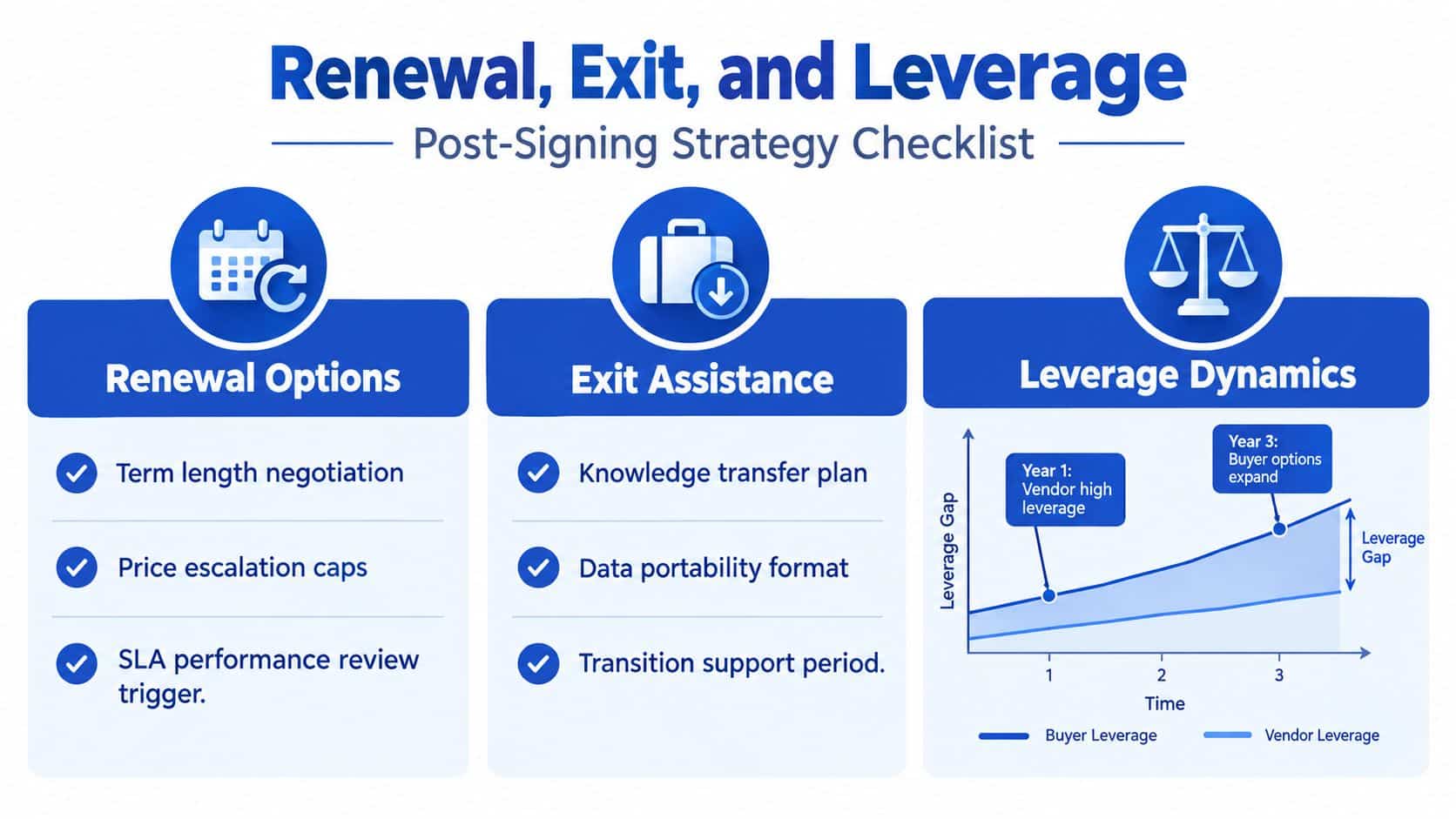
Require periodic review of security-as-a-service scope, subcontractors, AI tools, pricing, and service performance. The review should confirm that security duties still match the systems in use, AI and automation remain disclosed and governed, and high-risk actions remain subject to approval. Guidance on contract management best practices can support that post-signature process.
Before each renewal trigger, complete an exit-readiness review, confirm data portability, test documentation, reassess liability exposure, and compare actual performance with the negotiated SLA. The goal isn’t to terminate every provider relationship. It is to preserve the ability to do so without operational panic.
By Design Law Firm & Legal Consultancy, PLLC helps startups and growing companies draft, review, and negotiate managed services agreements covering scope, SLAs, cybersecurity, data protection, liability, intellectual property, and exit rights. Visit By Design Law Firm & Legal Consultancy, PLLC to discuss an MSA that matches the technology risk and operational dependency your business is taking on. Contact our law office at (206) 593-1519.