A founder usually reaches for an investment agreement template at the exact moment speed feels urgent. The investor wants a draft, the bank account is tight, and the temptation is to grab a polished form, swap in the company name, and move on. That shortcut can work for a narrow slice of simple rounds, but it can also leave ownership, control, and exit rights far less clear than everyone thinks.
The hard part is that an investment agreement is not a ceremonial document. It translates a check into equity, governance, and downside protection, and the wording controls what happens when the company raises again, sells, or stumbles. A founder who treats the template as a fill-in often discovers that the missing details were the most important details all along.
A better starting point is a template that behaves like a deal map. The best versions force the parties to settle the economics, the security type, and the control terms before signatures go on paper, which is why a practical resource like the Homebase subscription agreement guide can be useful when founders are comparing how transactional documents organize consent, timing, and payment mechanics. For founders tempted to let software or chat-based drafting substitute for counsel, the warning in By Design Law’s guide on bypassing attorneys is worth taking seriously, because the legal risk usually hides in the details, not the formatting.
Why Your Investment Agreement Template Needs More Than a Fill-In
A founder can feel pretty safe with a polished template right up until the investor starts asking what happens if the company sells early, issues new shares, or misses a milestone. At that point, vague language stops being a convenience and starts creating cost. The core issue is not that the form is short, it is that the most important rights often stay implied when they need to be spelled out.
A useful starting point is that these deals usually turn on a small set of repeatable terms, investment amount, valuation, ownership percentage, liquidation preference, dividend rights, governance, and exit conditions. SEC-filed agreements have even memorialized concrete economics such as a $6,000,000 purchase price for 600,000 shares in one transaction, and another agreement gave the investor 80% of quarterly net profits and 0.75% of net proceeds on sale in a 2015 deal, which shows how a template turns a financing milestone into enforceable rights (investment agreement template overview and examples).
What goes wrong when the form is generic
Ambiguity is the main risk. If liquidation preference, transfer restrictions, or valuation mechanics are thinly drafted, founders can end up arguing later over what everyone “meant” when the money came in. That becomes even more dangerous in a follow-on round, where a missing or unclear term can spill into dilution and control disputes.
Practical rule: if a term changes who gets paid first, who votes, or who can exit, it belongs in the agreement in plain language.
A good template also needs structure. The agreement should not just name the investor and company, then drift into boilerplate. It should make the economics and rights visible on the first read, because that is the only way to spot whether the draft matches the deal.
For founders who want a better baseline, the Homebase subscription agreement guide is useful for comparing how transactional documents organize consent, timing, and payment mechanics. For founders tempted to let software or chat-based drafting substitute for counsel, the warning in By Design Law’s guide on bypassing attorneys deserves attention, because the legal risk usually hides in the details, not the formatting.
Why customization matters before signature
A template is not neutral. Every default clause points toward some outcome, even if the draft reads politely. If the company does not tailor the form, the form tailors the deal.
The safer approach is to treat the template as a starting architecture, then pressure-test each clause against the actual financing, the cap table, and the exit path. That is also why the kind of modular clause guidance found in templated investment contract guidance can help founders organize the work around definitions, closing, representations and warranties, investor rights, use of funds, confidentiality, termination, and governing law. Those clauses work only when they fit the business reality behind them.
Core Clauses Every Startup Investment Agreement Must Contain
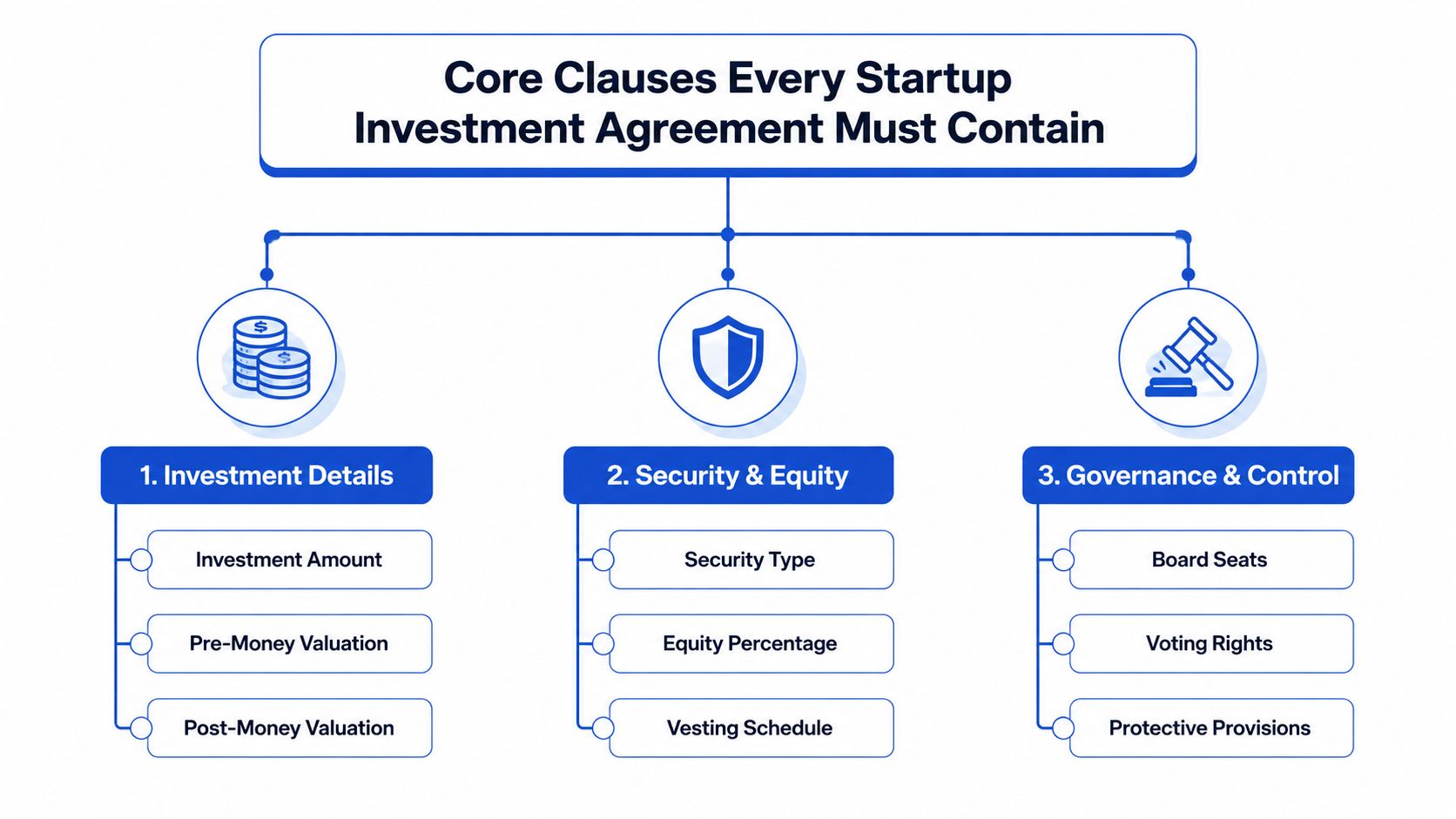
A startup investment agreement only works if the core clauses match the actual deal. If the draft leaves out how much is being invested, what security is being issued, or what rights travel with that purchase, the document can look finished while still failing at the point that matters. Founders should read each provision first as a business term, then as a legal term.
Investment details and security type
The agreement should state the investment amount, the payment terms, the valuation, the use of funds, the closing date, and the form of investment. It also has to identify the equity or instrument type, such as common stock, preferred stock, a SAFE, or a convertible note, because those labels control voting, dilution, and the rights that attach to the financing.
A vague convertibility clause creates real cleanup work later. If the document does not say whether the investor is buying equity now or receiving a later conversion right, the company can end up with a cap table that does not match the financing it thought it closed. The same problem shows up with valuation caps, discounts, and price-per-share mechanics, which should be written out plainly instead of left to inference.
Ownership and control rights
The agreement also needs to spell out the ownership percentage, liquidation preference, dividend rights, and governance terms that come with the investment. Those clauses determine what the investor gets if the company sells, distributes cash, or changes control. Thin drafting here creates conflict later, especially when the next round forces everyone to compare the paper to the original business deal.
The safest drafting habit is to cross-check every voting, information, and exit right against the main agreement and every schedule, because inconsistent rights language is usually where disputes start.
The investor-rights package in early-stage deals often extends into board representation, anti-dilution protection, pro-rata rights, voting rights, transfer restrictions, and exit mechanics. Founders should negotiate those terms against the company’s actual position, not against whatever language happens to be in a generic form. For clause-level detail on factual statements that support those rights, By Design Law’s guide to representations and warranties is a stronger reference point than a broad template summary.
Dispute resolution and enforceability
Dispute language is easy to skip until the relationship breaks down. Arbitration clauses, forum clauses, and governing law provisions can change balance once a dispute starts, especially if the investor wants a faster, private forum and the company needs more room to fight. For founders who want a practical read on that tradeoff, Kons Law on arbitration clauses is useful.
The agreement also has to hold together internally. The representations and warranties should match the rest of the package, because strong rights language paired with weak factual promises gives everyone false comfort. When those sections line up, the deal is easier to defend, easier to close, and less likely to blow up in diligence or in the next financing.
Customizing Your Template From Term Sheet to Signed Agreement
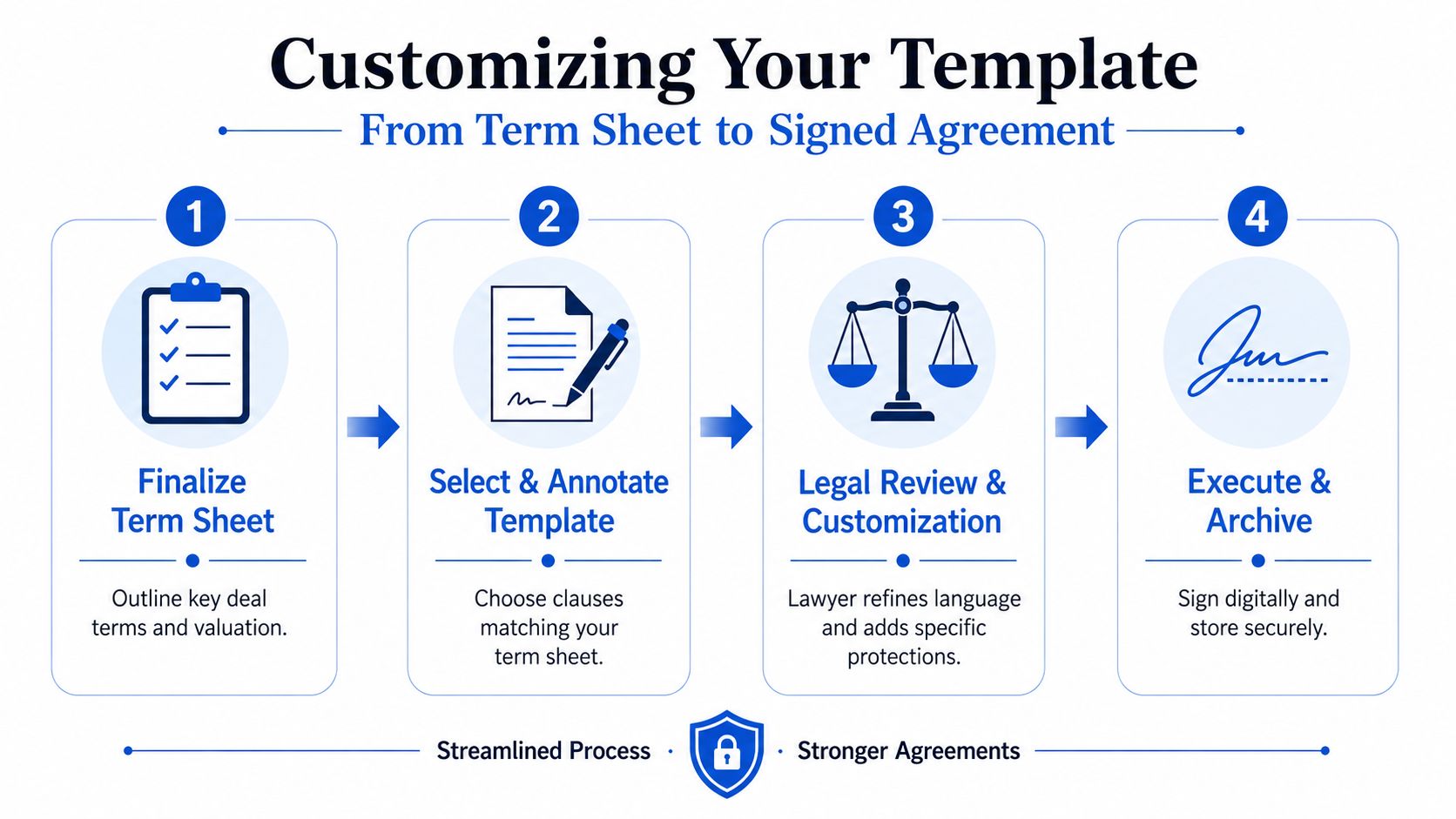
The cleanest way to customize a template is to work in sequence, not by random editing. The party names and governing entity come first, because everything else depends on who is signing. From there, the economics, the security class, and the rights package have to be locked before the schedules go on top.
Start with the term sheet and the cap table
The term sheet sets the business deal, but the cap table confirms whether the company can deliver it. That matters because the share price is derived from the pre-money valuation divided by fully diluted shares, so valuation and capitalization must be finalized before execution to avoid dilution mistakes. If the cap table is stale, the agreement can end up promising a percentage the company can’t support.
This is the point where founders should verify the current ownership picture, any outstanding options, and whether the proposed instrument changes the economics in a way the team understands. A template that doesn’t match the cap table will create friction in the closing package and usually more friction later.
Annotate only the clauses the deal actually needs
A solid drafting workflow is to leave the template structure intact but mark the deal-specific terms with precision. That means editing the valuation, investor rights, transfer restrictions, and closing deliverables so they reflect the term sheet, not a generic financing. The NVCA model forms are a useful benchmark here because they show how venture documents fit together as a package rather than as isolated clauses.
Before signature, the company should also confirm IP ownership, litigation exposure, and regulatory compliance. Missing that check can create avoidable risk if the company is funding software, data, or brand assets that are not fully assigned to the entity yet.
Closing rule: no money should move until the agreement, board approvals, and signature formalities line up with the closing deliverables.
Archive the executed package correctly
The final step is not glamorous, but it matters. Every signed version, approval, schedule, and exhibit should be stored together so the next financing round can be built on a clean record. If the paperwork is scattered, the company spends time reconstructing what should have been obvious at closing.
That’s also where founders should make sure the transfer mechanics are clear, the use-of-funds language is not vague, and the investor-rights provisions match across all related documents. The template should close the loop, not create a new ambiguity.
Negotiation Strategies That Protect Founder Interests
The best founder negotiations are calm, specific, and anchored in the actual tradeoffs. Investors do not expect every term to be perfect for the company, but they do expect founders to understand which provisions are structural and which are cosmetic. The founder who can explain that difference usually negotiates better terms without making the relationship adversarial.
Protect the terms that shape control
Board composition, voting control, and transfer restrictions deserve the most attention because they affect who steers the company after the wire clears. A founder can usually concede on smaller process items, but giving away unnecessary governance control is a long-term cost. If an investor is asking for broad veto rights, that should be tested against the size and stage of the round, not accepted by default.
Liquidation preference deserves the same discipline. The question is not whether investors deserve downside protection, because they do, but whether the waterfall is so investor-heavy that the founders’ upside becomes too thin to matter. Negotiation should focus on proportionality and clarity, not on pretending downside protection is inappropriate.
Use precision to avoid future friction
A good counterproposal is usually cleaner, not louder. If a transfer restriction is too broad, narrow it to what protects the company. If the rights package is inconsistent, ask for cross-references and defined terms so the investor can see exactly how the economics work.
The following checklist highlights the key points:
- Board Seats: keep the board balanced enough that operational decisions still move.
- Voting Rights: make sure founder control is not diluted through side language.
- Protective Provisions: limit vetoes to material events that need consent.
- Exit Mechanics: define what happens in a sale, redemption, or dissolution scenario.
A founder can also preserve bargaining power by conceding on minor drafting preferences when the investor is flexible on the points that affect long-term equity value. That trade works best when the legal draft reflects the same priorities as the term sheet. If the term sheet says one thing and the draft says another, the company should pause and clean it up before it becomes a closing problem.
Washington State Legal Requirements Every Founder Should Know
Washington founders do not get to rely on a generic national template and hope it happens to fit local law. The agreement still needs the usual deal terms, but it also has to sit comfortably inside Washington corporate practice, board authority, and entity governance. That means the company should confirm the document is consistent with its formation records, bylaws, and state-law approval requirements before anyone signs.
Align the agreement with corporate approvals
In Washington, the investment agreement has to match the company’s internal authorization trail. Board resolutions and, where needed, shareholder consents should be in place before closing, because the contract should reflect what the company is legally authorized to do. If the agreement says the company is issuing securities or granting rights without the needed approvals, the enforceability question starts getting messy fast.
The same is true of representations and warranties. Washington companies should be careful that factual statements about capitalization, authority, IP ownership, and compliance are accurate before they commit them to paper. A generic template won’t check those facts for them.
Make the dispute and filing posture intentional
The agreement should also identify the governing law and the dispute forum with care. For Washington companies, that choice should not be an afterthought buried in boilerplate. It affects where disputes are heard, how procedure unfolds, and what law interprets the rights package.
Founders operating across jurisdictions sometimes ask whether a local legal and accounting structure changes how they should think about the financing package. A useful operational parallel is Escrow Consulting Group’s resource on startup accounting help in Dubai, which shows how quickly document and compliance questions become jurisdiction-specific once a company grows beyond one legal environment.
Washington startups do best when the investment agreement, governance records, and closing approvals all tell the same story.
The practical move is simple. Use the template to document the deal, then verify that every provision fits the company’s actual Washington corporate posture before funds move. For a closer look at angel financing dynamics in the state, By Design Law’s angel investors page is a useful reference point.
Common Pitfalls That Cost Startups Equity and Control
The most expensive template mistakes are usually the ordinary ones, which is why they keep showing up in founder-side deals. A founder sees a clean draft, assumes the missing detail is routine, and only later learns that the omission gave the other side more room to argue, delay, or control outcomes. These errors are avoidable, but only if the draft is treated like a real deal document, not a formality to skim and sign.
Vague fund-use and transfer language
The first red flag is undefined use-of-funds language. If the document says the money will be used for “general corporate purposes” without any tighter guardrails, the company may lose the operational clarity it expected, and investors may later dispute whether spending matched the deal. The second red flag is transfer mechanics that do not say who can move what, when, and under what conditions.
A vague use-of-funds clause can also create a later argument about whether a founder used capital for growth, payroll, debt, or something else entirely. I have seen that kind of language turn into a fight after the money was already spent, which is the worst time to discover the draft was too loose. A startup dispute can start with nothing more than a sentence that sounded harmless at signing and then became the basis for a control argument later.
Missing exit and dissolution mechanics
A lot of off-the-shelf forms cover the investment and then go quiet on what happens if the company dissolves or enters bankruptcy. That omission matters because a founder needs to know how cash, claims, and ownership rights are treated if the company hits distress. The same is true for exit mechanics, because a sale or wind-down should not force the parties to improvise a settlement when bargaining power is already weak.
The most defensible agreements consistently include names, addresses, purpose, funding amount, transfer date, ROI terms, dispute resolution, dissolution or bankruptcy treatment, and choice of law. That list matters because it closes the gaps that often become points of contention later.
Why incomplete rights drafting hurts later rounds
A hidden risk shows up when voting, information, and exit rights are not cross-referenced across the agreement and schedules. A later financing round can expose those gaps and trigger conflict over control or transferability. That kind of problem may not show up on the day the wire lands, but it can slow the next raise or force a rewrite at the wrong time.
The fix is a real closing checklist, not a quick proofread. The company should confirm the signatures, formal approvals, rights package, and dissolution language before closing, then archive the final version with the board package. A detailed contract checklist from a legal drafting platform is useful here because it forces the founder to verify the pieces that rushed templates often leave scattered or incomplete.
When to Handle It Yourself and When to Hire an Attorney
A simple early-stage round can sometimes be handled with a carefully customized template, especially when the terms are straightforward, the investor relationship is clean, and the company already understands its cap table. In that narrow lane, a disciplined founder can use a template to organize the deal and keep transaction friction low. The key is that the agreement still has to be customized, reviewed against the actual economics, and matched to the company’s approvals.
When a template is usually enough
A template can be reasonable when the financing is small in scope, the security type is standard, and no one is asking for unusual governance rights. It also works better when the company has clear ownership records, no messy IP assignment issues, and no regulatory wrinkles. In that environment, the template is a drafting aid, not a substitute for legal thinking.
When counsel should be involved
The need for counsel rises fast when the cap table is complex, when there are multiple investor classes, or when the deal uses convertible instruments with nuanced terms. Legal help is also the right call when the financing touches intellectual property assignments, employee equity, side letters, board seats, or compliance-sensitive business lines. Those are not the places to improvise.
If the deal changes control, creates conversion mechanics, or affects future fundraising, counsel should review it before anyone signs.
That advice is especially important because many template-focused resources stop at clause lists and don’t explain how structure changes the legal outcome. The difference between equity, debt, and hybrid financing can change governance and exit rights in ways a generic form won’t catch. The investment contract template guidance from Titan DXP is a reminder that the instrument type itself matters, not just the surrounding language.
What to ask before hiring
A founder meeting a lawyer for the first time should ask about startup financing experience, Washington corporate practice, the attorney’s approach to cap-table cleanup, and how they handle closing checklists. The practical question is not whether the lawyer can draft a contract, but whether that lawyer can see the financing as part of the company’s long-term legal structure. Cost matters too, but bad drafting is far more expensive than a careful review.
For a cash-constrained startup, the best budget strategy is often to pay for targeted help on the terms that matter most, then use a template for the routine pieces. That keeps legal spend focused where the downside is real, which is how a startup protects both runway and control.
By Design Law Firm & Legal Consultancy, PLLC helps Washington startups and growing companies turn rough financing terms into clean, enforceable documents that fit the deal and the cap table. If your investment agreement template needs to be customized for a seed round, an angel deal, or a more complex financing, visit By Design Law Firm & Legal Consultancy, PLLC to get practical counsel that protects your equity, control, and closing timeline. Contact our law office today at (206) 593-1519.