A founder wants to update meeting rules before a financing. The board secretary has a draft ready, and the directors expect to approve it at the next meeting. Then someone asks whether the shareholders must vote, whether the notice needs the full amendment, and which copy belongs in the corporate records.
Knowing how to amend bylaws means answering those questions before scheduling approval. A sound amendment needs more than enough favorable votes: the right decision-maker must act on properly circulated language, and the secretary must preserve a record that proves what became effective.
Six Steps to Amend Bylaws at a Glance
A valid bylaw amendment follows six steps in order: review the governing documents, confirm authority, draft the text, obtain required board action, complete notice and approval, and preserve the adopted records.
- Review the governing documents. Gather the articles, current bylaws, shareholder agreements, and investor-rights documents.
- Confirm authority and the vote. Identify who can approve this particular change.
- Draft both versions. Prepare a redline and a clean restatement.
- Obtain board action where required. Distinguish final approval from a recommendation to shareholders or members.
- Complete notice and approval. Use a meeting or a legally permitted consent procedure.
- Record and update. Certify the effective text and retire superseded working copies.
Bylaw amendment steps and what each produces
| Step | What You Do | What You Keep |
|---|---|---|
| 1. Review governing documents | Read the articles, current bylaws, shareholder agreement and investor rights | A list of documents that control the change |
| 2. Confirm authority and threshold | Identify whether the board, shareholders or members hold power and the vote required | A written authority note |
| 3. Draft the amendment | Prepare a marked redline and a clean restatement with conforming edits | Exact amendment text ready for review |
| 4. Board action where required | Adopt a board resolution approving the amendment or sending it to holders | Signed board resolution |
| 5. Notice and vote | Send statutory notice with the text attached, then hold the meeting or obtain the permitted consent | Proof of notice and a vote tally |
| 6. Record and update | File the resolution, vote record, effective date and restated bylaws in the minute book | A certified current copy of the bylaws |
The table identifies each step's output, allowing the secretary to check the process against actual documents rather than recollections. Voting before identifying the proper voters, or sending notice after the meeting, reverses the process.
Before starting, open the current bylaws, articles of incorporation, and any shareholder agreement.
Confirm Who Holds Amendment Authority First
For Washington for-profit corporations, RCW 23B.10.200 generally permits directors to amend bylaws unless the articles, an authorized shareholder agreement, another statutory provision, or a shareholder-adopted limitation reserves that power exclusively to shareholders; shareholders retain amendment power even when directors can also act.
Search the articles for bylaws and amendment. Then examine voting covenants, investor consent rights, and restrictions in the shareholder agreement. Understanding the distinction between a shareholder agreement and bylaws helps prevent a secretary from treating either document as the complete answer.
Who can amend, by governing rule
| Governing Rule | Who Can Amend | What to Check |
|---|---|---|
| Washington default (RCW 23B.10.200) | Board, and shareholders | Articles, shareholder agreement and statute for any reservation |
| Articles reserve bylaw power to shareholders | Shareholders only | A board vote alone does not satisfy the requirement |
| Shareholder-adopted bylaw bars board changes | Shareholders only | Whether the bylaw itself names the vote needed for future changes |
| Board-adopted bylaw | Board or shareholders, subject to governing restrictions | Whether the bylaw sets a higher director quorum or vote |
| Delaware corporation after stock is paid for (DGCL §109) | Stockholders; directors also have power if the certificate grants it | Certificate of incorporation and any preferred stock rights |
Under Delaware's DGCL §109, stockholders generally hold amendment power after payment for stock, while directors need a grant in the certificate of incorporation. A Delaware corporation therefore shouldn't borrow Washington's board-authority default.
Check who adopted the existing provision
Locate the original resolution, not just the latest clean bylaws. Adoption history can determine who may change a protected provision later.
Say a five-person board unanimously changes a meeting quorum, but the articles reserve bylaw amendments to shareholders. The directors' agreement doesn't substitute for the required shareholder action.
Practical rule: Unanimity cannot supply authority that the governing documents withhold.
Incoming directors also need this distinction. Someone exploring board opportunity matching with SeatSignal should examine reserved powers during governance diligence, rather than assume a board appointment carries unrestricted amendment authority.
Before any vote, the secretary should write a paragraph naming the controlling document, the relevant clause, the authorized decision-maker, and any additional consent requirement.
Draft the Amendment Language and Clean Copy
Start with the last certified bylaws, not an editable file from an old email. Microsoft Word's Track Changes and Compare functions can show the proposed deletions and insertions against that baseline.
A side-by-side review makes discrepancies easier to spot.
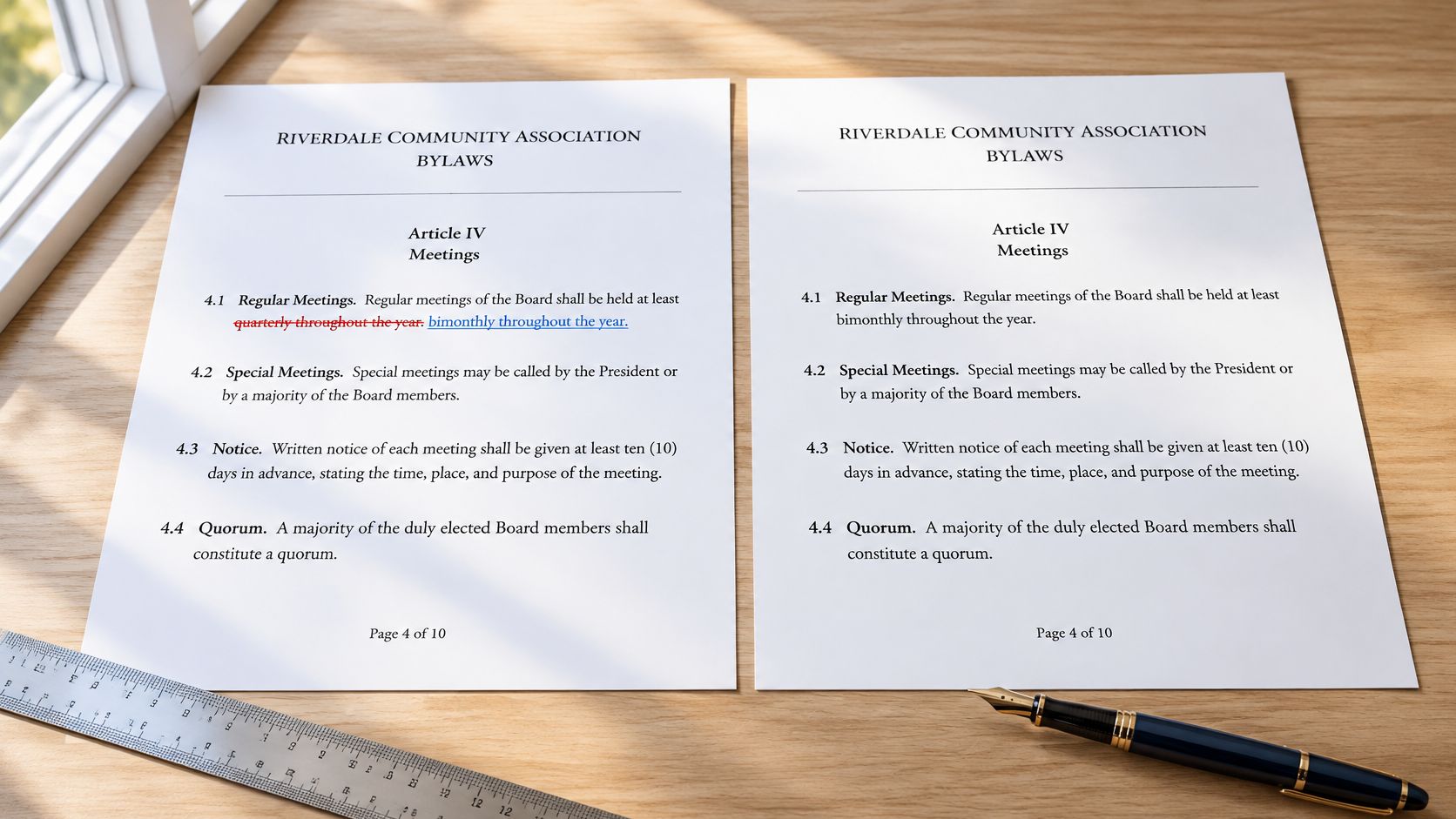
Write the operative change first
Suppose Article IV, Section 4.2 currently lets only the chair or president call special meetings. A hypothetical amendment adding a shareholder calling right could read:
Section 4.2 is amended to read: Special meetings may be called by the chair, the president, or holders of at least ten percent of the outstanding shares entitled to vote.
That percentage is an illustrative drafting choice, not a universal statutory standard. Counsel should verify that the proposed right fits the corporation's governing law, articles, and share structure.
Draft the resolution so it identifies the attached text precisely. A motion to approve updated meeting procedures leaves uncertainty about whether the board adopted the circulated draft, an oral revision, or something else.
Reconcile the rest of the document
A targeted amendment is easier to review than a wholesale rewrite, but it can leave inconsistent provisions behind. A full restatement is cleaner for future users, although reviewers need a reliable redline to detect unrelated changes.
- Cross-references and definitions. Check every reference to the changed section, including who qualifies as a holder.
- Related voting rules. A fixed quorum in Section 2.5 must work with the revised procedure in Section 4.2.
- Effective wording. Specify effectiveness upon adoption or a stated future date, including any approval condition.
- Version control. Assign an amendment number and identify the clean restatement that incorporates it.
Washington's corporate amendment provisions require attention to shareholder notice when applicable; the general meeting window is 10–60 days, while meetings addressing articles amendments require 20–60 days. Drafting should finish before notice starts, so the circulated attachment matches the proposal submitted for approval.
The accompanying video offers another format for reviewing the process.
Finally, test the language against mandatory law and the articles. Even a properly approved bylaw can be unenforceable if its substance conflicts with either. Produce the clean restatement and an approval certificate for completion after adoption, then run the pre-vote review before circulation.
Calculate Notice, Quorum and Vote Thresholds
A generic majority rule isn't safe. Entity type, the voting denominator, governing-document restrictions, and separate voting groups determine the approval calculation.
For affected Washington nonprofit classes, RCW 24.03A.695 requires class-specific approval in the circumstances it covers, including approval by a majority of members of each newly created class when an existing class is divided. A combined favorable tally can't replace a required class result.
Thresholds and notice windows for bylaw amendments
| Situation | Approval Needed | Notice Window |
|---|---|---|
| Washington business corporation, bylaw amendment at a meeting | Applicable statutory rule and articles or bylaws; confirm any higher threshold | General shareholder meeting window described in the drafting section; check special rules |
| Washington business corporation, bylaw changing director quorum or vote | Only shareholders if shareholders adopted the provision; board or shareholders if the board adopted it | Applicable board or shareholder meeting notice rule for the approving body |
| Washington nonprofit, member amendment at a meeting | Members entitled to vote at a meeting with quorum, unless a higher threshold applies; each entitled voting group separately | Notice to each member, whether or not entitled to vote, within the applicable member-meeting window |
| Washington nonprofit, one class divided into new classes | Majority of members of each newly created class | Applicable member-meeting notice rule, including affected groups |
| Older Washington nonprofit (RCW 24.06.190) | Two-thirds of votes cast, and two-thirds for each voting class | Notice rule under the corporation's governing statute and bylaws |
| Delaware corporation, stockholder bylaw amendment | Applicable statutory stockholder-vote rule, subject to charter and lawful bylaw requirements | Applicable stockholder-meeting notice rule; verify the current statute and governing documents |
The heightened-director-rule distinction follows Washington’s provisions on director quorum and voting bylaws. The older nonprofit threshold comes from RCW 24.06.190, which requires at least two-thirds of votes cast, including the required result for each voting class.
Calculate the denominator before counting support
The secretary’s worksheet should identify total eligible voting power, attendance needed for quorum, separate groups, and the approval denominator. Votes entitled to be cast, votes present, and votes cast aren’t interchangeable.
Consider a hypothetical class with 1,000 votes entitled to be cast and a governing requirement for a majority of all entitled votes. If 600 participate, with 450 in favor and 150 against, the proposal fails: it needs 501 favorable votes.
- Identify voting groups. Preferred holders or affected membership classes may need separate tabulations.
- Check heightened requirements. Review the articles, bylaws, and any authorized board requirement.
- Validate notice. Confirm the recipients, delivery method, timing, stated purpose, and amendment attachment.
Articles amendments follow separate approval rules. This bylaw-focused table isn’t a substitute for an articles-amendment analysis, and an unresolved notice window should stop scheduling rather than invite an estimate.
Sample Resolution, Minutes and Filing Records
For a board authorized to adopt the change, the following is adaptable resolution language, not a substitute for identifying the required approving body:
RESOLVED, that Section 4.2 of the Bylaws is amended as set out in Exhibit A, effective immediately upon adoption; and FURTHER RESOLVED, that the Secretary is directed to certify the restated Bylaws and file them in the minute book.
A board resolution records the corporate action. The minutes supply the surrounding facts that demonstrate how the authorized body took it.
Record the meeting facts
A hypothetical shareholder-meeting entry could read:
The meeting opened at 10:00 a.m. The Secretary reported 635,000 eligible votes represented, satisfying the applicable quorum, and confirmed notice and the proposed amendment were delivered on the date recorded in the notice certificate. The motion to adopt Exhibit A received 620,000 votes in favor, none opposed, and 15,000 abstaining. The chair declared the amendment adopted under the verified approval threshold, effective at 10:25 a.m.
Actual minutes should state the notice date, eligibility calculation, applicable threshold, and separate group results. A conclusion that the motion passed isn’t enough without the supporting tally.
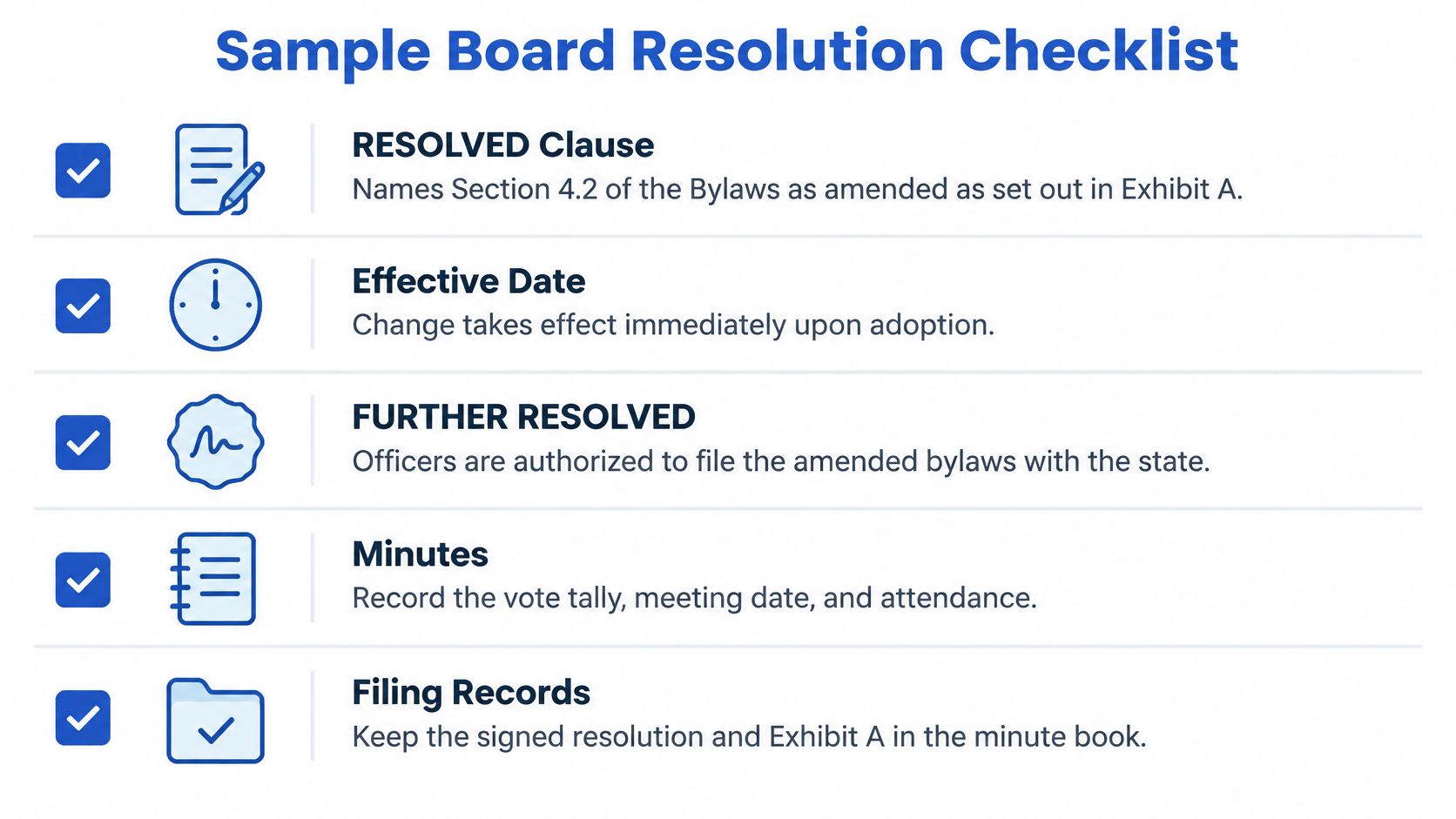
The checklist can organize the record package, but any state-filing direction requires a separate legal check.
Separate the minute book from public filings
Bylaws generally remain internal in Washington and Delaware; articles amendments generally require state filing. The infographic’s state-filing language shouldn’t be treated as a blanket instruction to file corporate bylaws.
For Washington nonprofits, the Nonprofit Corporation Act requires notice to all members at least five days before filing an articles amendment when no members are entitled to vote on it. That filing-related rule doesn’t create a general bylaw-filing requirement.
Keep the following together:
- Adopted text. Redline, clean restatement, and attached Exhibit A.
- Process evidence. Notice, delivery records, attendance, proxies or consents, and tabulation.
- Certification. Signed resolution, approved minutes, effective date, and version identifier.
Delaware corporations should retain both marked and clean versions for financing diligence. Cross-border operations also need separate licensing checks; Dubai license amendment guidance from Goodhand addresses a different administrative process, not a replacement for corporate approval.
Break a Blocked Amendment Without Breaking the Rules
A minority investor won’t attend. A member class is dormant, a consent holder can’t be reached, or the secretary used the wrong record date. None of those problems automatically authorizes the board to bypass the missing approval.
Under Washington’s nonprofit approval provisions, governing documents may require approval in a record by a specified person or group, and removing that requirement itself needs the specified approval. Silence from the consent holder isn’t a waiver.
Escalate without changing the electorate
The escalation sequence starts with diagnosing the missing legal condition, not finding a more favorable voting method.
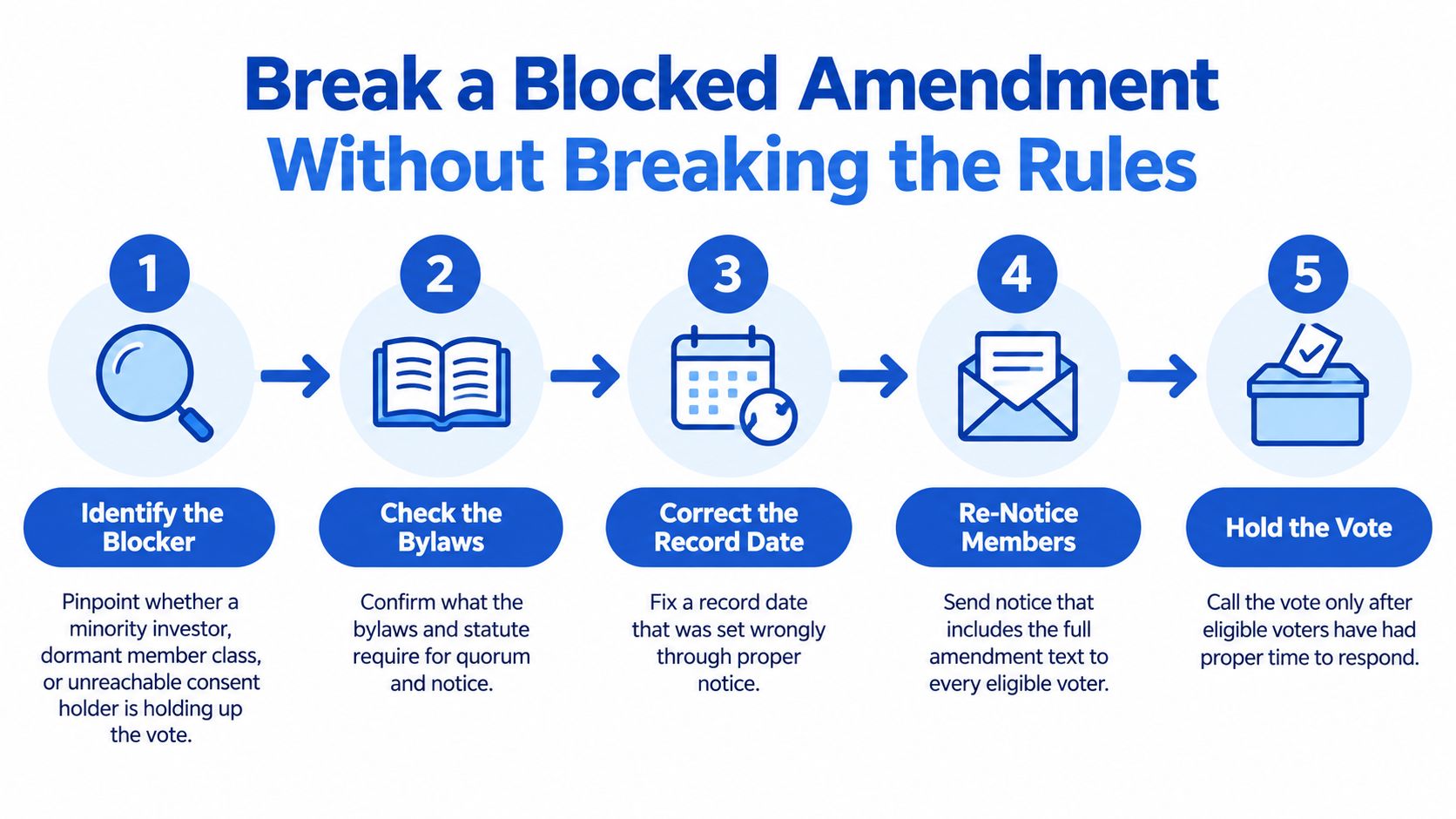
- Confirm power and required consents. Identify who can authorize the proposed procedural fix.
- Check eligibility. Validate the record date and correct defects through the proper process.
- Test alternative methods. Determine whether proxies, electronic participation, or written consent are permitted and what approval each requires.
- Preserve group rights. Conduct separate class votes where required.
- Consider formal relief. Consult counsel about court or regulator involvement only where the governing statute permits it.
A narrow route exists under RCW 24.06.190: where existing bylaws prohibit mail, electronic, or proxy voting and quorum hasn’t been obtained for at least two consecutive annual meeting dates, the board may gain authority to authorize those methods. That isn’t a general power for every Washington corporation.
Suppose a hypothetical company has three classes and its Class B holder hasn’t voted in four years. If separate Class B approval is required, inactivity doesn’t let the other classes supply it.
Easier voting procedures can change control. Convenience alone doesn’t establish authority.
Sound corporate governance practices include documenting failed approval attempts. If any escalation step fails its legal test, stop, record why in the minute book, and cure the defect before proceeding.
Check the Amendment Before the Vote Is Called
The principal defects to screen for are the wrong decision-maker, defective notice, conflict with superior governing rules, and an incomplete adoption record. A pre-notice review is cheaper and cleaner than trying to establish afterward which version passed.
The secretary should assemble the package as a single review file.

Apply a stop-or-proceed checklist
- Authority. The note identifies the document and clause granting amendment power.
- Approval. The worksheet states the threshold and every separate voting group.
- Notice. The calendar, recipient list, delivery method, and attachment are ready.
- Text. The clean copy matches the redline, with consistent definitions and cross-references.
- Effectiveness. The resolution identifies when the change becomes operative.
- Certification. A named officer will finalize the minutes and certify the adopted copy.
An LLC should first confirm the correct governing instrument rather than adapt corporate paperwork; the distinction between bylaws and LLC governance documents matters before drafting begins.
Decision rule: If a checklist item fails, delay approval rather than assume a later cure will work.
For changes involving reserved authority, class rights, or deadlock, business counsel should review the package before notice goes out. By Design Law Firm & Legal Consultancy, PLLC offers bylaw drafting and updates and can be contacted at (206) 593-1519.
By Design Law Firm & Legal Consultancy, PLLC helps businesses draft and update bylaws and review the approvals and records needed to support adoption. Before circulating an amendment, visit By Design Law Firm & Legal Consultancy, PLLC to discuss a pre-notice review of the governing documents, proposed language, and approval package. Contact our law office at (206) 593-1519.