A first-time franchise buyer may be comparing a promising sales pitch with a dense agreement while the disclosure clock is already running. If the franchisor also requires a chatbot, customer database, or AI-powered marketing tool, the deal has another layer of risk: the buyer may be responsible to customers for systems the franchisor selected and controls.
Treat the Franchise Disclosure Document (FDD) and franchise agreement as one package. The FDD describes the system and its disclosures; the agreement sets the obligations the franchisee will accept. Compare them clause by clause, and give special attention to technology, customer data, and who is responsible for chatbot disclosures and compliance.
Prepare Before You Read the Agreement
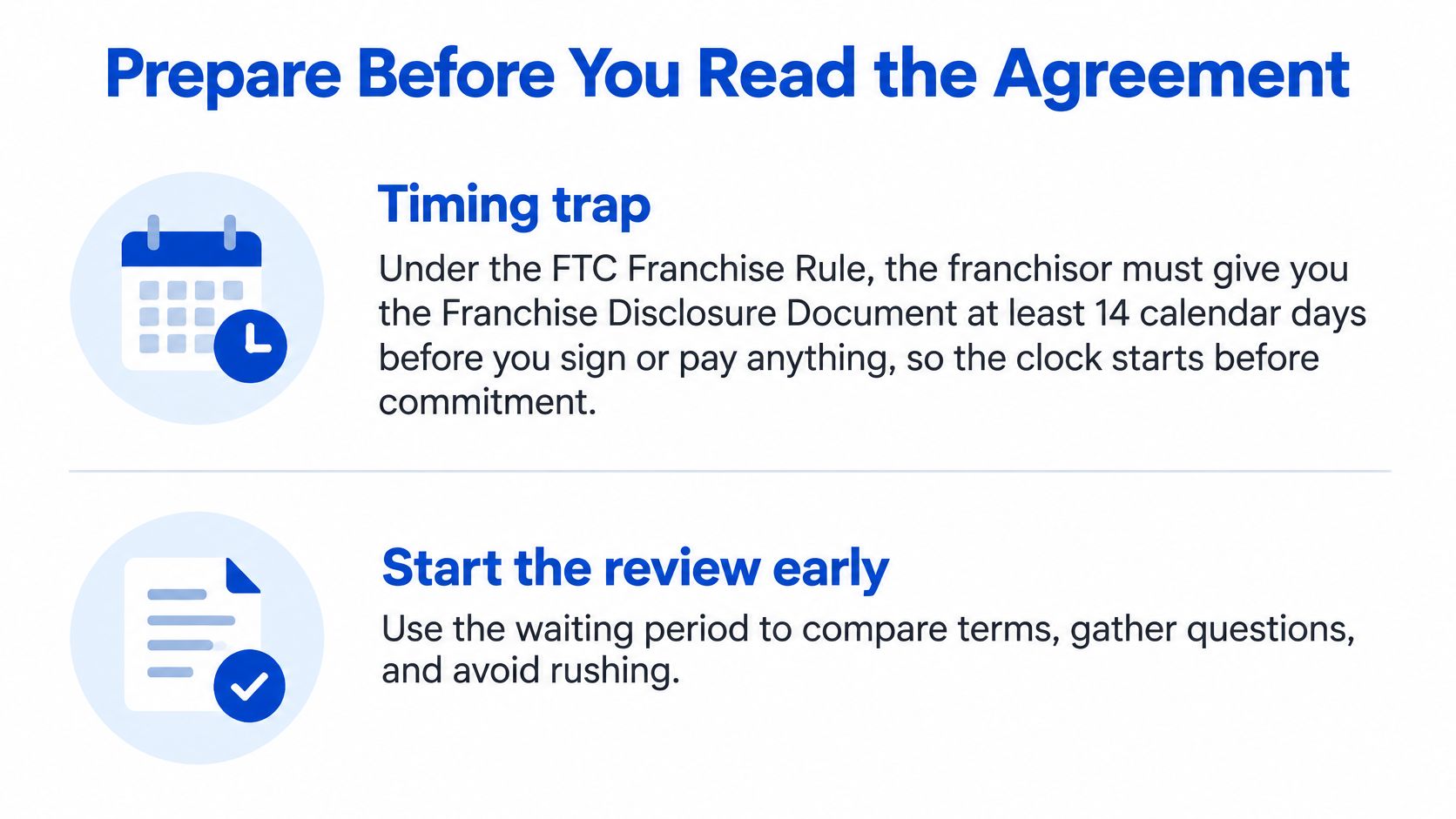
Under the FTC Franchise Rule, a franchisor must provide the FDD at least 14 calendar days before the prospective franchisee signs an agreement or pays the franchisor or an affiliate. That waiting period is not spare time at the end of negotiations. It's the time to investigate the deal, identify discrepancies, and get advice before a deadline or deposit puts pressure on the decision.
Work through these steps before negotiating:
-
Get the complete FDD and agreement. The FDD has 23 Items, and the agreement should be read alongside them. Pay particular attention to Item 3, litigation; Item 5, initial fees; Item 6, other fees; Item 19, financial performance representations; Item 20, outlet and franchisee data; and Item 21, financial statements. If a sales representative's explanation conflicts with the documents, ask for a written answer and identify which document controls.
-
Check Washington registration. Look up the franchisor's registration status with the Washington State Department of Financial Institutions, Securities Division. Washington regulates franchise sales under the Franchise Investment Protection Act, RCW 19.100. Registration is a step to verify, not proof that the business will be profitable or that every contract term is fair.
-
Build a one-page cost model. List the initial fee, build-out, working capital, royalties, advertising contributions, technology charges, and required purchases. Apply recurring fees to a revenue figure the business could realistically produce, rather than relying on the franchisor's most optimistic scenario.
-
Speak with franchisees. Contact at least five people listed in Item 20, including two who have left the system. Ask what they paid, how support compares with the sales process, whether required technology works as promised, and why former franchisees departed.
-
Set a review budget, a decision date, and priorities. Write down three to five essential requirements, such as a defined territory or a limit on personal liability. Starting with a focused list makes legal review more useful and gives negotiations a clear purpose.
Practical rule: A mismatch between the FDD and agreement is a disclosure question as well as a negotiation issue. Get the explanation in writing before deciding whether to accept the term.
For a plain-language overview of what the disclosure document contains, see this guide to the Franchise Disclosure Document.
Clause-by-Clause Review Checklist
Fill every row in the checklist before negotiating. Record the agreement section, the exact wording or figure, and whether the FDD says the same thing. A discrepancy should be tracked as a question requiring an answer, not treated as a normal drafting difference.
| Clause | What to verify | Question to ask the franchisor | Red flag |
|---|---|---|---|
| Fees | Initial fee, royalty base, advertising fund, and technology fee in FDD Items 5 and 6 | Which fees can rise during the term, and how is gross sales defined? | Fees missing from the FDD or changeable by notice alone |
| Territory | Exclusive or protected area, online and delivery sales, and encroachment rights | Can you open another location or sell online into my area? | Vague radius or “reasonable” language with no carve-outs |
| Term and renewal | Length, renewal conditions, required upgrades, and release requirements | What will renewal cost, and which standards apply then? | Renewal only on then-current terms with a new fee and no defined limits |
| Transfer | Approval criteria, transfer fee, buyer training, and right of first refusal | What must a buyer meet, and how quickly do you answer a request? | Approval at the franchisor's sole discretion with no timeline |
| Intellectual property | Trademark license, manual ownership, and ownership of improvements | Who owns the menu, process, or software improvements I develop? | Franchisor claims all improvements with no license back to you |
| Training and support | Initial training hours, cost, ongoing field support, and required travel | What is included in the fee, and what is billed separately? | Support promised in sales materials but absent from the agreement |
| Termination | Grounds for termination by each party, cure periods, and notice requirements | Which breaches allow termination without a cure period? | Termination for any breach with no cure period |
| Post-termination covenants | Non-compete radius and length, de-identification, lease assignment, and purchase options | Does the non-compete apply if the franchisor ends the relationship? | Multi-year, broad-area non-compete that survives every termination |
| Technology and data | Customer data ownership, system access, required vendors, AI chatbots, and scripts | Who owns customer data, and who approves chatbot scripts and vendors? | Franchisor keeps all customer data and mandates vendors with no disclosure role for you |
Count red flags by clause, not as a single score for the whole agreement. One concern in a clause the buyer can live with may be a note to resolve or price into the decision. Several concerns concentrated in one clause, such as broad discretion, unclear costs, and no deadline for the franchisor to respond, point to a provision that may need a substantive rewrite.
Before sending comments, sort each row into must-fix, should-fix, or accept-as-is. A must-fix item should be resolved before signing. A should-fix item is worth negotiating but may be traded for something more important. An accept-as-is item should still be understood and recorded, rather than forgotten.
A franchise agreement template can help a buyer recognize common provisions, but it can't establish whether the franchisor's actual language matches its FDD or fits the buyer's circumstances. For a separate drafting perspective, Franchise Foundry's guide to customize your franchise agreement template can help identify terms that need to be adjusted. Neither resource replaces review of the executed documents.
Fees and Territory Terms That Drive Costs
Fees can make a workable business model unworkable. Use the table to locate each charge in the FDD, then compare the disclosed structure with the agreement's definition of what the franchisee must pay.
| Fee type | Typical range or structure | Where to verify |
|---|---|---|
| Initial franchise fee | Varies widely by system, often a five-figure sum | FDD Item 5 |
| Royalty | Percentage or fixed amount set by the system; confirm whether the base is gross or net sales | FDD Item 6 |
| Marketing or brand fund | Often 1% to 4% of gross sales | FDD Item 6 |
| Technology fee | Often a flat monthly amount that may increase | FDD Item 6 |
| Transfer fee | Frequently a flat sum, sometimes a share of the sale price | FDD Item 6 |
| Renewal fee | Varies, sometimes a reduced share of the initial fee | FDD Item 6 |
| Required supplier markups | Margin built into mandated purchases; varies by system | FDD Item 6 |
The ranges are checks against the disclosure, not a quote for any particular franchise. For a simple illustration, a franchisee with $900,000 in gross sales paying a 6% royalty owes $54,000 a year. Add a 2% marketing fund, and the total reaches $72,000 before any technology fee. The agreement's definitions matter because a percentage is only useful if the parties agree on what it applies to.
Check whether royalties are calculated on gross or net sales, whether delivery-platform orders count, and whether the franchisor can impose a minimum royalty during a slow period. Also ask whether discounts, refunds, gift cards, taxes, or third-party charges are included in “gross sales.” A small difference in the base can matter more than a small difference in the rate.
A fee schedule is not complete if it lists the charge but leaves the franchisor free to change it without a clear limit or process.
Territory language needs the same close reading. An exclusive area may bar the franchisor from placing another outlet there; a protected area may provide narrower safeguards; a radius may offer no exclusivity at all. The agreement should also say how online orders, delivery partners, national accounts, and franchisor-owned outlets affect the boundary. Ask for each carve-out in writing and compare the answer with the agreement before treating a map as a promise.
Renewal, Transfer and Termination Terms
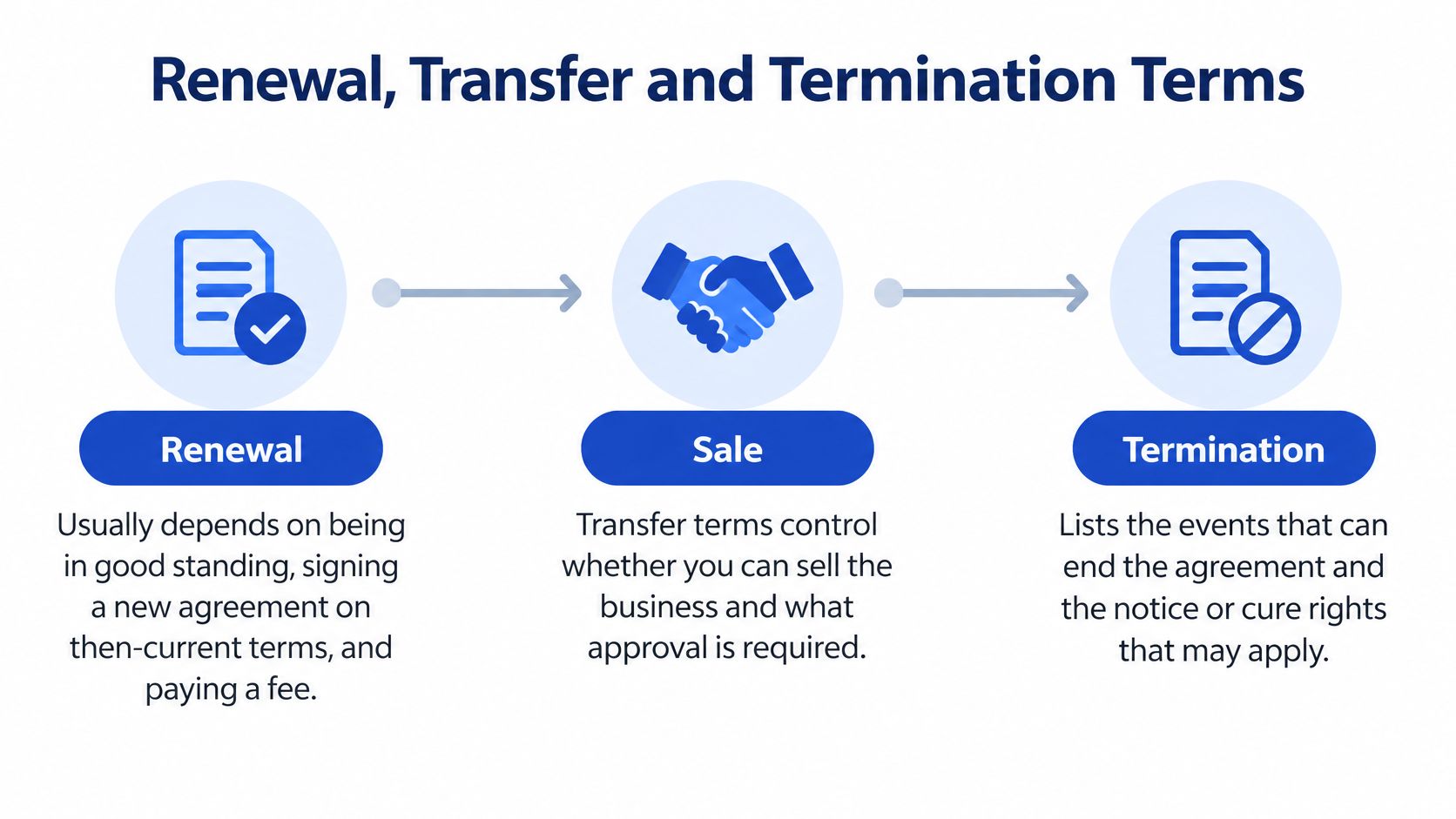
A franchisee may satisfy every day-to-day requirement and still face a costly choice at renewal, a restricted sale, or termination. Read these clauses together: the agreement sets the conditions, while the FDD may describe the franchisor's practices and renewal obligations.
Renewal
Renewal may depend on good standing, signing the franchisor's then-current agreement, paying a fee, or giving a release. Compare the renewal language with the FDD, especially any description of required upgrades or changes in terms. Ask which operating standards apply, whether renovations are required, and whether royalties, technology obligations, or territory protections will change.
A release can require you to give up claims as a condition of continuing to operate. Have counsel review its scope before renewal is near, when you have less time to negotiate.
Sale
A transfer clause may require franchisor approval, buyer training, a fee, or compliance with current brand standards. Check the approval criteria, the deadline for a decision, and whether the franchisor can reject a buyer for reasons the agreement leaves broad or unclear.
A right of first refusal may let the franchisor match a buyer's offer. That can make a prospective buyer less willing to invest time and money in the process. Review the notice and response procedures alongside the FDD's transfer disclosures.
Termination
Identify each termination ground, the notice required, and whether you have a chance to cure a breach. Washington's franchise investment law can limit termination and non-renewal. Have counsel confirm how it applies to the agreement, the parties, and the facts.
After termination, review restrictions on competing, customer information, confidential material, lease assignment, and equipment. Washington's non-compete statute may limit post-termination restrictions, but its application depends on the business and agreement. Ask counsel to assess the language before signing, not after an exit dispute begins.
AI Chatbot Laws and Brand, Training and Data Clauses
A franchisor may require every outlet to use a specific chatbot, booking platform, loyalty system, or vendor. The agreement should state who controls each system, approves chatbot content, provides customer disclosures, and handles complaints. A franchisee may still bear contractual or customer-facing responsibilities even when the franchisor selected the tool.

Check the brand and know-how provisions together with the FDD. Confirm that the trademark license applies only to authorized operations and ends when the agreement ends. Review who owns the operations manual and any menu, process, or software improvements you develop. The training provisions should specify initial training hours, costs, required travel, and promised ongoing support.
For technology, ask four direct questions: Who owns customer records? Who contracts with the chatbot vendor? Who provides the AI disclosure? Who keeps conversation logs and handles a complaint caused by a script? Also check access rights, security duties, retention periods, vendor changes, and whether you can export customer information when the relationship ends.
The compliance picture
The EU AI Act creates a binding framework with staged application. It entered into force on August 1, 2024, and its transparency rules for chatbots are scheduled to apply on August 2, 2026. Under Article 50, users generally must be told they are interacting with AI no later than their first interaction, unless that is obvious. The European Commission's AI Act overview explains the broader rollout.
Article 50 covers more than chatbot greetings. The European Commission's Article 50 guidance describes duties involving direct interaction with AI, synthetic-content marking, certain biometric or emotion-recognition systems, and labeling deepfakes or specified public-interest text. Violations can carry penalties of up to €15 million or 3% of worldwide annual turnover, subject to proportionality considerations for smaller businesses, according to the Commission's transparency-rules fact page.
| Rule or action | Date | What it means for a franchisee |
|---|---|---|
| EU AI Act enters into force | August 1, 2024 | Risk-based framework with staged application |
| Prohibited practices and AI-literacy duties apply | February 2, 2025 | Early compliance milestone |
| Article 50 chatbot disclosure applies | August 2, 2026 | Users must be told they're talking to AI |
| Limited extension for machine-readable marking of existing systems | December 2, 2026 | Applies to systems already on the market before August 2, 2026 |
| NIST AI Risk Management Framework 1.0 | January 2023 | Voluntary risk-management guidance |
| NIST Generative AI Profile | July 26, 2024 | Voluntary guidance on generative and chatbot risks |
| FTC Section 6(b) orders to seven companion chatbot companies | September 2025 | Focus on minors, COPPA compliance, and data practices |
In the United States, the National Institute of Standards and Technology's AI Risk Management Framework and Generative AI Profile offer voluntary guidance rather than a single federal chatbot statute. The NIST Generative AI Profile provides a structure for addressing inaccurate outputs, privacy exposure, security weaknesses, bias, and inadequate testing.
The Federal Trade Commission has scrutinized consumer-facing companion chatbots. Its inquiry seeks information about effects on children and teenagers, age restrictions, data practices, and compliance with the Children's Online Privacy Protection Act Rule. The FTC issued Section 6(b) orders to seven companies.
State rules add another layer. Stanford University's 2025 AI Index reported 131 state-level AI-related laws passed in the prior year, compared with 49 in 2023. Check whether the franchise agreement assigns the cost of mandated system updates and responsibility for revised notices, testing, and vendor changes. The firm's overview of the EU AI Act and its implications offers further context on that framework.
Red Flags and How to Negotiate Them
| Red flag | Why it matters | Counter-ask |
|---|---|---|
| Unilateral amendment right | The system can change mid-term at your cost | Require reasonable notice, and require the franchisor to pay for mandated technology |
| Choice of law or venue outside Washington | Disputes can be pushed out of state, away from Washington franchise protections | Request Washington law and venue for franchise claims, or obtain counsel's review of enforceability |
| Unlimited personal guarantee | Personal assets are exposed to all obligations | Cap the guarantee or limit it to the operating entity's obligations |
| Mandatory arbitration with one-sided costs | The cost of bringing a claim may become prohibitive | Require shared arbitration costs and a local hearing location |
| Termination for any breach with no cure period | A minor lapse can end the business | Require defined cure periods for curable breaches and notice before termination |
A clause doesn’t become harmless because it appears in a standard form. The question is whether the risk fits the business and whether the franchisor will put workable limits in writing.

Three habits make negotiations more disciplined:
-
Send three to five priorities early. Share the essentials before paying a deposit. This gives the franchisor a chance to respond while the buyer still has room to assess the deal.
-
Trade rather than demand. A buyer might accept a somewhat higher royalty in exchange for a stronger territory or a cap on a personal guarantee. The trade should be specific, documented, and valuable enough to justify the cost.
-
Put every change in a signed addendum. The addendum should identify the provision it changes and state that it overrides inconsistent agreement language. A sales representative’s oral assurance is a poor substitute for a signed amendment.
A useful negotiation record tracks each requested change, the franchisor’s response, and whether the final document includes it. For technology terms, an internal AI governance policy can help a business define who approves tools, scripts, and data practices across its operations.
For a discussion of negotiation points and contract review, the video below provides another perspective.
If a franchisor refuses to address a serious clause that also conflicts with its disclosure, treat that refusal as information about the relationship. The issue isn’t whether the buyer can win a redline. It’s whether the franchisor’s answers show a willingness to clarify responsibilities before the franchisee is committed.
When to Bring In Counsel Before You Sign
Engage a franchise attorney before paying a deposit, ideally at the start of the disclosure period. A review that begins near the signing date can leave little time to understand the FDD, resolve discrepancies, or negotiate chatbot and data responsibilities.
Look for counsel familiar with Washington franchise registration under RCW 19.100 and the relevant industry. Request a written flat-fee quote that states whether it covers the FDD, agreement, and any chatbot or data clauses. Fees depend on the system and scope, so confirm the cost directly rather than relying on a general estimate.
A practical review sequence is:
- Send counsel the full FDD and agreement.
- Ask counsel to mark the fixed requirements and red flags.
- Negotiate changes and record each one in a signed addendum.
- Confirm registration and disclosure dates.
- Sign only after every must-fix item is resolved.
By Design Law Firm & Legal Consultancy, PLLC advises clients on contractual obligations and compliance, and its AI law services include risk assessments, policy creation, and regulatory compliance. Its contact form allows visitors to select practice areas including Business Law, Contract or Transactional Law, Data Privacy / Cyber Law, Intellectual Property, and Artificial Intelligence Litigation. To request a scoped franchise agreement review, contact the firm at (206) 593-1519.
For a Washington franchise agreement review, By Design Law Firm & Legal Consultancy, PLLC offers contract and compliance counsel, including review of chatbot and data clauses that affect franchise operations. Contact the firm to discuss the FDD, agreement, and technology obligations before signing or paying a deposit. Contact our law office today at (206) 593-1519