Cyberlaw is the body of legal rules that govern how businesses handle computers, networks, digital information, and online services, covering cybersecurity duties, data-privacy obligations, computer-crime exposure, and jurisdiction across state and international lines. For a Washington startup, that means the legal risk can begin when a customer submits an email address, a cloud vendor stores it, or an AI-powered payment tool processes it, long before anyone reports a breach.
A founder may have customer emails in a marketing platform, payment records moving through a third-party processor, employee credentials in a cloud identity system, and product data sent to an AI service. Without a formal inventory, vendor review, or incident plan, the company may not know who can access the information, where it travels, or what must happen after an unauthorized person obtains it. Cyberlaw turns those ordinary operating choices into questions of responsibility, evidence, contracts, privacy, and response.
What Cyberlaw Means for Your Business
Cyberlaw is the legal framework governing conduct involving computers, networks, digital information, and online services. It isn't one statute or one compliance certificate. It connects computer-crime rules, privacy duties, cybersecurity expectations, contracts, intellectual property, jurisdiction, incident response, and electronic evidence. The Council of Europe's overview of the Budapest Convention describes the treaty as the first international agreement specifically designed to address crimes against computers, crimes committed using computers, and the preservation and collection of electronic evidence.
A Washington startup can trigger cyberlaw duties at several ordinary moments:
- Collecting data: A signup form creates questions about purpose, notice, retention, access, and deletion.
- Choosing a cloud provider: The provider's security terms, subcontractors, access controls, and incident obligations can affect the startup's own exposure.
- Using an AI tool: Customer or employee information may be transferred to a model provider, retained for service improvement, or used in an automated process that requires documentation and transparency.
- Accepting online payments: The company must understand which party secures payment information, which records remain in the company's systems, and which contract promises bind the business.
- Selling the company: Investors and acquirers will examine data flows, privacy notices, vendor agreements, security controls, and unresolved incidents.
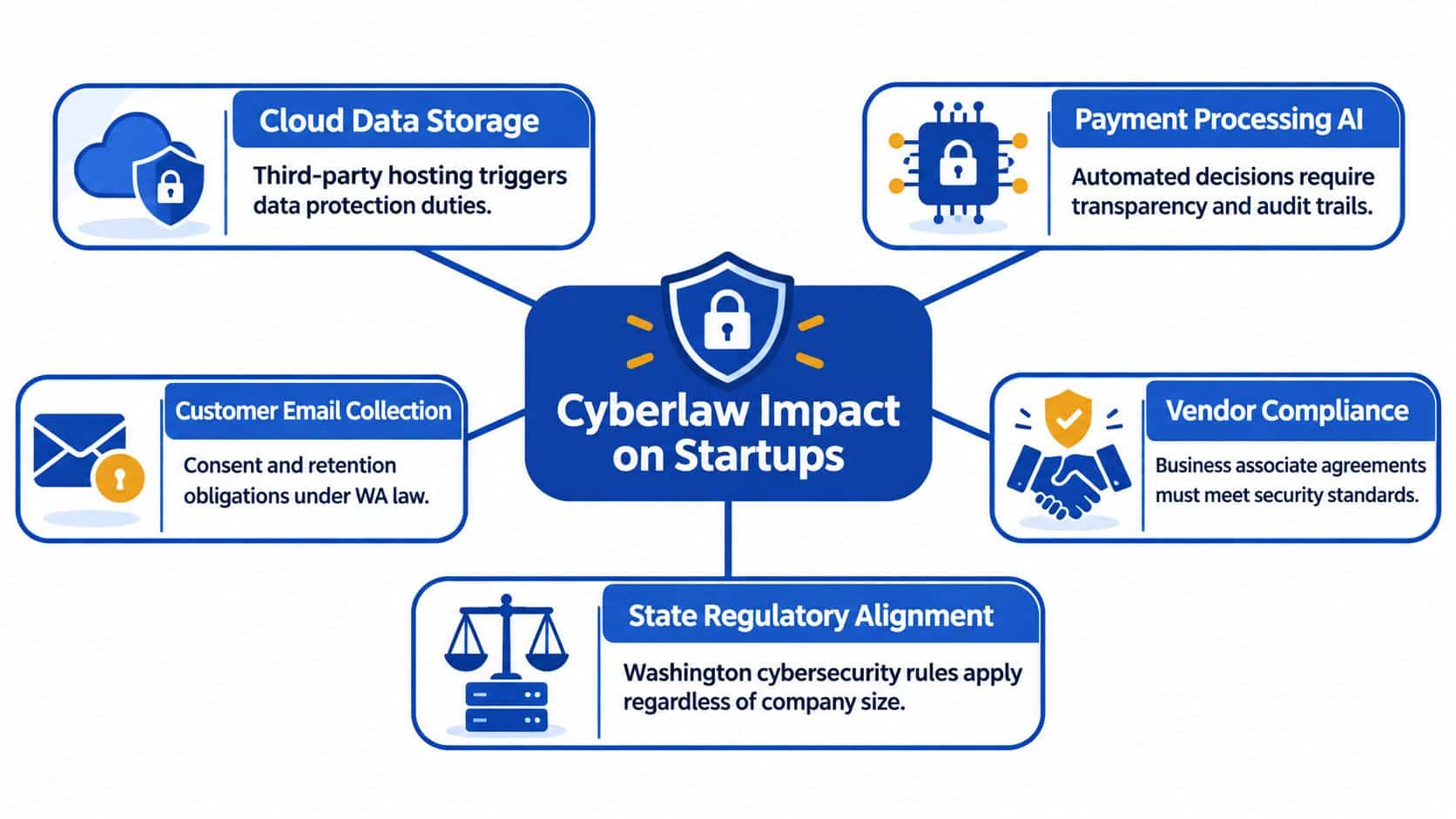
Practical rule: A business shouldn't wait for a hacker to identify its cyberlaw obligations. The collection, sharing, storage, and deletion of data can create legal exposure by themselves.
A useful first step is a data-flow map. The company should record what it collects, why it collects it, where it is stored, which vendors receive it, who can access it, and how long it remains available. A focused data privacy and compliance review can then connect that operational map to policies, contracts, and Washington requirements.
The Five Pillars of Cyberlaw
A founder signs a new analytics tool on Friday, routes customer data into it by Monday, and only later learns the contract, privacy notice, and security settings do not line up. That is how cyberlaw problems usually start. They arise at business moments, collecting data, picking vendors, granting access, responding to suspicious activity, not in a neat list of statutes.
Five pillars help keep those moments organized.
Cybersecurity duties
This pillar covers the safeguards that protect confidentiality, integrity, and availability. For a startup, that often means identity management, multifactor authentication, encryption, logging, vulnerability management, backups, recovery testing, and access reviews. The legal question is whether those controls fit the data involved, the threats the company can reasonably expect, the promises it made to customers, and the duties imposed by law or contract.
Data-privacy obligations
Privacy law attaches as soon as a business starts collecting personal information and keeps following the data as it moves. A customer email, employee record, payment-related data, or behavioral profile may pass through product tools, cloud storage, support software, and AI vendors before anyone documents the full path. If the privacy notice does not match that actual use, the company creates risk at the exact moment it is trying to grow.
Computer-crime exposure
This pillar matters when someone accesses systems without authorization, interferes with data, intercepts communications, or commits fraud through computer systems. The Budapest Convention covers illegal access, illegal interception, data interference, system interference, computer-related fraud, online child exploitation, electronic-evidence preservation, and international cooperation, as summarized in the Council of Europe's cybercrime materials. For a business, the practical point is straightforward. Access permissions, investigation records, and evidence handling can matter just as much as preventive controls once an incident starts.
Jurisdiction and cross-border issues
Cross-border exposure does not require a foreign office. It can start with overseas cloud hosting, remote developers, international customers, foreign investors, or a third-party analytics stack that sends data abroad. A Washington company can end up dealing with state, federal, and foreign rules at the same time, especially when contracts and data flows point in different directions.
Contract and liability management
Many startups get burned here. Vendor terms often turn security and privacy expectations into enforceable promises about breach notice, confidentiality, deletion, audit rights, indemnities, and limits of liability. If the team accepts standard terms without checking how data is used, who gives notice, or who pays when something fails, legal exposure shows up later during a breach, a customer dispute, or diligence.
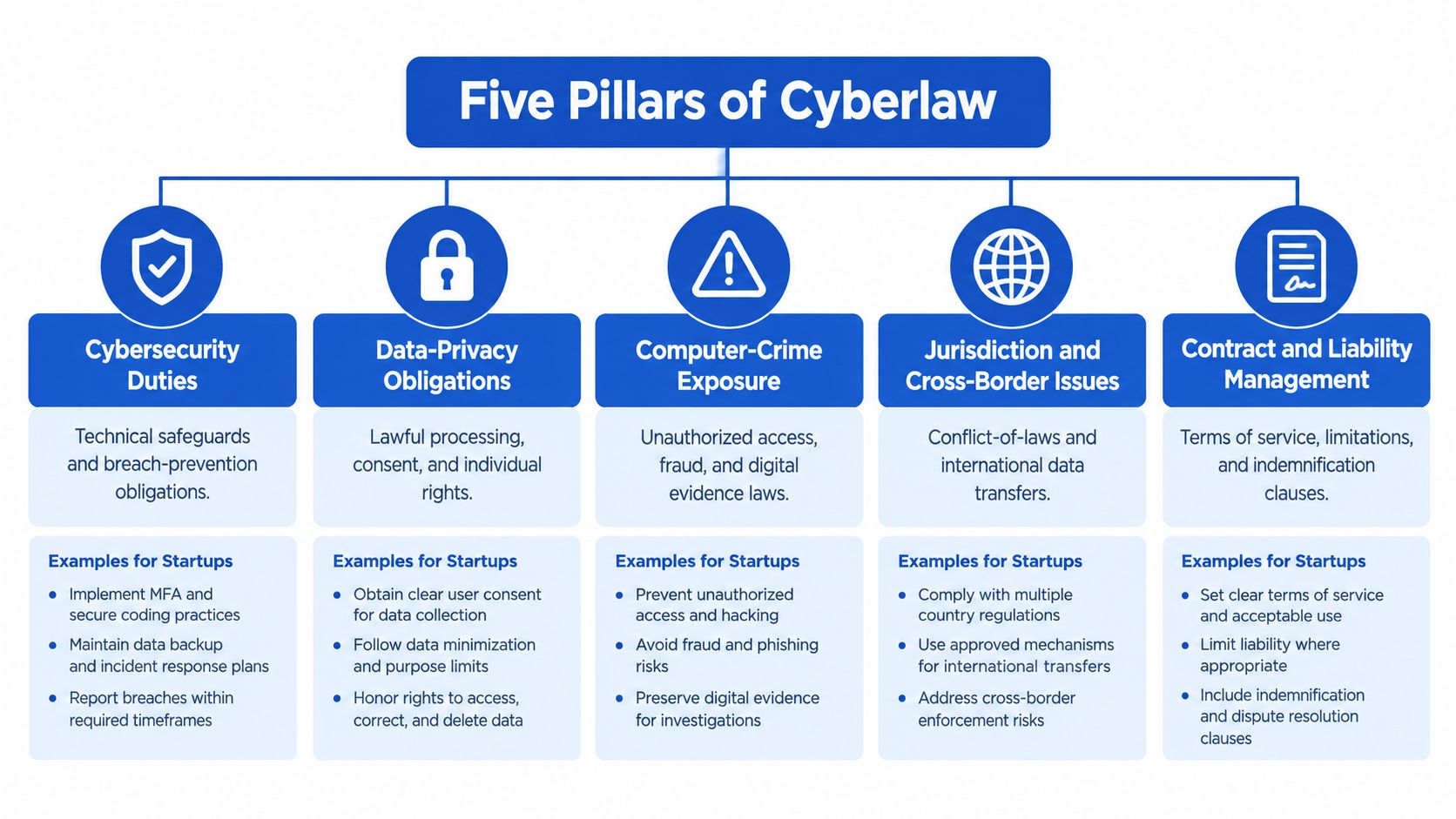
The pillars overlap constantly. A vendor decision affects privacy duties. A logging choice affects evidence preservation. A data-classification choice affects breach analysis. Used together, these five pillars give founders a working map for the moments that create cyberlaw exposure.
Key U.S. and Washington Cyberlaw Statutes
The question founders need answered is not only which statutes exist. It is which business event has occurred and what legal response follows. Federal computer-crime rules may become relevant when someone accesses a system without authorization, while Washington privacy and breach rules focus on personal information, security, consumer harm, and notice.
Washington's breach-notification framework generally applies when qualifying personal information was acquired, or reasonably believed to have been acquired, by an unauthorized person, the information wasn't secured, such as through encryption, and the incident is reasonably likely to create a risk of harm to consumers. Notice must be provided in the most expedient time possible and generally no later than 30 days after discovery. If more than 500 Washington residents are affected, the business must also notify the Washington Attorney General within that period, as explained by the Washington Attorney General's breach-notification guidance.
The table below is a working orientation, not a substitute for applying the facts to the governing law.
| Statute | Trigger | Deadline | Penalty |
|---|---|---|---|
| Federal computer-crime rules | Unauthorized access, misuse, or related conduct involving protected computers | Depends on the event and proceeding | Criminal and civil exposure may apply |
| Washington breach-notification rules | Unauthorized acquisition or reasonably suspected acquisition of unsecured personal information creating a risk of harm | Consumer notice generally no later than 30 days after discovery; Attorney General notice within that period when more than 500 Washington residents are affected | Regulatory, civil, contractual, and reputational exposure |
| Washington privacy requirements | Collection, use, disclosure, retention, or protection of covered personal information | Depends on the applicable obligation and business activity | Enforcement and other legal exposure may follow |
| Contractual security duties | Failure to meet a vendor, customer, insurer, or investor security commitment | The contract controls | Damages, indemnity claims, termination, or loss of trust |
Applying the rules to business moments
- Collecting data: Identify the purpose and the minimum information needed before a form or product feature goes live.
- Storing data: Review encryption, access privileges, retention, subcontractors, and recovery arrangements.
- Sharing data: Confirm whether the recipient may use the information for its own purposes or only to provide contracted services.
- Selling or licensing data: Treat the transaction as a privacy, contract, and consumer-protection issue, not merely a revenue decision.
- Responding to an incident: Preserve evidence and begin legal analysis immediately rather than waiting for a perfect forensic picture.
Washington founders handling a suspected incident can use a focused Washington data breach notification guide as an operational reference, then obtain advice on the specific data, systems, contracts, and affected residents involved.
NIST Framework and Startup Compliance
A small company doesn't need a large compliance department to create a disciplined security program. It does need a repeatable method for deciding what matters, assigning responsibility, documenting choices, and testing whether safeguards work.
The National Institute of Standards and Technology released Cybersecurity Framework version 1.0 on February 12, 2014, following Executive Order 13636 issued in 2013. Its original core used five functions, Identify, Protect, Detect, Respond, and Recover. NIST released CSF 2.0 on February 26, 2024, adding Govern to emphasize leadership, accountability, risk strategy, and oversight, as documented in the NIST Cybersecurity Framework FAQ.
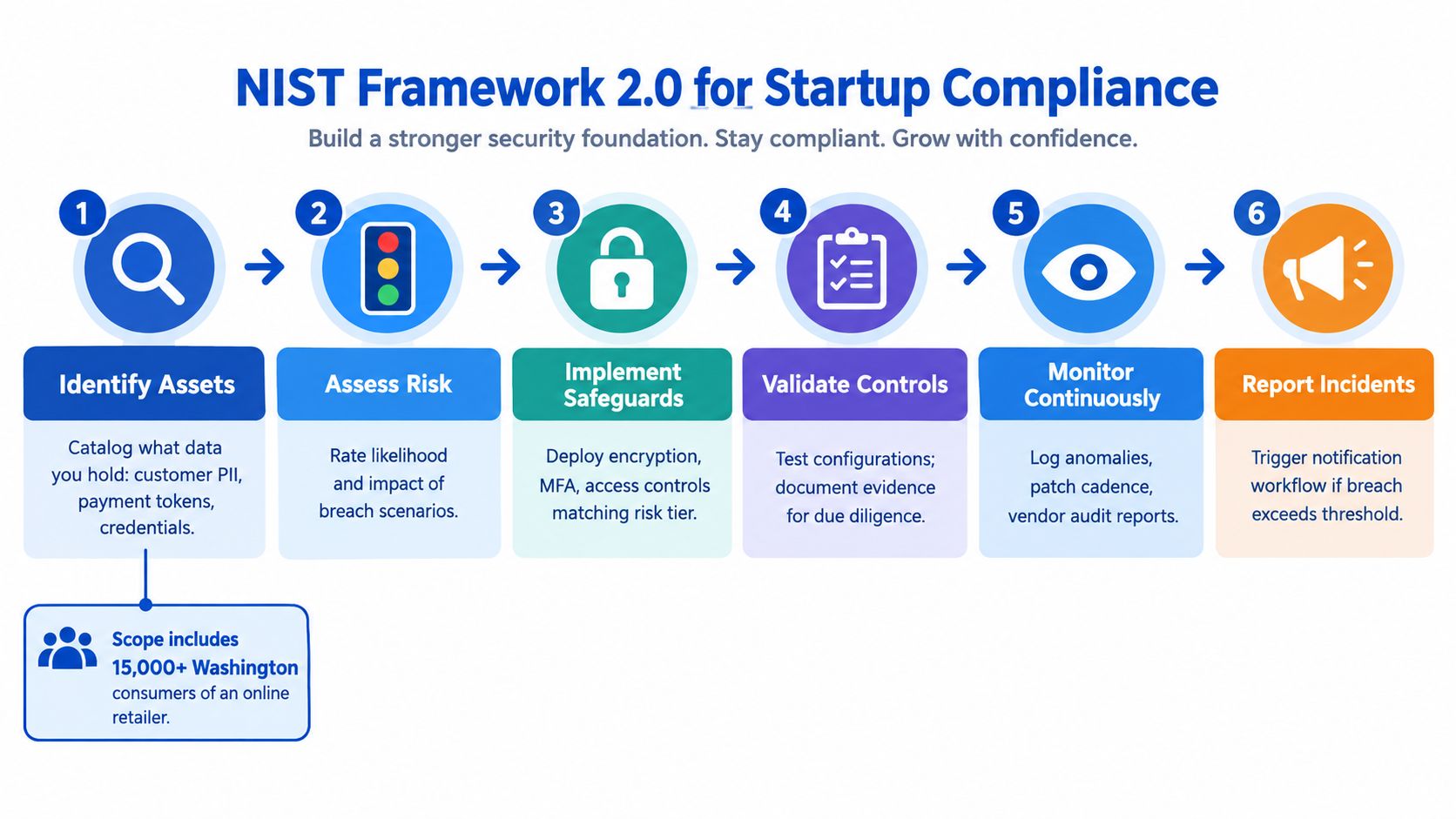
Turning functions into evidence
The framework becomes useful when each function produces an artifact someone can inspect.
- Identify: Maintain an asset inventory covering applications, cloud accounts, endpoints, databases, credentials, and data categories.
- Protect: Assign access owners and document safeguards such as multifactor authentication, encryption, least privilege, and secure configuration.
- Detect: Define what logs exist, who reviews alerts, and how the company recognizes suspicious activity.
- Respond: Maintain escalation contacts, decision authority, communications procedures, and evidence-preservation steps.
- Recover: Test restoration, record recovery objectives, and identify the person responsible for returning critical services to operation.
- Govern: Make leadership accountable for risk acceptance, vendor oversight, policy approval, and reporting.
The framework is voluntary by itself and isn't an automatic legal safe harbor. Still, a documented implementation can help demonstrate a deliberate, risk-based approach when regulators, customers, insurers, investors, or courts evaluate cybersecurity practices. The NIST CSF 2.0 publication describes the framework as a taxonomy of cybersecurity outcomes applicable to organizations of different sizes, sectors, and maturity levels.
A control that nobody owns is a policy statement, not a functioning compliance program.
Startups preparing for customer diligence can also compare governance platforms through a practical resource on the best SOC 2 software for 2026. Software can organize evidence and reminders, but it won't decide whether the company collected too much data, accepted an unacceptable vendor term, or failed to escalate a suspected incident.
A Washington company can pair the framework with a targeted cloud security compliance program, especially when critical systems depend on external infrastructure. The strongest baseline remains proportional: map risk, choose controls, document why they fit, and revisit the decisions when products, vendors, or data flows change.
Incident Response and Legal Steps
A security alert becomes a legal issue when the company must determine what happened, whose information was involved, whether unauthorized acquisition occurred, and whether the facts create a legally relevant risk of harm. Washington guidance emphasizes that notification can arise when an unauthorized acquisition compromises the security, confidentiality, or integrity of a resident's personal information.
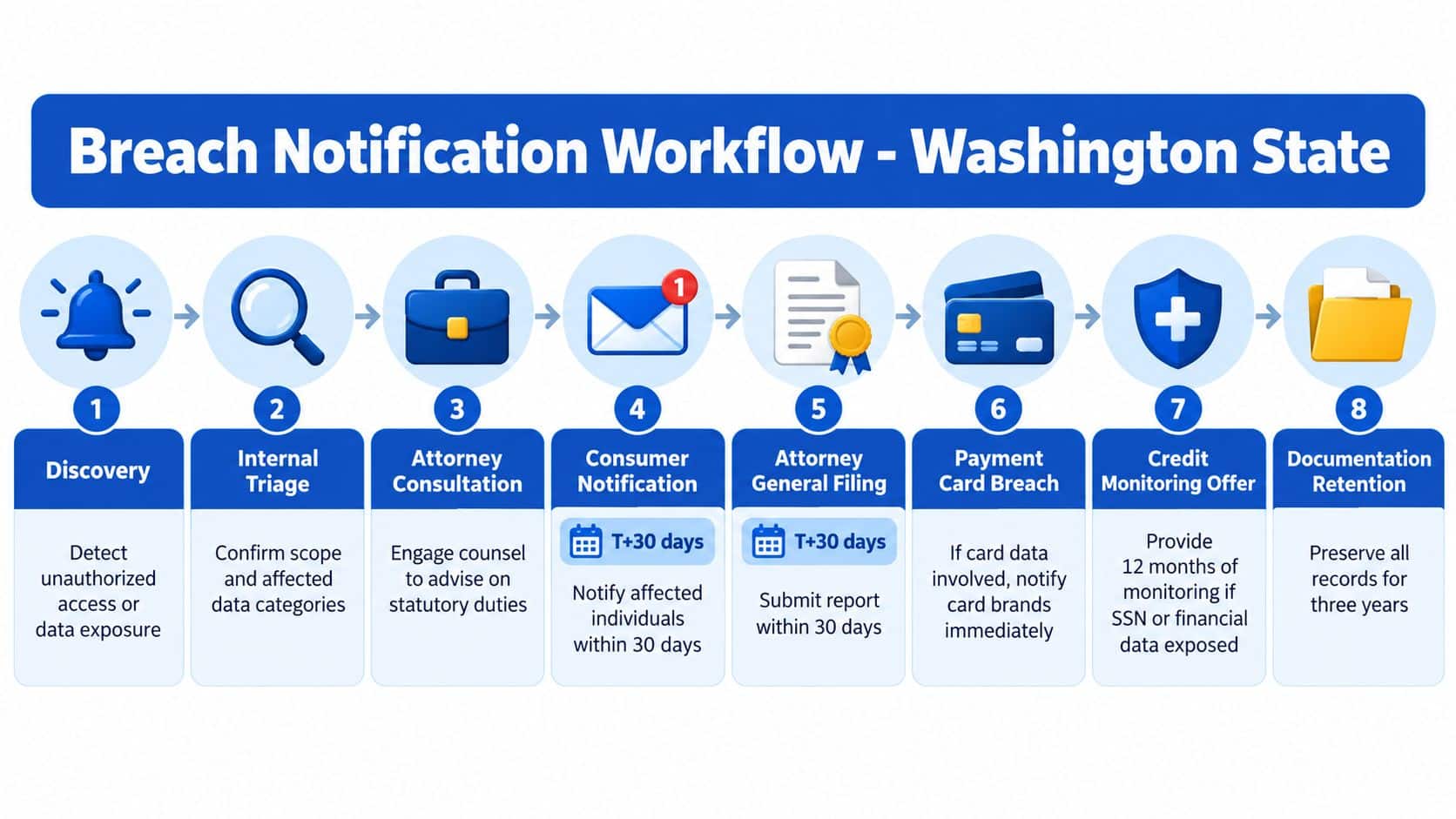
Washington entities must notify affected residents as soon as possible and generally no later than 45 days after discovering the breach. If more than 500 Washington residents are affected, the entity must notify the Washington Attorney General within 30 days after discovery, according to the Washington Department of Licensing privacy guidance. Because Washington materials describe timing and applicability through related requirements, counsel should reconcile the facts and governing provision before communications go out.
The first response window
The company should activate a written escalation process, preserve forensic logs, record discovery and containment timestamps, and identify the systems and data involved. Technical staff should contain the threat without destroying evidence, while legal counsel coordinates the notification analysis and communications record.
A practical sequence looks like this:
- Confirm the alert: Separate a suspected event from a false positive without delaying escalation.
- Preserve evidence: Protect logs, access records, relevant messages, system images, and vendor reports.
- Scope the data: Identify affected fields, individuals, systems, and time periods.
- Assess protection: Determine whether encryption or another safeguard secured the information.
- Analyze acquisition and harm: Decide whether an unauthorized person acquired or may have acquired the information and whether consumers face a risk of harm.
- Coordinate notices: Prepare resident and Attorney General communications when the applicable trigger is met.
- Document the decision: Record facts, assumptions, timestamps, approvals, and reasons for notifying or not notifying.
A decision matrix for Washington incidents
| Question | If yes | If no |
|---|---|---|
| Was personal information acquired, or reasonably believed to have been acquired, by an unauthorized person? | Continue the legal analysis | Record the basis for concluding otherwise |
| Was the information unsecured, such as through encryption? | Continue the legal analysis | Assess whether another rule or contract still requires action |
| Is the incident reasonably likely to create a risk of harm? | Prepare required notices promptly | Document the harm analysis and supporting evidence |
| Are more than 500 Washington residents affected? | Evaluate Attorney General notice | Continue the resident-notice analysis |
Waiting for a complete forensic investigation can create timing problems. Early facts may change, but the company should preserve a dated decision record and update it as evidence develops.
Organizations with field teams, physical assets, or distributed vendors can also review guidance on protecting construction businesses online because incident planning must account for operational systems, not only office laptops. A written cyber incident response plan gives employees a defined path before pressure makes every decision improvised.
Beyond Breaches and Vendor Contracts and AI Exposure
The trouble often starts during an ordinary business decision. A startup signs a new analytics vendor, gives support access to a customer database, or plugs an AI tool into an internal workflow. No one sees a breach, but the company has still created legal exposure if the data moves to the wrong place, gets used for a different purpose, or cannot be accounted for during diligence.
That is why cyberlaw cannot be treated as a breach-only subject. The triggers are operational moments: collecting sensitive data, choosing a vendor, approving cross-border access, and adopting AI before anyone has defined ownership or limits.
The U.S. Department of Justice Data Security Program became effective on April 8, 2025. It restricts certain transactions involving bulk U.S. sensitive personal data or U.S. government-related data connected to countries of concern, including China, Russia, Iran, North Korea, Cuba, and Venezuela, as described in this analysis of U.S. data privacy developments. For companies, that changes how vendor review, data access design, and deal diligence should work. A privacy notice alone will not solve a transfer problem.
Vendor diligence must follow the data
Procurement review should follow the actual data path, not the sales deck. I have seen teams approve a well-known provider and only later learn that support staff, subprocessors, or administrative tools could reach production data from jurisdictions the customer never evaluated.
The better approach is specific. Review the vendor’s subprocessors, support-access model, storage locations, retention practices, model-training terms, incident notice language, audit rights, deletion process, and ability to meet customer commitments. Contract language matters, but system design matters just as much.
- Map access: Identify which vendor personnel and subcontractors can view or administer the data.
- Limit purpose: Prohibit unrelated advertising, model training, resale, or secondary use unless expressly approved.
- Control retention: Require deletion or return when the service ends, subject to documented legal requirements.
- Align notices: Make vendor incident deadlines workable with the company’s own notification duties.
- Review procurement systems: A resource on the risks of procurement platforms can help teams examine how purchasing tools collect, expose, and share supplier information.
AI creates a governance question
AI adds another trigger point. The legal question starts before deployment: what system is being used, who is responsible for it, what data enters it, what outputs matter, and what records the company can produce later.
The EU Artificial Intelligence Act entered into force on August 1, 2024, with staged obligations. Prohibitions on specified AI practices and AI-literacy requirements began applying on February 2, 2025. Rules for general-purpose AI models and governance obligations began applying on August 2, 2025. Transparency requirements under Article 50 and related innovation measures are scheduled for August 2, 2026, while certain high-risk obligations are currently projected to apply on later dates in the Act’s implementation timeline, including December 2, 2027 and August 2, 2028, according to the EU AI Act timeline.
For a Washington startup, that means classifying the AI system, determining whether the company acts as a provider or deployer, documenting inputs and outputs, restricting sensitive data, preserving evaluation records, and assigning one accountable owner. If the business cannot explain purpose, access, controls, decision points, and contractual boundaries, the problem is already here.
Building a Defensible Cyberlaw Baseline
A defensible baseline doesn’t require a startup to treat every framework as mandatory or purchase every security product. It requires the company to understand its own data and make repeatable decisions that match its actual risk.
Five practices with immediate value
-
Maintain an asset and data inventory. List production systems, employee tools, cloud services, databases, payment integrations, AI applications, and physical devices. Link each asset to the data it holds and the person responsible for it.
-
Classify sensitive information. Separate ordinary business records from credentials, financial information, health-related information, government-related data, employee records, and other information that could cause greater harm or contractual exposure.
-
Assign control owners. Name the person responsible for access reviews, patching, backups, vendor diligence, log retention, privacy notices, and incident escalation. Ownership should appear in a current record, not only in a meeting conversation.
-
Document risk decisions. Record why the company accepted a vendor, retained a data field, chose a safeguard, or deferred a control. A short explanation can show deliberate judgment and identify the date for reassessment.
-
Preserve incident-response records. Keep escalation contacts, tabletop results, forensic materials, discovery timestamps, containment actions, legal analyses, and notification decisions in a controlled repository.
The U.S. privacy environment is fragmenting rather than converging. In 2025, the number of states with privacy laws in effect reportedly rose from nine in 2024 to 16, according to this 2025 cybersecurity and data-protection review. A company that sells across state lines therefore needs a trigger-based process rather than a policy copied from one jurisdiction.
A practical operating sequence
A founder can begin with the next product launch, vendor renewal, or financing review:
- Before collecting data: define the purpose, minimum fields, notice, retention, and access.
- Before signing a vendor: review processing, security, subcontractor, deletion, and incident terms.
- Before deploying AI: classify the system, restrict inputs, evaluate outputs, and record oversight.
- After a security alert: preserve evidence, engage the response team, assess legal triggers, and document decisions.
- Before fundraising or sale: assemble policies, inventories, contracts, risk records, and unresolved incident materials.
Two startups can experience the same suspicious login and face very different consequences. One has an inventory, clear ownership, preserved logs, vendor terms, and a tested escalation path. The other has scattered credentials, undocumented data flows, unclear access, and no record of when the event was discovered. Cyberlaw compliance is an ongoing governance cycle, not a one-time policy exercise.
By Design Law Firm & Legal Consultancy, PLLC helps Washington startups and established businesses connect data maps, vendor contracts, privacy programs, risk assessments, and breach-response procedures to their actual operations. Visit By Design Law Firm & Legal Consultancy, PLLC to discuss a practical cyberlaw baseline before the next vendor decision, product launch, or security incident. Contact our law office at (206) 593-1519.