A licensing agreement is a contract that grants defined rights to use intellectual property in exchange for payment, without transferring ownership. In 2022, the global licensing industry was valued at $267 billion, and it grew at a 5.2% CAGR from 2017 to 2022 (industry data).
A founder usually feels this first when a partner sends over a draft that looks harmless on page one and restrictive by page six. The label says “permission,” but the document controls who can use the asset, where, for how long, on what terms, and at what price.
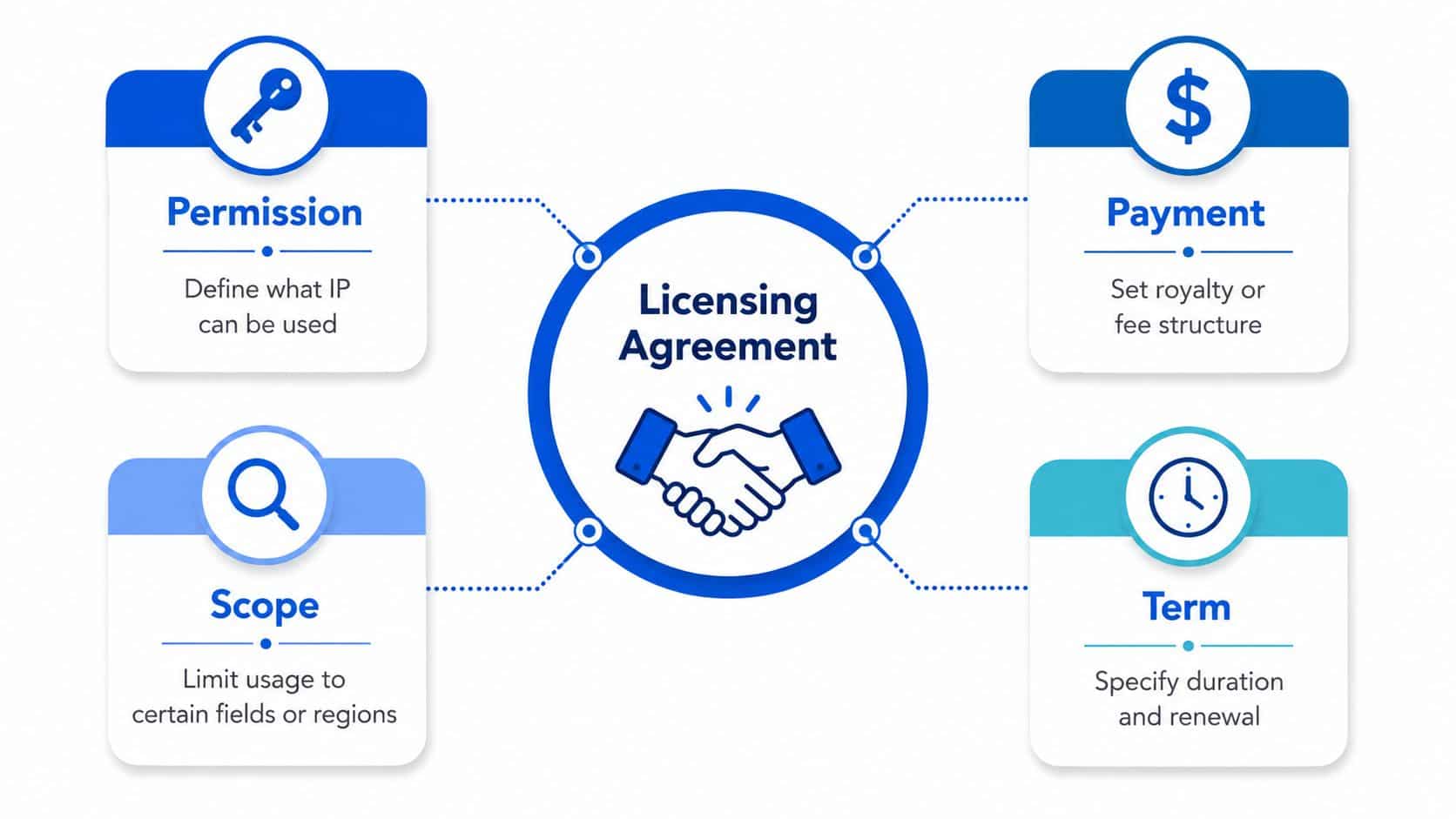
What a Licensing Agreement Does
What a Licensing Agreement Does is grant limited use rights while the owner keeps title and control. It can set royalties, upfront fees, territory, exclusivity, and field of use.
A licensing agreement is not a sale. It does not transfer title the way an assignment does, and that difference matters because the licensor can keep the underlying rights while granting a narrower commercial slice. In practice, that can mean a brand owner keeps the trademark, a software company keeps the code, or a patent holder keeps the invention while granting use under defined conditions.
The payment structure usually reflects that split. Founders often see royalties, upfront fees, or a mix of both, and the balance changes the economics of the deal. That is why the payment section should be read as part of the revenue model, not as filler.
A useful way to read the document is as a commercial-control document. It decides whether the licensee can expand into new channels, whether the licensor can license the same asset elsewhere, and whether the deal stays narrow or becomes the basis for a broader monetization strategy.
Practical rule: if the draft changes territory, exclusivity, or field of use, it is not a cosmetic edit. It changes bargaining power.
The same control issues show up in broader permission-based deals, including a franchise agreement 2026 guide. The legal label changes, but the bargaining logic is similar. Contract scope decides who can sell, where they can sell, and how much control the owner keeps.
That is the frame that matters before anyone starts arguing over small wording choices. The real questions are what rights are being granted, what rights are being kept, and what controls the owner is trying to preserve.
The Four Main Types of Licenses
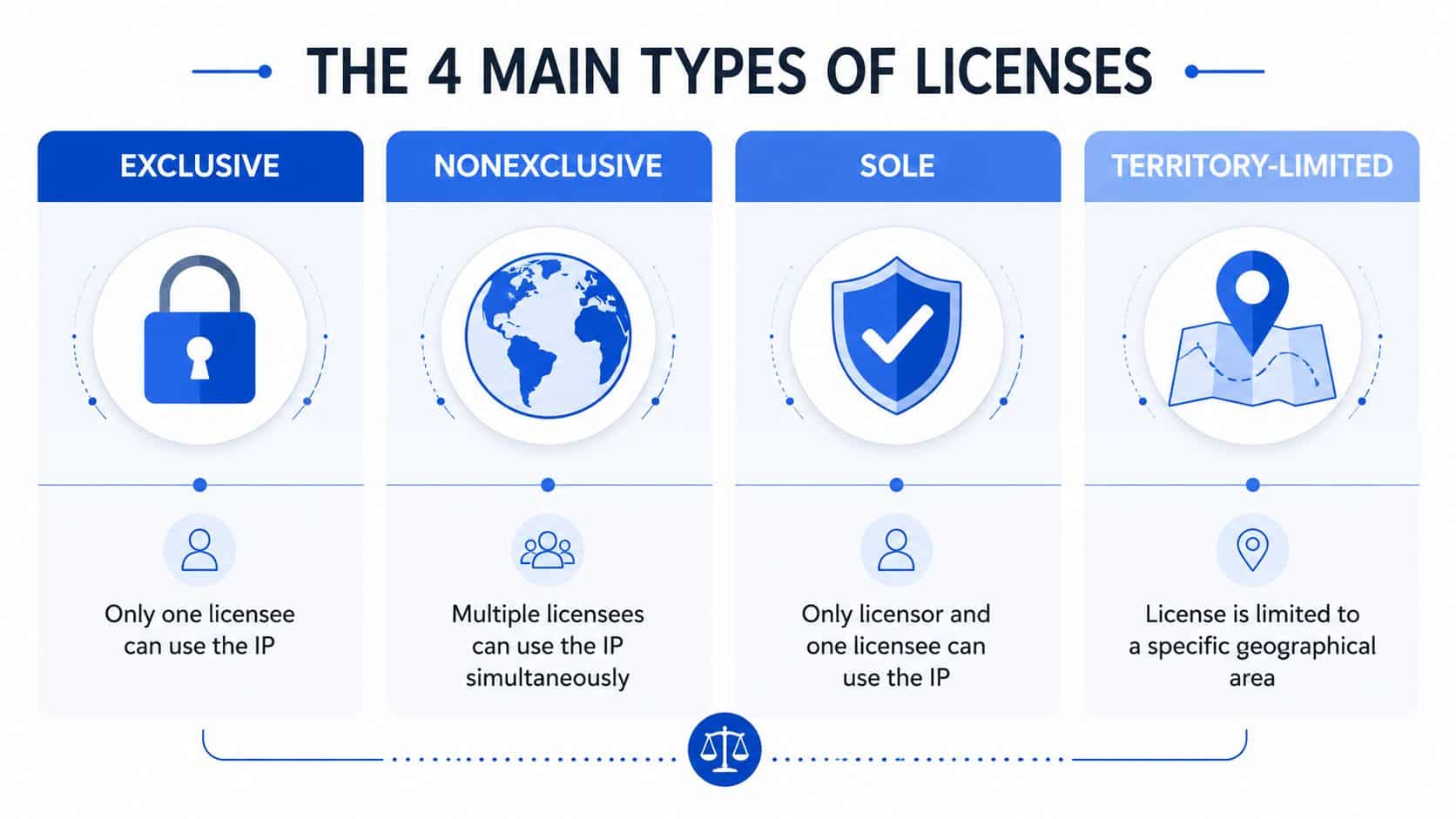
A licensing deal becomes easier to evaluate once the grant is labeled correctly. The four common forms are exclusive, nonexclusive, sole, and territory-limited licenses, and each one changes how much control the licensor keeps over the same asset.
An exclusive license gives one licensee the commercial lane. That structure can make sense for a regional distributor, a strategic software integration partner, or a brand collaborator that needs certainty before spending on rollout. As the exclusivity expands, the licensor gives up more room to license the same asset elsewhere, so scope and price usually move together.
A nonexclusive license lets multiple parties use the same IP at the same time. That fits internal-use software, syndicated content, or brand assets that can support more than one channel without conflict. The licensor keeps the ability to sell again, which is why the economics usually look more modest than a fully exclusive grant.
A sole license sits between those poles. Only the licensor and one licensee can use the IP, so the licensor stays in the commercial picture while still limiting additional third-party licensing. Many deals drift past this structure because the business effect is easy to misunderstand.
A territory-limited license narrows the deal by geography. The same asset may be licensed in one country, one state, or one region while the owner keeps the rest of the map open. That is a common way to segment markets without giving away global control.
The cleanest comparison is simple, who else can use the asset?
| Type | Who Can Use It | Why It Matters |
|---|---|---|
| Exclusive | One licensee, sometimes only within a defined scope | Raises value because the licensor gives up parallel monetization |
| Nonexclusive | Multiple licensees | Preserves licensor flexibility and usually lowers price pressure |
| Sole | Licensor plus one licensee | Restricts third-party licensing without fully surrendering owner access |
| Territory-limited | Defined geography only | Lets both sides segment markets and manage channel conflict |
The first drafting fight is usually not about price. It is about how much of the market the licensee gets to control.
If the deal is software-heavy, a useful comparison point is the free music license template download, because creative-asset licensing often shows how territorial limits and use limits shape the commercial structure. For a broader view of intellectual property rights types, the taxonomy helps separate the rights being licensed from the business controls attached to them.
If you want to see how related contract language allocates risk, the By Design Law Firm guidance on representations and warranties is a useful reference point. Those clauses often sit beside the license grant and tell each side what it is standing behind.
For a closer parallel in a different commercial setting, a template from PuppetVendors for consignment stores shows the same basic bargaining pattern. One party keeps title or core ownership, the other gets limited selling rights, and the document controls where the money, risk, and discretion sit.
Core Clauses That Drive the Deal
The clauses that move value are usually not the prettiest ones on the page. They tell each side who can do what, how money is counted, and how much control remains with the licensor if the relationship turns sideways.
The grant and the money mechanics
The scope of the grant should spell out what IP is covered, what uses are allowed, and whether sublicensing is permitted. Narrow language gives the licensor more control and makes overreach easier to police. Broader language gives the licensee room to grow, but it also gives the other side less room to pull the deal back if the business model changes.
Royalty formulas are the commercial heart of the deal. They set how compensation is calculated, and they usually sit next to minimum royalties, milestones, and reporting obligations. Industry and WIPO guidance treats those terms as central because they make the economics measurable and enforceable (WIPO licensing guidance, technology licensing guidance).
Audit rights matter more than many founders expect. Without them, royalty reporting turns into a trust exercise, and trust is a poor substitute for records you can verify. Minimum royalties and performance quotas also matter because they keep a party from parking rights without using them in the market.
Control and exit provisions
Quality control matters most in trademark and brand licensing, because the owner has to care about how the mark appears in the market. Indemnification decides who pays when a third-party claim arrives, and that clause can separate manageable risk from open-ended exposure. Termination tells the parties how the deal ends, and sometimes it ends faster than the business expected.
| Clause | What It Does | Pressure Point |
|---|---|---|
| Scope of grant | Defines the rights and uses covered | Licensee wants breadth, licensor wants limits |
| Royalty formula | Sets how payment is calculated | Disputes over definitions, deductions, and reporting |
| Minimum royalties | Forces commercial activity | Licensee resists paying for unused rights |
| Milestones | Ties payment to events | Parties argue over timing and proof |
| Sublicensing | Lets rights flow to others | Licensor worries about control loss |
| Audit rights | Allows verification of reports | Licensee resists intrusive review |
| Termination | Ends the license | Both sides fight over cure periods and trigger events |
A practical drafting point shows up in technology deals. Agreements often attach schedules for technical specifications, service levels, acceptance testing, and security requirements, so the license becomes a control framework rather than a passive grant of rights. That is the part that usually determines whether the deal is usable in practice (technology licensing guidance).
For a useful template-style comparison of how detailed business agreements can get, even outside pure IP, the template from PuppetVendors for consignment stores is a practical reminder that payment, reporting, and control language drive real-world risk. For issues around deal promises and allocation of risk, the internal resource on representations and warranties fits naturally alongside these clauses.
How Licensing Looks Across IP Types
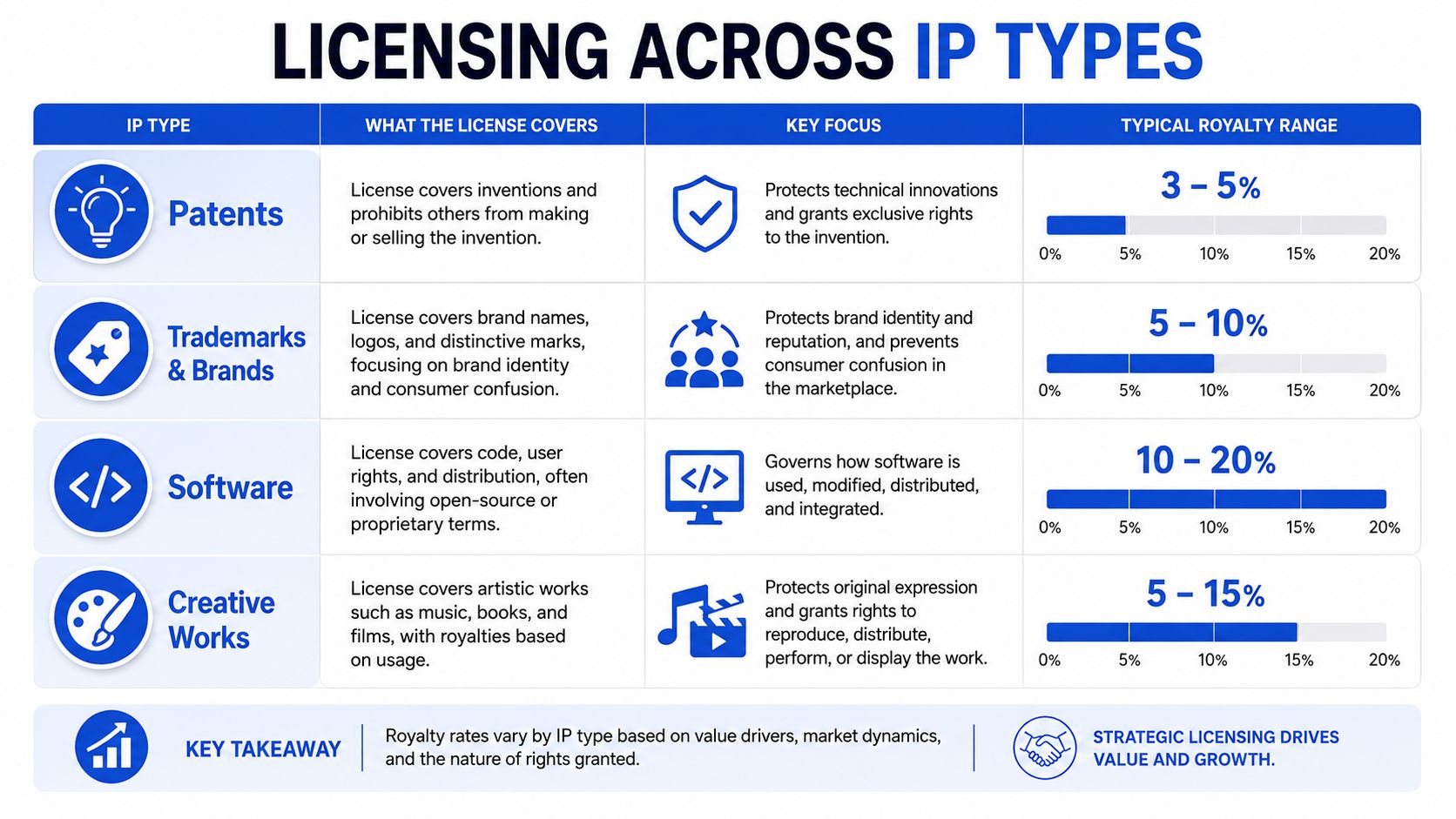
A licensing agreement changes shape fast once the asset changes. A patent deal, a trademark deal, a software deal, and a creative-works deal all use the same basic contract skeleton, but the bargaining power sits in the details, especially field of use, territory, exclusivity, approval rights, and audit rights.
Patents, trademarks, software, and creative works
A patent license usually turns on field-of-use language because the licensor may want one buyer for medical use and a different buyer for industrial use. The fight is often over whether the licensee can make, use, or sell within a tightly defined commercial lane. Payment terms also tend to track development and rollout milestones more closely than they do in a simple resale arrangement.
A trademark or brand license is driven by quality control. If the mark appears on a product, the owner has to care about consistency, brand reputation, and consumer confusion. The licensor may allow use of the mark, but only if packaging, approval rights, and product quality stay under control. For a basic cross-check on asset categories, intellectual property rights types is a useful reference.
A software license often reads like a service governance document. It usually covers who can access the code or platform, what users can do, and how support, security, and updates work in practice. Modern software and data deals can also raise AI-adjacent issues, because use scope and downstream model permissions now matter more than older templates assumed (contracting basics on licensing).
A creative works license usually turns on usage, distribution, and royalties tied to how the work is exploited. Music, books, film clips, illustrations, and similar works often need approval rights, channel limits, and clear accounting language. That is why a music-oriented form can still be a useful drafting reference, even for businesses licensing other content categories, and the free music license template download is a practical example of how those business terms are often organized.
| IP Type | Common Focus | What Usually Drives Negotiation |
|---|---|---|
| Patents | Commercial use of an invention | Field of use, milestones, exclusivity |
| Trademarks and brands | Brand identity and consumer perception | Quality control, approvals, reputation risk |
| Software | Access, deployment, support, and security | User limits, service levels, data handling |
| Creative works | Reproduction, distribution, and display | Usage rights, royalties, territory |
The industry differences are not just legal. They change economics. In licensing surveys, royalty expectations vary with exclusivity and the commercial value of the right being granted, which is why a narrow internal-use software right should not price like a broad brand carve-out or a patent package with market exclusivity (licensing deal survey data).
Negotiation Tactics and Deal Economics
The economics of a licensing deal usually follow the scope of the grant. A narrow, internal-use license leaves the licensor with more future upside, while an exclusive, worldwide, field-of-use license supports a higher royalty expectation because the licensee is getting more commercial freedom and the licensor is giving up more monetization options.
That’s why smart negotiators separate the price discussion from the rights discussion. A licensee often wants lower royalties, but the cheaper move may be to narrow the territory, reduce exclusivity, or limit use to a single channel. Those concessions can be cheaper than a headline rate cut, especially if the business only needs part of the asset’s potential.
Leverage points that actually matter
Minimum royalties and performance quotas are not just financial garnish. They push the licensee to commercialize rather than sit on the rights, which protects the licensor from dead paper deals. Reporting cadence and audit rights should be tied together, because a royalty clause without verifiable reporting is hard to enforce.
Most Favored Nation pricing can matter when a licensor is giving similar rights to multiple parties, but it should be drafted carefully. A vague MFN clause can create comparison disputes that are expensive to resolve. Sublicensing deserves the same attention, because a licensee that can pass rights downstream often needs more control language, not less.
A strong negotiation checklist usually starts with the same three questions:
- What is being licensed? The narrower the asset definition, the easier it is to manage scope.
- Where can it be used? Territory, channel, and field-of-use rules decide market reach.
- How is performance measured? Royalties, milestones, and reporting tell the licensor whether the deal is working.
If the draft gives broad rights but weak reporting, the licensor is taking commercial risk without enough visibility.
For due diligence before a counterproposal lands, the internal checklist due diligence resource fits well. It helps teams pressure-test whether the deal terms line up with the business plan, not just with the vendor’s preferred template.
The core idea is simple. Small wording changes can shift revenue, control, and optionality at the same time. That’s why license negotiations should be treated as commercial design work, not as a document cleanup exercise.
Red Flags and Pressure Tactics to Watch For
A signed license can still be lopsided. The draft may read like a routine permission document while giving one side most of the control over scope, pricing, and exit rights.
Contract red flags
Undefined sublicensing rights are a classic problem. If the draft does not say who can sublicense, on what terms, and with whose approval, downstream use becomes hard to police and even harder to unwind. Vague territory language creates the same risk, because “North America” and “global” can mean very different things depending on the product, the channel, and the customer base.
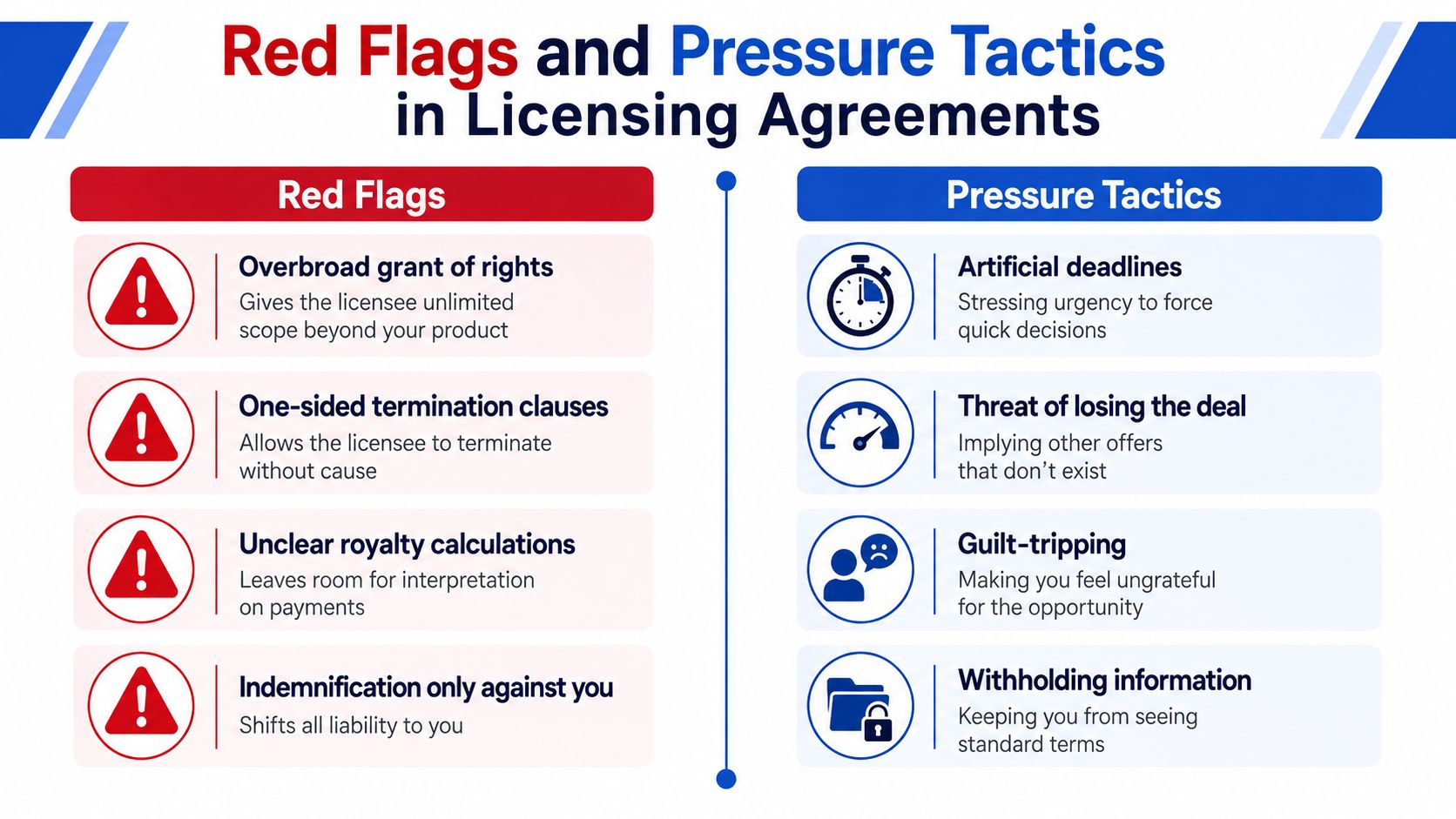
Missing audit rights are another warning sign. A licensor that cannot verify reports has little practical way to confirm royalties, and a licensee that accepts vague reporting can later face a surprise reading of the payment clause. One-sided termination triggers deserve immediate scrutiny, especially if they let one party exit on short notice while forcing the other to live with long cure periods.
Indemnification only against you is also a red flag. If the clause pushes product, third-party, or compliance risk entirely onto the smaller party, the agreement starts to look less like a business partnership and more like a liability transfer. That is the point where the commercial terms stop matching the actual risk profile.
Pressure tactics in negotiation
Artificial deadlines, threats of losing the deal, guilt-tripping, and withholding standard terms all do the same thing, they cut review time. That pressure is especially risky when the subject is software, data, or AI outputs, because modern licensing often turns on scope, dataset provenance, and downstream model use rather than just ownership and royalties (licensing and AI permissions overview).
For older brand deals, recall and product liability exposure can matter just as much. A recent California bill, Assembly Bill 2462, would broaden the way brand licensors could be treated in the product recall framework if enacted, which is a reminder that product-facing licenses can carry regulatory risk beyond ordinary contract language (California recall liability discussion).
Key points that matter
The key pressure points are usually field of use, territory, exclusivity, audit rights, and termination. Those terms decide how much commercial control the licensor keeps and how much room the licensee has to build a business without later getting boxed in. If the grant looks broad but the reporting is thin, the licensor is taking risk without visibility.
A separate trap shows up when a license is drafted as if goodwill will police the relationship. Avoiding the pitfalls of naked licensing matters because a licensor that gives away rights without enough quality control can weaken the value of the mark or brand it is trying to protect. The cleaner the control language, the less room there is for a dispute about whether the deal is still working the way both sides expected.
The practical move is to slow the process down enough to read the risk allocation, not just the cover page. A license that looks routine can still function like a commercial-control document if the scope, exit rights, audit rights, and liability language are off.
When to Bring in Outside Counsel
Some licensing questions are manageable in-house. Others deserve outside counsel before the draft gets anywhere near signature.
Exclusive deals, cross-border deals, and agreements tied to high-value royalty streams are obvious candidates. So are deals involving AI training, data-use rights, or any provision where indemnification exposure could exceed the contract value. Those are the moments when one clause can change the business model, not just the paperwork.
Before the first attorney meeting, bring three things. A one-page summary of the deal, the full draft agreement, and a short list of items you must secure. If the business already has internal red lines on territory, payment, or sublicensing, put them in writing so counsel can work against a real standard instead of guessing.
A lawyer with IP, contract, and technology transactions experience is the right fit for most licensing work, especially when the agreement also touches privacy, cybersecurity, or software support. For Washington State founders and companies in the Greater Puget Sound, that mix matters because the same deal can involve business formation, data governance, and brand protection at once.
The most expensive licensing mistake is usually not the royalty rate. It’s the clause that transfers risk the business never meant to take.
By Design Law Firm & Legal Consultancy, PLLC handles licensing, technology transactions, intellectual property, and data privacy work for startups and growing companies that need a commercial contract to match the business plan. For a licensing draft that affects revenue, control, or AI-related rights, visit By Design Law Firm & Legal Consultancy, PLLC to review the firm’s services and start the conversation. Call our law office today at (206) 593-1519.