Post-merger integration is where deals actually get made or broken. You've closed the transaction, signed the papers, and now comes the hard part: turning two separate companies into one coherent operation without losing customers, talent, or revenue along the way. It's a bit like rewiring a building while the lights stay on—everything has to keep running even as you tear out old infrastructure and thread in the new. As recently highlighted by a Bain & Company report, successful integration is the primary driver of deal value, yet fewer than one-third of mergers achieve their stated synergy goals.
What Post Merger Integration Actually Looks Like
Here's something that surprises most first-time acquirers: integration doesn't happen in neat, sequential steps. You can't finish people issues, then move on to IT, then tackle finances. The real work demands simultaneity. Think of it as six interdependent pillars advancing in parallel—People, Systems, Finances, IP, Contracts, and Data Security—each with a clear owner and a concrete 30-day priority so nothing falls through the cracks.
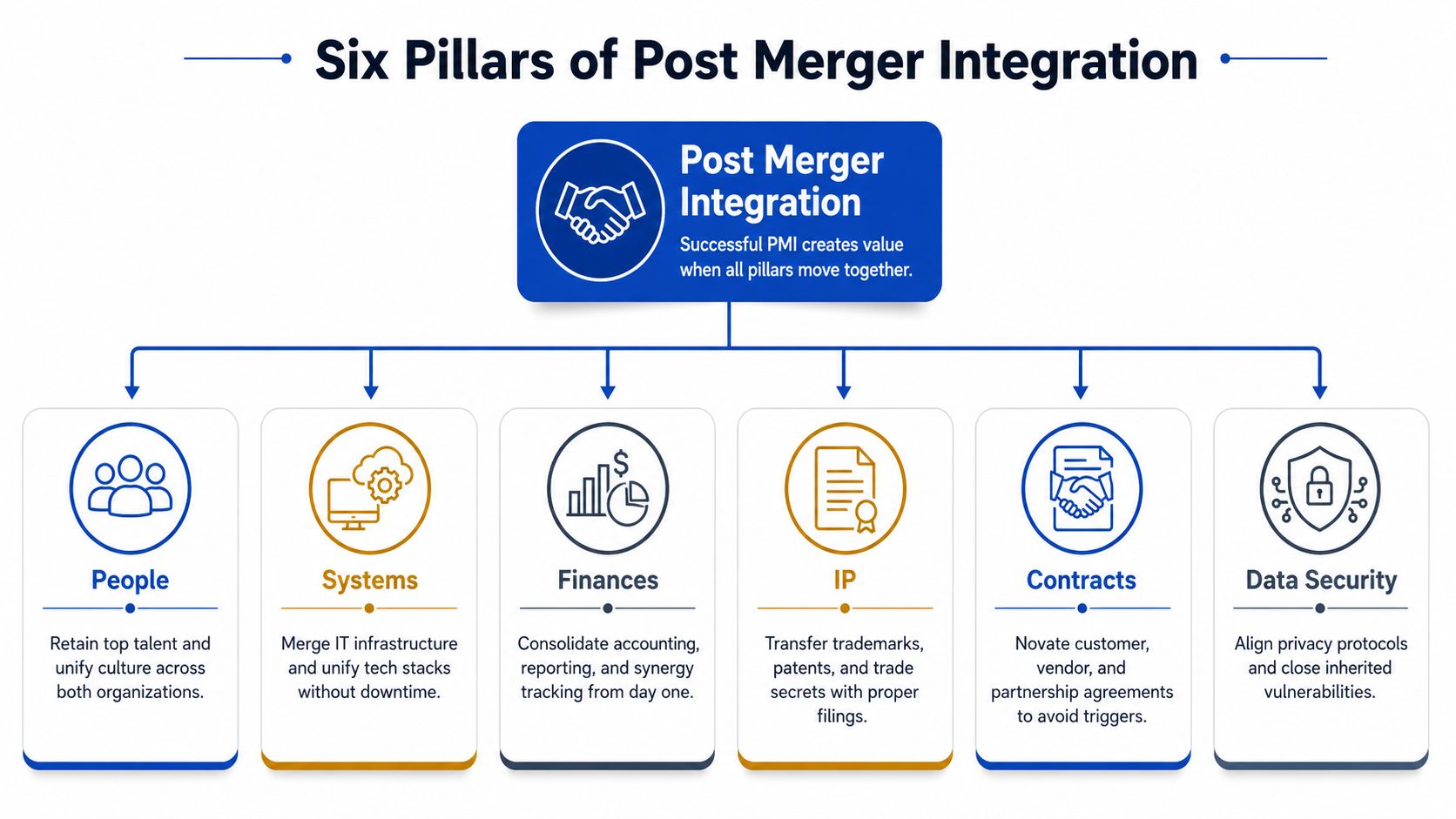
The diagram above maps out how these six pillars connect and why they need to move together. When one workstream stalls, the others feel it almost immediately. A delay in finalizing employment agreements ripples into IT access issues. A contract novation backlog puts revenue at risk. The visual shows how parallel progress reduces single-point failure risk and surfaces those cross-pillar dependencies early, so tactical fixes don't end up masking strategic gaps.
"Integration is operational work that eats strategy if left unmanaged" — treat execution like concurrent engineering, not a relay race.
The core idea here is that integration isn't a phase you hand off to an integration manager and check in on quarterly. It demands the same rigor and cross-functional coordination as a product launch, with weekly visibility into what's working and what's breaking.
Six Pillars of Post Merger Integration
| Integration Pillar | Primary Objective | First 30-Day Priority |
|---|---|---|
| People | Retain talent and unify culture | Confirm retention offers for top 10% of earners |
| Systems | Merge IT without outages | Inventory systems of record and define freeze windows |
| Finances | Consolidate reporting | Reconcile month-end close process |
| IP | Preserve ownership rights | Record assignments and update filings |
| Contracts | Prevent termination triggers | Identify change-of-control clauses and notify key counterparties |
| Data Security | Close inherited vulnerabilities | Run an external vulnerability scan and patch plan |
This table gives you a snapshot of the essential workstreams every integration leader needs to coordinate from day one. Each pillar has a distinct primary objective, and the 30-day priority column tells you where to start before competing demands pull your team in every direction.
So where do you actually begin on day one?
Get the right people in the room. Identify pillar leads who have real decision authority—not just advisory roles. Pair each lead with a deputy so coverage doesn't depend on a single person. Then establish a combined RACI for high-risk activities like payroll transfers, IP assignments, and vendor novation. If you only do one thing in the first week, make it this.
Run a 30-day stabilization sprint. Focus on four things that cannot break: continuity of revenue, payroll accuracy, security posture, and critical contract maintenance. Everything else can wait. The sprint isn't about transformation yet—it's about making sure nothing collapses while you figure out the longer playbook.
Here's what that parallel work looks like in practice:
-
People — Finalize key retention targets, communicate role changes to affected teams, and secure critical employment agreements before uncertainty drives your best people to update their resumes.
-
Systems — Map systems of record across both organizations, freeze nonessential changes to avoid mid-integration surprises, and plan a phased cutover so business units aren't hit with downtime during the transition.
-
Finances — Align ledgers, set a consolidated reporting cadence, and start tracking synergies with measurable KPIs so you can demonstrate progress to the board within the first quarter.
On the tools side, you'll need a project management setup that can handle cross-pillar workflows and give you a single view of dependencies. For practical guidance on what to look for, check out project management apps features.
Before you close, make sure your due diligence foundation is solid. A weak due diligence process creates integration problems that no amount of project management can fix. See the due diligence checklist for legal teams and executives looking to get ahead of the common pitfalls.
Measure early, measure often. Pick a small set of cross-pillar KPIs—employee retention rate, system uptime, days to consolidated close, open IP matters—and publish a weekly integration dashboard. Stakeholders stay aligned when they can see progress, and accountability becomes a lot harder to dodge when the numbers are sitting in everyone's inbox every Friday.
Washington State Rules You Cannot Afford to Miss

National integration playbooks are useful — until they aren't. They break down fast when they hit the specific compliance requirements that Washington State imposes on mergers, acquisitions, and corporate restructurings. Your post-merger integration plan needs to account for these Washington-specific rules from the very beginning, not as an afterthought.
The Washington Business Corporation Act governs corporate governance changes and director approvals for a large number of deals in the state. Stock transfers, amendments to articles of incorporation, and certain shareholder approvals each carry procedural steps that are easy to overlook. Miss one, and you could face a delayed filing — or worse, a voided corporate action that unravels key parts of the deal.
Employment law is another area that trips up even experienced deal teams. Washington doesn't simply follow federal guidelines; it layers on its own requirements around wage statements, final pay timing, and leave accruals. When employees transfer between entities or exit the company, these rules directly shape how you structure retention offers and time your communications.
Failure to align local employment timelines with legal requirements is one of the most common sources of claims — and those claims can derail integration goals fast.
Data privacy deserves special attention here. The Washington My Health My Data Act, along with ongoing state-level consumer privacy developments, has upended the data privacy landscape. When you're consolidating employee health records or consumer data, expect consent and retention obligations that go well beyond what federal law requires.
Then there are the filings that routinely get missed. Secretary of State entries for IP assignments and business name changes need to be handled carefully. Recording trademark assignments or transferring LLC interests often involves specific documents and fee schedules unique to Washington. Overlooking them can weaken your chain of title in ways that surface months later at the worst possible time.
Common Washington Steps to Prioritize
- File corporate amendments and notices promptly to preserve authority to act on behalf of the combined entity.
- Review payroll and final wage rules so that retention payments and employee exits comply with state-specific timelines.
- Map health and consumer data flows against My Health My Data Act standards and update your privacy notices accordingly.
- Record IP assignments with the Secretary of State where applicable, and confirm that USPTO records are consistent.
Washington also enforces change-of-control triggers in public benefit corporations and certain regulated industries. Utilities, healthcare providers, and firms holding state contracts may need pre-approval or formal notice to agencies before any integration actions can proceed. Ignoring these triggers can stall the entire post-merger timeline.
Practical Checklist for Counsel and Executives
- Confirm that board and shareholder approvals match Washington statutory language and timing requirements — not just your home state's.
- Audit employment contracts for state-specific termination provisions, notice obligations, and equity transfer rules.
- Run a data inventory focused on healthcare and consumer data categories, then update consent records to reflect the new organizational structure.
- Submit Secretary of State filings for IP or ownership transfers at the earliest practical window — don't let these sit while you focus on systems integration.
Treat Washington compliance as a parallel workstream in your integration plan. It's the single most effective way to reduce last-minute legal friction and preserve deal value.
Real-world examples make the risks tangible. One Seattle-based acquirer postponed recording trademark assignments after closing, only to find a third party asserting months later that it held prior rights. The resulting dispute complicated rebranding efforts and sales operations for the better part of a year. In another case, a midmarket buyer overlooked Washington's final-pay requirements and faced a wave of wage claims that consumed enormous legal and HR bandwidth during the critical stabilization sprint.
For practical guidance on handling pre-adverse employment notices during integration, read our guide.
Build Washington rules into your RACI matrix. Classify them as non-negotiable tasks. Make sure your integration dashboard tracks state filings and labor milestones alongside systems and finance KPIs. When federal and Washington obligations stay synchronized, local law stops being a costly afterthought and starts being just another managed part of your post-merger integration.
Aligning People and Culture Without Breaking Either
Culture is usually the silent deal-maker or deal-breaker in any merger. A 2021 study by Willis Towers Watson found that transaction-related people risks, including cultural misalignment, were the top contributors to deal failure. Treating the people side as an afterthought? That's a gamble most companies can't afford to lose.
Think of cultural integration less like a corporate restructuring and more like restoring a wetland. You don't bulldoze the native plants and lay down sod. You remove what's harmful, protect what's essential, and give the local ecosystem time to find its footing. The same principle applies here: gradual, evidence-based moves consistently outperform aggressive mandates that treat every team the same.
Start by running a rapid cultural assessment to surface friction points and hidden strengths before they become problems.
Use a mix of surveys, structured interviews, and a handful of focus groups to map out how each organization actually operates—their values, how decisions get made, what rituals matter. A 30-day assessment gives you enough signal to prioritize retention and governance moves without grinding operations to a halt.
Quick Framework for Retention and Role Clarity
- Pinpoint the top 10–15% of contributors who drive revenue or own critical product knowledge, and get retention packages locked in within 30 days. Build those agreements around clear performance triggers and vesting schedules tied to integration milestones—not just time served.
- Harmonize compensation using transparent band mapping so people understand exactly where they land and, more importantly, why. Rumors thrive in ambiguity, and ambiguity drives attrition.
"Clarity beats optimism" — when people know what's coming next and see fair treatment, voluntary departures drop.
When you're sorting out reporting lines, keep spans of control manageable and avoid dual reporting for at least one quarter. Nothing slows decision-making faster like two bosses with different priorities. Temporary steering committees with built-in sunset dates work far better while things settle.
Working Across Cultures and Everyday Practices
When you're bringing teams together, figuring out how to work effectively across cultural backgrounds isn't a nice-to-have—it's the difference between integration that sticks and integration that frays. For practical approaches worth bookmarking, check out the working across cultures guide.
The most effective changes are often the simplest: shared onboarding rituals, agreed-upon meeting norms, and a straightforward glossary that translates role titles and acronyms between the two organizations. These small moves cut daily friction and speed up real collaboration.
- Rituals that help: a common status template, 15-minute daily standups for cross-functional squads.
- Communication ground rules: set clear response-time expectations and pick a single source of truth for project documentation.
Governance and Decision Rights
Set up a lightweight, temporary governance model that spells out decision rights across six areas that matter most: people, systems, finances, IP, contracts, and data security.
Be specific about who can escalate, who holds final signoff, and which decisions require unanimous agreement. Track everything on one dashboard so you're not re-litigating the same arguments every other week.
- Appoint integration pillar leads who actually have authority to make calls.
- Pair each lead with a deputy from the other company.
- Publish a RACI for the top 20 integration tasks.
This structure keeps personality clashes from freezing operational progress while giving the emerging culture room to develop on its own terms.
Washington Employment Law Practicalities
Retention agreements need to play by Washington's wage and final-pay rules. Structure the timing and tax treatment carefully to avoid wage claims down the road. And before you finalize any noncompete, non-solicit, or severance language, run it by counsel—Washington law puts real limits on enforceability in certain contexts. Bake these legal constraints into your RACI and track them with the same urgency as any other critical milestone.
Practical Example and Next Steps
One midmarket tech acquirer ran a 30-day stabilization sprint that locked in five key retention agreements, stood up a temporary governance board, and rolled out a unified meeting cadence across both teams. Voluntary attrition dropped by 40% in the first three months, and product delivery never missed a beat.
If you're leading integration work, here's where to focus next: run a rapid cultural audit, finalize your top retention offers, publish a temporary governance charter, and standardize the daily operating norms that keep people aligned.
Read also: When transitions do become necessary, our Employee Offboarding Checklist covers the employee separation practices that protect your organization.
Merging Technology Systems and Locking Down Data

Merging technology systems during a deal is a lot like replacing a building's plumbing while tenants still have the water running — you need a staged approach with clear shutoff points so nobody gets flooded. Start by building a fast, zero-blame inventory: list every system of record, identity provider, and third-party API, along with who owns each one and when support windows close. That inventory becomes the single source of truth for both technical and legal teams, and it prevents ugly surprises six weeks in when someone realizes the billing platform can't talk to the CRM.
Once you've got that map in hand, run a phased data flow analysis so you can see exactly where sensitive records cross boundaries. Picture customer data flowing from the CRM into billing, then into analytics — and mark any health or payment data that triggers special handling under Washington statutes. You need to know where that data moves before you move it.
Quick Technical Priorities
- Build an application inventory that notes vendor contacts, contract renewal dates, and license transfer requirements for each system.
- Tag every system using a TIME classification — Tolerate, Invest, Migrate, Eliminate — so your team has a shared language for cutover sequencing.
- Freeze nonessential changes during stabilization sprints to keep integration risk contained.
Key takeaway: An early freeze window cuts down on accidental regressions and keeps daily business operations steady while migrations are underway.
Harmonize identity and access controls before you start moving significant amounts of data. Stand up a single identity provider or set up short-term federation with strict least-privilege defaults, solid logging, and multifactor authentication across the board. This approach stops privilege drift in its limits the blast radius if inherited accounts turn out to be compromised.
Numbered steps for secure access consolidation:
- Audit privileged accounts and remove anyone who hasn't logged in for months.
- Enforce MFA and role-based access control across every system in scope.
- Consolidate logging into a centralized SIEM or cloud-native logging stack so you actually have visibility.
When cloud migration enters the conversation, lean toward incremental lift-and-shift for low-risk workloads and save replatforming for mission-critical apps — but only after you've mapped out the dependencies. This keeps downtime minimal and SLAs intact.
Security and Compliance Focus
Washington-based companies have to pay close attention to state privacy rules, especially when health-related records are involved. Refresh your incident response plans to include merged notification chains, a common runbook, and updated legal contacts for breach reporting. Don't assume the acquiring company's plan fits the combined entity — it rarely does.
Bullet checklist for incident readiness:
- Run a combined tabletop exercise within 30 days of close.
- Reissue data processing agreements that reflect novation or assignment of contracts.
- Identify and prioritize inherited vulnerabilities with an external scan and a concrete patching schedule.
Vendor contracts deserve early legal attention, and this is where deals often stumble. Novation, consent, or assignment language can block a migration entirely if nobody reads the fine print. Build a contract tracker that links each system component to its specific contract clause and renewal date so nothing slips through the cracks.
Stat: According to Deloitte, unidentified technology and vendor contract issues are a leading cause of integration delays and budget overruns. Early discovery of novation clauses prevents avoidable downtime and contract disputes.
A practical example for CTOs and counsel:
- Build a shared checklist that pairs each system owner with a legal reviewer.
- Schedule weekly touchpoints during the first 90 days that publish a short status dashboard covering system uptime, open vulnerabilities, contract blockers, and access exceptions.
For teams that want to dig into classifying sensitive assets before migration, read more about data classification in our article.
Final Tips
- Publish a migration playbook that includes rollback steps for every cutover — because no plan survives first contact with production unchanged.
- Use feature flags to decouple deployment from release wherever your architecture allows it.
- Treat data security as a continuous workstream, not a one-time checklist. Customer trust and regulatory compliance both depend on sustained attention long after the integration wraps up.
Protecting Contracts and Intellectual Property Through Transition

Contract and IP risks have a nasty habit of staying hidden until a counterparty or competitor forces the issue. The first step? Map out every customer, supplier, franchise, open-source dependency, and R&D agreement. You are looking for change-of-control clauses and assignment restrictions that could pull the plug on your revenue streams overnight.
Once you have that map, build a contract migration tracker. This tool should capture the following to help you prioritize the chaos:
- Counterparty name, contact, and specific notice requirements.
- Trigger language and your remedy options.
- Financial value and the revenue sitting at risk.
- Required consents, novation deadlines, or termination dates.
Think of this tracker as the single source of truth for your legal, sales, and integration teams. It tells you exactly what needs a notice, what needs negotiation, and what needs an immediate workaround. For instance, a customer contract representing $3M in ARR with a 30-day consent clause should absolutely take priority over a low-value vendor whose assignment is automatic.
Recording IP Assignments And Maintenance
You need to record assignments promptly to keep your chain of title clean. For trademarks and patents, file assignment records with the USPTO and update notices with the Washington Secretary of State when state filings come into play. When it comes to copyrights, written assignments and deposits are your best bet.
- File USPTO assignment recordations for trademarks and patents within weeks of closing.
- Submit state-level documents affecting franchises, trade names, or LLC interests to the Washington Secretary of State.
- Keep a renewal calendar so high-value marks do not accidentally lapse.
Expert takeaway: Getting these filings done on time lowers the risk of third-party challenges and makes rebranding or licensing decisions much easier down the road.
Open Source And AI Related Risks
Open-source obligations can stick around long after an acquisition closes, bringing distribution, copyleft, or attribution duties with them. Take inventory of your codebases and run an open-source license audit early. You need to spot restrictive licenses now before they force a costly redesign later.
Then there are the emerging AI IP risks. Provenance of training data is often murky, and ownership disputes over models or outputs are becoming common. If you are a Washington acquirer, document your datasets, model development records, and licenses for third-party models thoroughly. It is the best way to head off future disputes.
Practical Steps For Contracts And IP Migration
- Triage agreements based on revenue and operational impact, then assign an owner to each.
- Send standardized notices where consent is required, and log every response in the tracker.
- Negotiate short-term standstill or transition agreements when counterparties push back on assignment.
- File those USPTO recordations and state filings, and keep proof of submission in the tracker.
- Remediate open-source triggers by replacing, relicensing, or segregating code as needed.
Templates And Communication Tips
- Use a short, factual notice template that cites the specific clause and proposes a limited transition plan.
- Offer counterparties commercial incentives when consent speeds up integration—think pricing safeguards or service continuity commitments.
- Keep communications transparent but narrow. Stick to legal and operational facts to avoid accidentally triggering a termination event.
| Document Type | Immediate Action | Owner |
|---|---|---|
| Customer contracts | Check consent triggers; notify if required | Commercial lead |
| Vendor agreements | Review assignment/novate options | Procurement |
| Trademarks/patents | File USPTO and state assignment recordations | IP counsel |
A consistent process, quick filings, and targeted communication are what preserve value and keep disputes at bay during post-merger integration. For deals in Washington, make those Secretary of State and USPTO recordation steps non-negotiable items on your Day-1 checklist.
Spotting and Surviving Common Integration Pitfalls
Even well-run post merger integration efforts slam into unexpected walls that bleed value fast. Small misses—late financial consolidations, untracked vendor novations, muddy reporting lines—compound into lost revenue and fractured teams. Here’s where the leaks tend to show up, and how to plug them before they widen.
Poorly tracked synergy targets are usually the first casualty. When finance closes monthly reporting late, boards lose confidence and executives spend their days firefighting instead of leading. Set a consolidated close cadence early, and publish a weekly KPI pack that tracks days to close, revenue at risk, and retention metrics. That way slippage becomes visible before it becomes a crisis.
Customer attrition tends to spike when transitions drag on. Billing or support handoffs that haven’t been tested produce outages or incorrect invoices—and customers notice immediately. Map customer journeys carefully, assign single-owner transition leads, and run parallel billing validation for at least one full cycle before cutting over.
AI adoption introduces a fresh set of risks in merged entities. Agentic or generative AI can speed up integration analytics, but it also brings training-data provenance issues and IP ambiguity along for the ride. Document datasets, model licenses, and inference logs from day one. Build an AI checklist that covers governance, bias testing, and vendor contract rights before deployment, not after.
Operational friction often traces back to overlooked contract language. Change-of-control and assignment clauses can block novation or trigger termination without warning. Prioritize contracts by revenue impact and legal risk, then send standardized notices and log responses in a contract tracker tied to integration milestones.
Early visibility beats late surprises
A simple risk matrix that maps likelihood against impact helps you prioritize where to focus. A practical setup might look like this:
- High likelihood, high impact: payroll errors, change-of-control terminations
- High likelihood, medium impact: access provisioning delays, minor vendor novations
- Low likelihood, high impact: IP chain-of-title challenges, major regulatory consents
Prioritize With Practical Steps
- Run a 30-day stabilization sprint focused on revenue continuity, payroll, security, and top customer contracts.
- Publish a weekly dashboard with three cross-pillar KPIs and exception flags.
- Assign owners for AI provenance, contract novation, and consolidated reporting with clear escalation paths.
Quick Tools and Templates
- Contract tracker template linking clause, owner, value, and consent status
- Weekly KPI dashboard template for integration leads
- AI provenance checklist for models, datasets, and vendor rights
Short, concrete cycles of visibility and remediation keep small issues from becoming deal killers—and help your combined company actually capture the value the deal promised.
Frequently Asked Questions About Post-Merger Integration
How Long Should Full Operational Integration Take for a Mid-Sized Tech Acquisition?
Plan on 9–18 months to get everything fully integrated. Start with a tight 90-day stabilization sprint focused on locking down revenue, payroll, security, and key contracts. This phased approach keeps the business running smoothly while your parallel workstreams gradually come together.
What Are the First Three Legal Filings Required in Washington State Within 30 Days of Closing?
You need to file corporate amendments or a notice of change with the Washington Secretary of State, record any applicable IP assignments, and update business licenses or tax registrations to reflect the new ownership. Getting these filed right away protects your authority to act and secures the chain of title.
How Do We Handle Employee Stock Options and Equity Awards During Transition?
Start by triaging outstanding awards and confirming the vesting acceleration rules. Then, clearly communicate the conversion mechanics to your team. Issue straightforward grant replacement or assumption letters, and make sure you document the tax implications under Washington wage and withholding rules so there are no surprises later.
When Should We Engage Outside Counsel Versus Relying on Internal Teams for IP and Data Privacy Audits?
Bring in outside counsel for title recordations, novations, and complex IP provenance issues. Your internal teams can handle the initial inventories and mapping. However, when dealing with sensitive datasets and regulatory compliance under Washington privacy laws, it is smart to bring external counsel in early.
Explore how AI business intelligence supports post-merger integration decisions with the founder’s guide to AI BI.
For expert guidance contact By Design Law Firm & Legal Consultancy, PLLC at https://www.bydesignlaw.com. Contact our law office today at (206) 593-1519.