A lot of people reach this issue in the same state. They haven't slept well, their phone is full of screenshots, and they need to know what happens next. Sometimes they're trying to get protection from someone who won't stop contacting them. Sometimes they're holding papers that say a hearing is already set, and they have no idea how serious that is.
In Washington, protection order cases move fast. A judge may review allegations before the other side has a chance to respond. Deadlines come quickly. Small procedural mistakes can shape the outcome as much as the underlying facts. That's why the role of a restraining order lawyer isn't just filling out forms. The essential work is choosing the right order, framing the facts in a legally usable way, and avoiding preventable errors at the hearing.
The legal system feels impersonal when the facts are profoundly personal. One person is afraid to list a home address. Another is worried that a temporary order will affect parenting, housing, or work before there has been a full hearing. Both problems are real, and both require a strategy grounded in Washington procedure rather than internet generalities.
Readers looking for broader legal guidance in Washington can start with By Design Law Firm & Legal Consultancy, PLLC, but the immediate priority in a protection order case is understanding the process in concrete terms. The right next step depends on whether the person is asking the court for protection or responding to allegations.
A protection order case is often won or lost on details that don't look dramatic on paper. Dates, service, exhibit organization, and witness preparation matter.
A calm approach helps. Write down the timeline. Save every message in its original form. Identify witnesses who personally saw or heard events. If a hearing date is already set, act quickly. Waiting for the situation to "settle down" is one of the most common ways people lose control of a case they might otherwise have handled well.
Introduction Navigating a Personal Crisis with Legal Clarity
The first hard moment usually isn't in court. It's at a kitchen table, in a parked car, or late at night while reading court paperwork on a phone screen. One person is deciding whether the conduct has crossed the line from upsetting to legally actionable. Another is trying to understand how a temporary order could be issued before a full hearing has happened.
That confusion is understandable. Washington uses several different forms of protection orders, and each one has its own requirements. The name of the order matters because it affects what the court expects the petitioner to prove, what defenses are available, and what restrictions might be entered if the order is granted.
What people usually need first
At this stage, individuals don't need abstract legal theory. They need a short list of practical priorities:
- Safety first: If there's immediate danger, call 911 and focus on physical safety before anything else.
- Preserve the record: Keep texts, emails, voicemails, call logs, photos, and social media posts in their original form.
- Build a timeline: Judges often absorb a case more clearly when events are presented in date order with specific incidents.
- Avoid self-help mistakes: Don't contact the other side to argue the merits of the case. That often creates new evidence for the hearing.
- Get legal advice quickly: A restraining order lawyer can spot procedural issues that a person under stress may miss.
People often assume the judge will "just understand" what happened if they tell the truth. Courts don't work that way. The judge has to match facts to legal elements, and that requires organization, admissible evidence, and a presentation that stays focused on conduct the law covers.
Why clarity matters early
The earliest decisions affect everything that follows. If the wrong type of order is filed, the case starts on weak footing. If a respondent ignores papers because they sound exaggerated, the court may still proceed on a dangerous timeline. If evidence is scattered across devices and apps, the hearing can become harder than it needs to be.
Practical rule: In a protection order case, urgency doesn't replace preparation. It increases the need for it.
A good restraining order lawyer brings order to a chaotic situation. That means turning a stressful personal story into a case the court can evaluate. It also means explaining trade-offs. Some cases need immediate emergency relief. Others need a more careful filing with better corroboration. Some respondents should contest aggressively. Others should focus on narrowing terms and avoiding collateral harm.
Understanding Washington State Protection Orders
Washington doesn't use one single order for every safety concern. The right remedy depends on the relationship between the parties and the conduct involved. That threshold question matters because courts don't evaluate a family violence allegation the same way they evaluate repeated harassment by a neighbor, coworker, or former friend.
The main categories to know
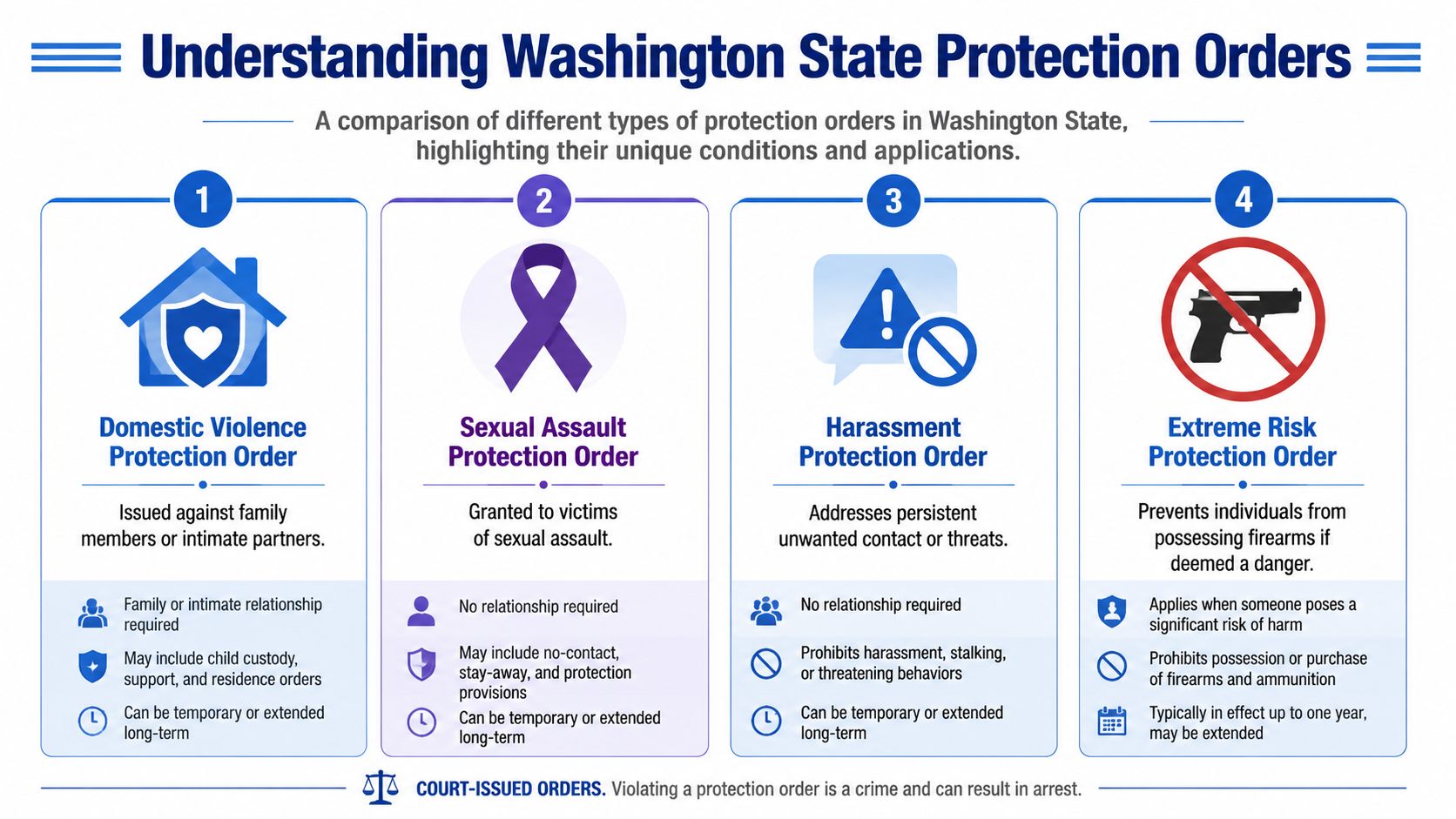
A Domestic Violence Protection Order generally applies when the parties have a qualifying family or intimate relationship. A Civil Antiharassment Order is commonly used when there isn't that domestic relationship but there is a pattern of unwanted conduct or threats. A Sexual Assault Protection Order addresses sexual assault allegations. An Extreme Risk Protection Order focuses on firearm-related danger and has its own procedural and evidentiary features.
A lot of confusion comes from using "restraining order" as a catch-all phrase. In everyday speech that's common, but in court the exact order type matters. Filing under the wrong category can weaken a case before the hearing even starts.
Washington State Protection Orders at a Glance
| Order Type | Relationship Requirement | Conduct Covered | Typical Duration |
|---|---|---|---|
| Domestic Violence Protection Order | Family or intimate relationship required | Domestic violence, abuse, threats, related conduct | Generally one year from entry |
| Civil Antiharassment Order | No domestic relationship required | Unlawful harassment, repeated unwanted contact, threats | Generally one year from entry |
| Sexual Assault Protection Order | No domestic relationship required | Sexual assault and related conduct | Varies by order entered |
| Extreme Risk Protection Order | No domestic relationship required in the same way as domestic orders | Danger involving firearm possession or access | Varies by order entered |
For two of the most commonly encountered Washington orders, duration is a concrete issue. A Civil Antiharassment Order or Domestic Violence Protection Order is generally effective for one year from the date it is entered, and the petitioner must return to court to renew it if the restrained person remains a threat, as noted by Northwest Law Group's discussion of Washington protection order duration.
That one-year structure changes strategy for both sides. Petitioners need to calendar renewal issues early instead of assuming the order will continue automatically. Respondents need to understand that even a limited-duration order can create immediate consequences for contact, access, and daily routine.
The order type isn't just a label. It determines what facts matter most and what the judge expects to hear.
Navigating the Legal Process Step by Step
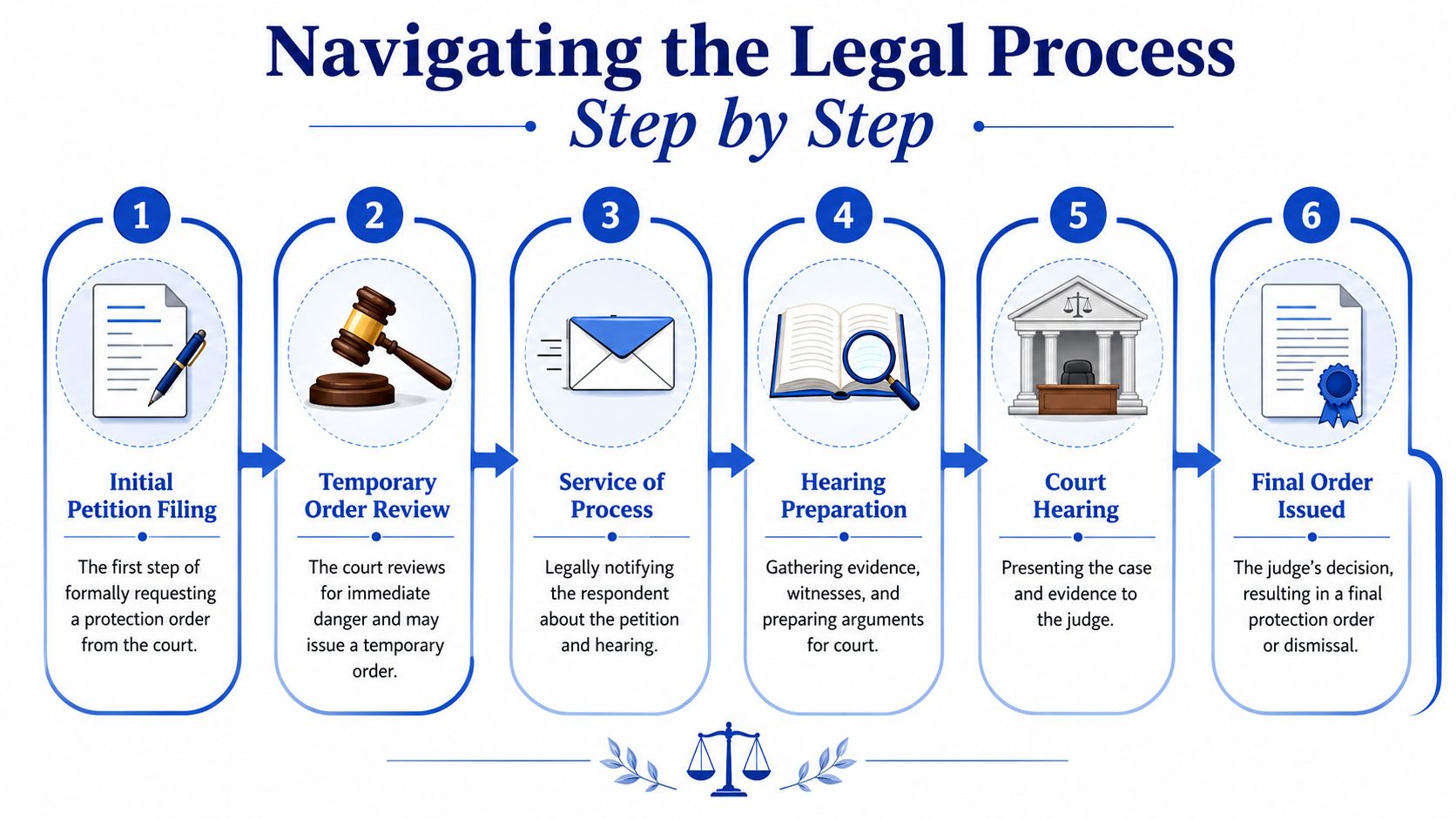
The Washington process is chronological, and timing matters at every stage. A person who understands the sequence usually makes better decisions than someone reacting to each document as it arrives.
Step one through step three
The case begins with a petition. The petitioner files sworn allegations and asks the court for specific relief. The quality of that initial filing matters because judges often decide whether temporary protection is warranted based on those written materials.
The next stage is temporary review. In many cases, the court considers whether immediate restrictions are needed before the respondent has appeared. That doesn't decide the whole case, but it can shape the practical reality until the full hearing.
Service comes next, and it can't be casual. The respondent must be legally notified in a way the court recognizes. If service is defective, the hearing may be delayed or the relief may be harder to enforce.
The hearing is where preparation shows
Before the full hearing, both sides should organize exhibits, line up witnesses, and decide what facts prove or disprove the legal elements. That may sound obvious, but many people walk into court with a stack of messages and no theory of the case.
This overview video gives a useful visual sense of how the process unfolds:
At the hearing itself, the judge isn't evaluating who is more upset. The judge is deciding whether the statutory standard has been met. Under RCW 7.10.105, the petitioner must prove specific elements of harassment or abuse, and a respondent often must request a continuance on the first court date to file a written response or secure an attorney, as discussed in this Washington protection order hearing explanation on YouTube.
That continuance issue is one of the most overlooked strategic points in the process. A respondent who appears without exhibits, witnesses, or a written response may need more time, and asking for it promptly can matter. A person who practices in adjacent areas such as business litigation in Washington already understands a larger truth about courtrooms. Procedure often decides substance.
- For petitioners: Specific incidents usually carry more weight than broad character descriptions.
- For respondents: Silence or informal denial usually isn't enough. The court needs a factual answer.
- For both sides: Deadlines, service, exhibit labeling, and witness attendance affect outcome more than commonly anticipated.
The Strategic Role of a Restraining Order Lawyer
A restraining order lawyer adds value by doing the work that courts reward. That starts with legal framing. Facts that sound persuasive in conversation may do very little in court unless they match the elements the judge has to decide.
Strategy is more than paperwork
One of the biggest differences between self-representation and skilled counsel is evidence architecture. Lawyers don't just collect facts. They sequence facts, connect them to the statute, and strip out material that distracts from the claim or defense.
That matters because the burden of proof isn't static. A restraining order lawyer must navigate a tiered evidentiary framework where the burden rises from reasonable proof, meaning preponderance of the evidence, for temporary orders to clear and convincing evidence for permanent orders, as explained in Gedulin Law's review of proof requirements. The practical point is simple. Allegations that may support temporary relief can fail at the later stage if they aren't supported by stronger, more objective proof.
What counsel actually changes
A lawyer can improve a case in several concrete ways:
- Refining the theory: The court needs a legal story, not a complete history of the relationship.
- Screening exhibits: Some documents help. Others create confusion, hearsay problems, or credibility issues.
- Preparing testimony: Witnesses need to answer the question asked and stick to what they personally know.
- Making objections: Courts may receive a lot of information quickly. A lawyer can challenge material that shouldn't carry weight.
- Managing fallout: Orders can affect housing, contact, scheduling, and parallel family law or criminal matters.
Good lawyering in this setting often looks quiet. The lawyer narrows the issues, excludes weak points, and keeps the hearing from drifting into emotion and speculation.
Lawyers also help clients understand when a hard fight is wise and when a targeted solution is better. Some cases should be contested from the start. Others are best handled by limiting the scope of relief, clarifying contact terms, or preserving a record for later modification. Readers evaluating professional background can review the firm's profile and legal approach, but in any Washington protection order matter, the essential question is whether counsel understands this specific courtroom process.
How to Prepare Your Case with Strong Evidence
Judges don't grant or deny protection orders based on intuition. They rely on evidence that is specific, organized, and tied to the legal standard. That's why evidence preparation isn't clerical work. It's the center of the case.
What strong evidence looks like
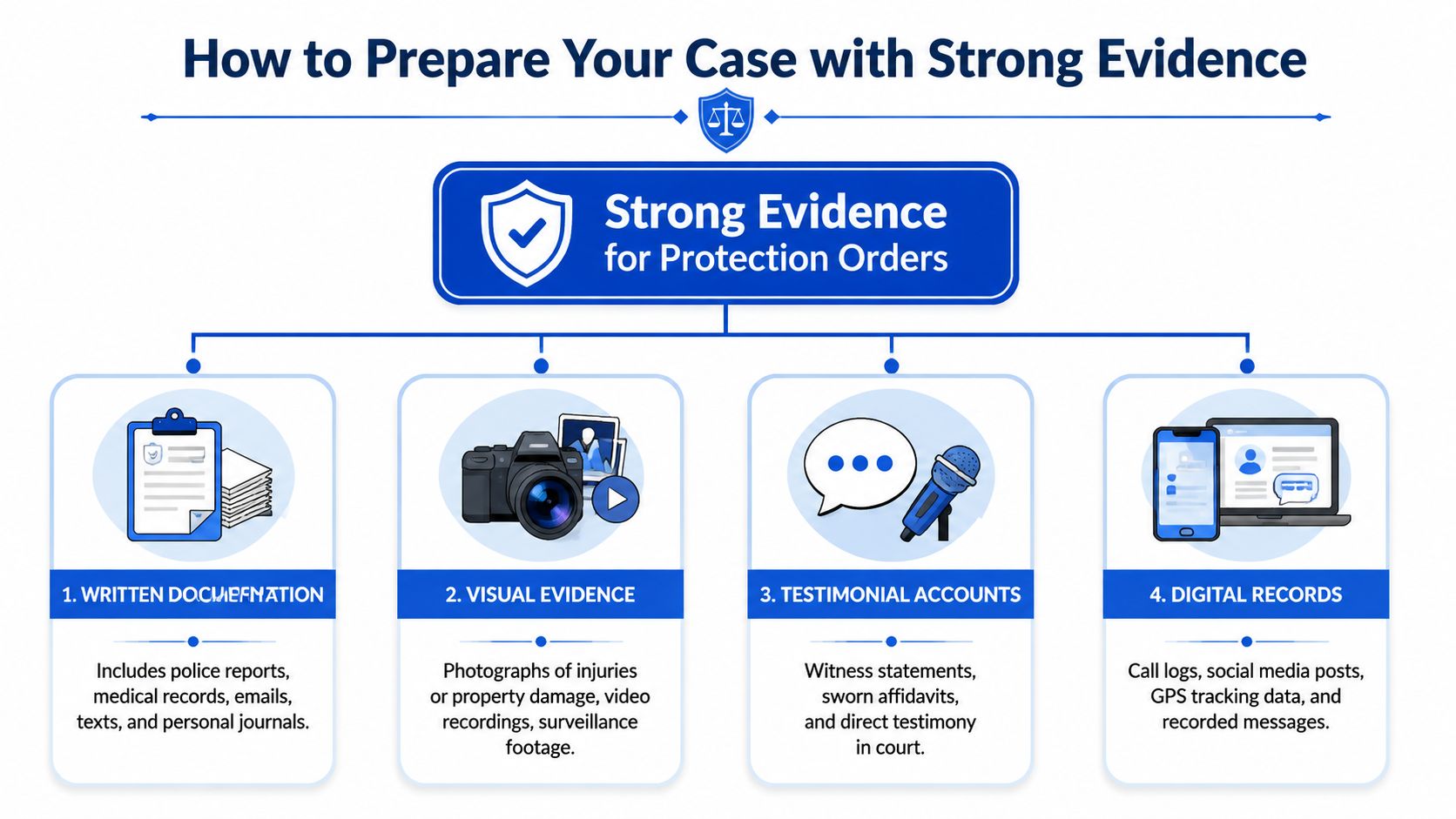
The most persuasive records usually fall into a few familiar categories:
- Digital communications: Text messages, emails, voicemails, social media posts, and call logs can show timing, tone, repetition, and escalation.
- Visual proof: Photos of injuries, damaged property, or relevant scenes can anchor testimony in something concrete.
- Institutional records: Police reports, medical records, workplace incident reports, and school notices often help corroborate a timeline.
- Witness testimony: Third-party witnesses are often the difference between a case that feels real and a case the court can confidently verify.
Third-party witnesses deserve special attention. They are often underused. A neutral person who personally observed conduct, heard threats, or saw the aftermath can strengthen a petitioner's case or support a respondent's defense against false or exaggerated allegations.
Preservation and privacy both matter
Evidence needs to be preserved in a usable form. Screenshots help, but they aren't always enough on their own. Save messages with identifying details, dates, and context. Keep original files when possible. If records may need signatures or authentication, it helps to understand basic document formality. For readers sorting out paperwork issues, SendItFax explains legally binding principles in a way that's useful when evaluating what a document does and doesn't prove.
Washington adds a separate concern that many people miss. A restraining order in Washington is a public document, which means the petitioner's home address becomes public if it is listed, according to Washington LawHelp's protection order filing guidance. That creates a real trade-off. The court needs enough information to process and enforce the case, but public filing can expose sensitive location details.
Protecting a case file isn't only about proving danger. It's also about not creating new safety problems through the filing itself.
A restraining order lawyer helps decide what address information should appear, whether alternatives are available, and how to present evidence without disclosing more than necessary. That kind of care often matters most in the cases where the petitioner has already moved, is staying with family, or is trying to keep a workplace or child's school out of the record.
Deciding When and How to Hire the Right Attorney
Not every case requires full-service representation from start to finish. Some do. Others call for targeted help at the moment that matters most. The right decision depends on risk, complexity, and the person's ability to organize and present the case alone.
When legal help becomes especially important
Representation is usually worth serious consideration when the case involves disputed facts, possible false allegations, children, overlapping family law issues, sensitive employment consequences, or digital evidence that needs careful handling. A hearing can also matter more than people expect when the temporary order already changed living arrangements or communication with family members.
The cost question is real, and people shouldn't ignore it. The better approach is to match the level of representation to the level of risk.
A practical hiring framework
One option that many people don't realize exists is limited scope representation. A client can hire an attorney solely for the hearing phase without full representation, as noted in this discussion of limited scope representation in restraining order cases. For a cost-conscious client, that can be the most efficient use of legal help because the hearing is often where organization, objections, and witness handling matter most.
When evaluating counsel, these questions are useful:
- Case fit: Does the lawyer regularly handle Washington protection order hearings, not just general litigation or family matters?
- Strategy: Can the lawyer explain what evidence will likely matter and what won't?
- Scope: Is the attorney offering full representation, hearing-only help, drafting support, or coaching?
- Communication: Will the client get practical preparation guidance before court, not just a calendar date?
- Fees: Are the billing structure and expected tasks clear at the start?
A good consultation should leave the person with a better understanding of the case, even if they haven't yet decided to hire. Readers who are ready to discuss legal needs directly can use the firm's contact page, but the broader principle applies across the board. The right restraining order lawyer is the one who can explain the Washington process clearly, identify key pressure points, and tailor help to the stakes of the case.
Your Next Steps and Washington State Resources
The next move should be simple and immediate. If there's current danger, call 911. If the issue isn't an emergency but the hearing is approaching, shift into document-gathering mode today, not next week.
A short action list that helps
- Write a timeline now: Dates blur quickly under stress. A same-day timeline is usually better than a polished one written later.
- Collect records in one place: Gather texts, emails, photos, voicemails, police contacts, and witness names.
- Read every court paper carefully: Hearing dates, service details, and restrictions can appear in different parts of the packet.
- Avoid direct conflict: Don't send messages trying to negotiate the case facts with the other side.
- Contact a lawyer referral source: County bar associations and legal aid channels can help connect people with attorneys who know local court practice.

Washington help that can move things forward
Washington residents often have more support options than they realize. Local bar associations can be a strong starting point for referrals in urgent family or safety matters. Verified background material also notes that many counties offer legal aid services or volunteer lawyer programs for urgent cases, and that some attorneys offer free initial consultations while others charge for them, so it's worth asking that question up front before scheduling.
For petitioners, advocacy organizations can also help with safety planning, court accompaniment, and practical concerns like address confidentiality. For respondents, early legal advice can prevent avoidable mistakes, including missed hearings or poorly framed written responses.
The best first step is rarely the most dramatic one. It's usually the most organized one.
A restraining order case can feel like a crisis of uncertainty. It becomes more manageable once the person identifies the order type, secures the timeline, preserves the evidence, and gets informed about hearing procedure. That doesn't remove the stress, but it does replace confusion with a plan.
By Design Law Firm & Legal Consultancy, PLLC serves Washington clients with clear, practical legal guidance grounded in real-world problem solving. To learn more or request a consultation, visit By Design Law Firm & Legal Consultancy, PLLC.