A Seattle founder closes a financing round on Friday and spends Monday answering questions that have nothing to do with product or growth. A vendor sends over a contract with broad indemnity language. A customer asks for a security addendum. A contractor relationship starts to look like an IP ownership problem. Then a privacy issue lands in the inbox.
That is usually the moment when legal work stops feeling like a series of isolated tasks and starts feeling like a system problem. Paying for one-off help every time can work for a while, but it often creates delay, repeated onboarding, and uncertainty about cost. A legal retainer agreement solves a different problem than a single project engagement. It creates an ongoing working relationship so the company can get advice before a small issue becomes an expensive one.
For startups in Washington, that difference matters. Speed matters. So does knowing who to call when a contract, product launch, hiring decision, or data issue needs legal review today, not after another round of intake and fee negotiation.
Securing Your Legal Foundation
A legal retainer agreement is the contract that defines the attorney-client relationship, covering scope, fees, and responsibilities. For businesses, its core value is predictability because it locks in access to counsel for an ongoing period instead of forcing a new negotiation for each matter, as explained in this overview of legal retainer agreements.
For a startup, predictability is not just a budgeting benefit. It is a decision-making benefit. Founders move faster when they know whether legal review is already built into the relationship, what kind of work is covered, and how billing works if a matter grows beyond the original plan.
Why founders reach for a retainer
Early-stage companies usually face legal work in clusters, not in neat, isolated projects. A financing leads to governance cleanup. A go-to-market push leads to customer paper, privacy review, and vendor negotiation. A new hire raises equity, confidentiality, and invention assignment issues.
A retainer arrangement works best when the company needs recurring access to counsel across these moving parts. It is less about buying a stack of future hours and more about creating legal continuity.
Three practical advantages tend to matter most:
- Faster context. Counsel already knows the company, its cap table issues, its risk tolerance, and the usual friction points.
- Better issue spotting. Regular review catches scope creep, liability shifts, and compliance gaps earlier.
- Cleaner internal planning. Finance and operations teams can plan around reporting, replenishment, and approval rules instead of reacting to surprise invoices.
Founders dealing with formation, governance, and foundational contracts often benefit from reviewing the broader contract stack alongside the retainer itself. A useful starting point is this guide to essential contracts for business owners.
What does not work
A retainer does not fix vague expectations. Trouble starts when a founder assumes “general counsel access” means unlimited support, while the law firm assumes only a narrow slice of work is included.
A good retainer reduces friction because it answers questions before they become billing disputes.
The companies that get the most value from a legal retainer agreement usually do one thing well at the outset. They define what kind of relationship they are buying. Ongoing business counsel is one thing. A fixed-fee trademark filing is another. Emergency cyber response is something else entirely.
What a Retainer Agreement Really Is
The most common misunderstanding is simple. People use retainer fee and legal retainer agreement as if they mean the same thing. They do not.
The fee is the money paid up front. The agreement is the rulebook that explains what the lawyer will do, how the money is handled, how work is billed, and what happens if the relationship ends. The Federal Bar Association explains that distinction clearly in its discussion of lawyer retainers, purpose, and ethics.
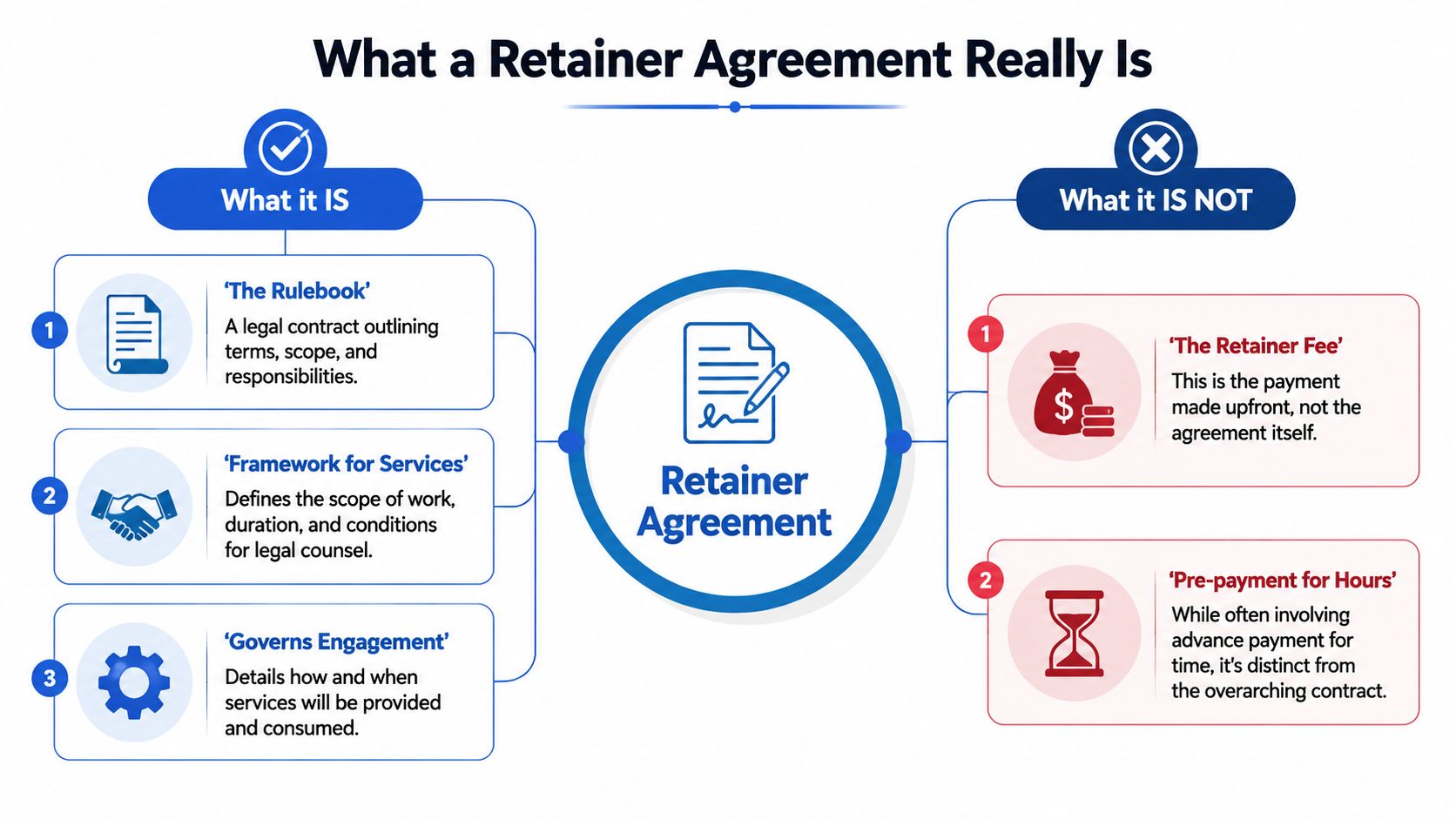
The easiest way to think about it
For many startup clients, the practical analogy is a dedicated wallet with rules attached.
The company deposits funds. Those funds are generally not treated as the law firm's revenue the moment they arrive. Instead, the agreement controls when money is earned, when it can be moved, and what gets refunded if work is not performed. That is one of the key client protections built into a properly structured arrangement.
A founder should read the agreement as the operating manual for five questions:
- What work is covered
- How time or fees are applied
- When the firm can draw funds
- When the client must replenish
- What happens to unused funds
Why trust accounting matters
Trust accounting sounds more mysterious than it is. The practical point is straightforward. Client money that has not yet been earned is handled differently from firm revenue.
A simple way to view it is this:
| Item | What it means in practice |
|---|---|
| Deposit | Money paid in advance to secure the engagement or fund future work |
| Trust handling | Funds are held separately until the agreement says they are earned |
| Invoice event | Work is performed, billed under the agreement, and then funds may move as earned |
| Unused balance | If not earned, it is typically refundable to the client |
That distinction matters to founders because it affects both visibility and influence. The company can see how funds are being used. The firm has a documented basis for billing. Both sides have fewer reasons to fight about whether money was earned.
Washington founders looking at fundraising documents often encounter retainers around financing support, investor docs, and follow-on corporate work. This broader context is useful when paired with a financing checklist such as funding and seeding guidance.
The retainer fee is the fuel. The legal retainer agreement is the dashboard, the map, and the rules of the road.
Common Types of Legal Retainer Arrangements
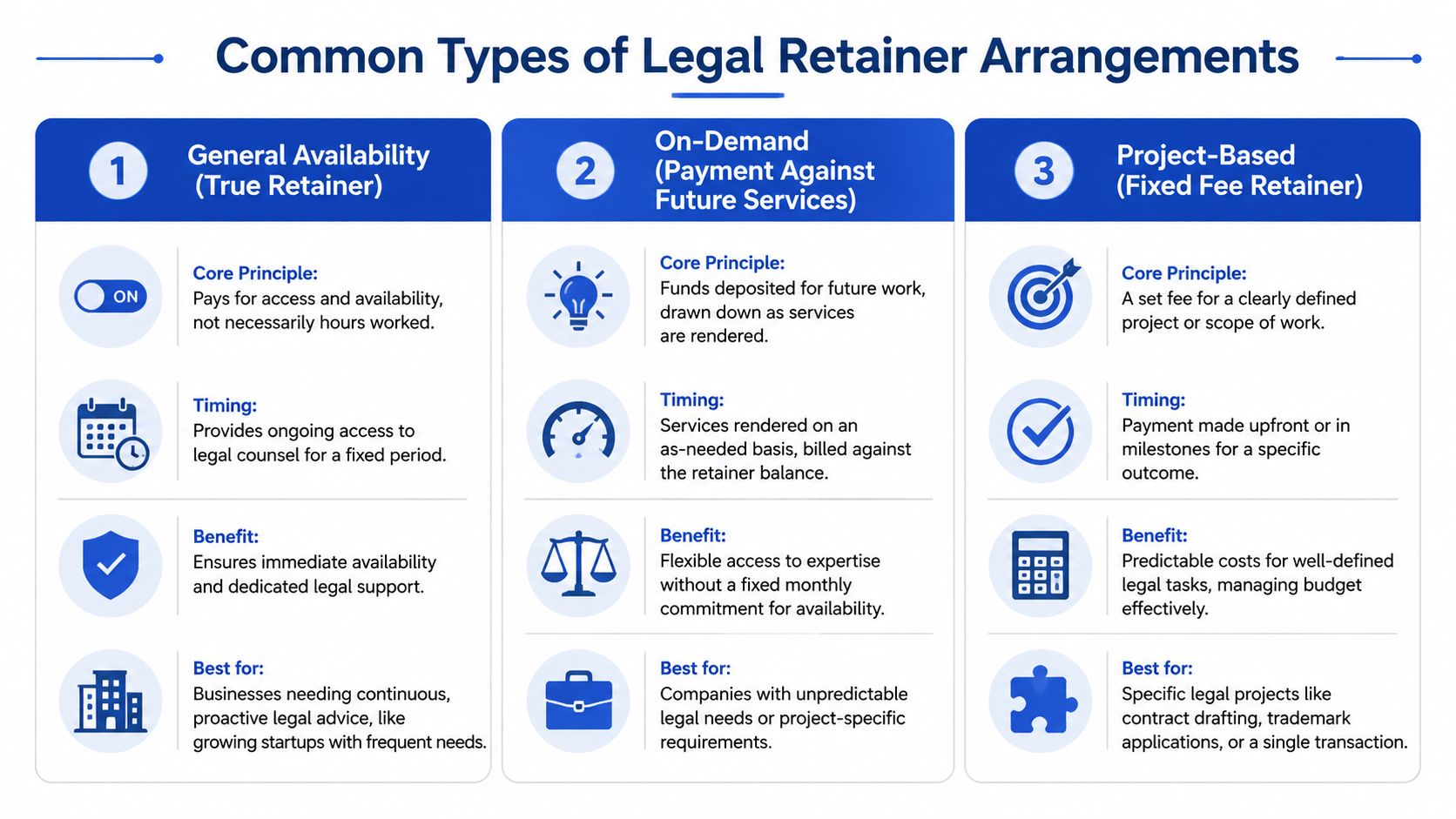
Not every retainer works the same way, and startups often sign the wrong format because no one slows down to name the model. The design choice that matters most is whether the arrangement operates as a true availability retainer, a security retainer, or a hybrid structure. That distinction affects trust handling, invoicing, and termination rights, as summarized in this retainer agreement overview.
True availability retainer
This is the least understood model.
The company is paying for access and reserved capacity. In plain terms, the lawyer is agreeing to be available and to hold space for the client's needs, whether or not the full amount of legal work materializes during that period. That can make sense for a company with constant executive questions, active transactions, or repeated urgent decisions.
This model works when:
- Speed is mission critical. Leadership needs counsel on short notice.
- Demand is continuous. Legal questions come weekly, not quarterly.
- The company values access itself. Reserved availability is part of the bargain.
This model does not work well for a startup that only has occasional, narrow legal projects. It can feel expensive if the founder thinks in terms of “unused hours.”
Security retainer
This is the structure most founders expect, even if they do not know the term.
The company prepays funds for future services. Those funds are then drawn down as work is performed and billed. If work ends before the balance is exhausted, the unused portion is generally returned based on the agreement.
This model usually fits startups best when legal needs are recurring but uneven. It gives the company an established relationship without pretending every month looks the same.
A founder should still ask two hard questions:
- What exactly counts as billable under the retainer?
- What happens when the balance gets low or hits zero?
Hybrid or evergreen retainer
This is often the most practical business-counsel model.
The company starts with a funded balance and agrees to replenish it when it drops below a stated threshold. This keeps the relationship active and reduces stop-start billing friction. It also gives the law firm confidence that the matter will not drift into unpaid work.
Hybrid arrangements tend to work best when the company wants continuity without paying solely for abstract availability.
For founders, the risk is not the replenishment clause itself. The risk is agreeing to replenishment language without regular reporting, clear burn-rate visibility, or a process for approving work that sits outside the expected lane.
Teams managing outside vendors often see the same scope issues in legal work that they see in procurement. This is one reason disciplined vendor management best practices often pair well with disciplined retainer management.
Subscription and incident-response wrinkles
Some modern legal services look like subscriptions. That is not automatically a problem, but founders should be careful when the retainer promises future services triggered by uncertain events, especially in cyber or breach-response contexts.
A prepaid legal services retainer can raise insurance-regulation issues if the promised services depend on a fortuitous event, unless the fee structure separately accounts for the contingent services. That issue is discussed in a New York Department of Financial Services opinion on prepaid legal services and insurance treatment.
That does not mean startups should avoid incident-response retainers. It means those arrangements should be drafted carefully.
Anatomy of a Strong Retainer Agreement
A founder signs a retainer on Friday to cover “general corporate support.” By Tuesday, the company is asking about an enterprise customer contract, an employee separation, a board consent, and a threatened demand letter. The agreement either answers what happens next, or it leaves room for a billing dispute at the worst possible time.
That is the critical test of a strong retainer agreement. It should work under pressure, not just look polished on intake.
For Washington startups, I want this document to do two jobs at once. It should give the company predictable rules for cost, scope, and response time. It should also reflect the ethical rules Washington lawyers must follow, especially around client funds and communication. If those mechanics are vague, founders usually feel the problem later, after money has been spent and expectations have diverged.
Scope of services
Scope sets the operating boundary for the relationship. If the clause is broad enough to mean anything, it usually creates arguments about what the monthly fee was supposed to cover.
Strong scope language names the categories of work included, the categories excluded, and the point at which a separate engagement is required. “General legal advice” is rarely enough by itself. A startup usually needs sharper lines, such as commercial contracts, routine corporate governance, employment counseling, and day-to-day business questions, while carving out financing transactions, litigation, patent work, and tax advice unless separately approved in writing.
A useful test is simple. If a founder, in-house operator, and law firm could read the same sentence and reach different conclusions about whether a task is covered, the scope needs revision.
Fees and billing mechanics
The fee paragraph should explain more than the amount due. It should explain how the relationship functions week to week.
That means identifying whether the arrangement is hourly, fixed-fee, monthly, project-based, or hybrid. It also means spelling out who may work on the matter, whether paralegal time is billed, how expenses are handled, and when the client receives statements. Startups should pay close attention to approval thresholds for outside costs, especially if specialists, filing fees, foreign counsel, or e-discovery vendors may be involved.
A well-drafted billing clause reduces friction because everyone can see the same meter. If you want a practical drafting reference, this guide on how to create retainer agreement is a useful supplement, but the agreement still needs to be suited to the company's actual legal workload.
Replenishment and reserve levels
Reserve language matters because legal work rarely arrives on a neat schedule. A startup may go quiet for two weeks, then need immediate help across several issues in the same afternoon.
A good replenishment clause answers three questions clearly:
- What balance triggers notice.
- How long the client has to restore the retainer.
- Whether the firm may pause work, decline new tasks, or withdraw from non-urgent matters if the balance is not restored.
Those details are not just administrative. They affect continuity. If the agreement is silent, founders often assume the firm will keep working while accounting catches up. Many firms assume the opposite.
Trust account treatment and refundability
Misunderstandings can become expensive.
In Washington, the handling of advance fees is tied to professional responsibility rules, not just contract wording. Founders should be able to tell whether the initial payment is a true availability retainer, a deposit against future work, or a flat fee earned under the terms of the agreement. Each structure has different consequences for where the funds sit, when the lawyer can treat them as earned, and what must be returned if the relationship ends early.
The easiest business analogy is a security deposit. Money held for future work usually should not be treated as the lawyer's money on day one. It is held until earned under the agreement and applicable ethics rules. If the engagement ends with unused funds still unearned, those funds are generally returned.
The agreement should answer these points in plain English:
- What the client is paying for.
- Whether the funds go into trust first.
- When fees are considered earned.
- Whether any portion is nonrefundable under Washington rules.
- How unused balances are handled at the end of the engagement.
Duration and termination
A retainer agreement should let the relationship end cleanly without creating operational chaos.
Termination language should cover client notice, the firm's right to withdraw where permitted, final invoicing, return of unearned funds, and transfer of files or work product. For startups, file transfer language matters more than many founders expect. If new counsel has to pick up a financing, dispute, or commercial negotiation quickly, delays in getting organized materials can cost more than the legal fees in dispute.
This part of the agreement should also match the company's real cadence. A month-to-month advisory relationship calls for different termination mechanics than a retainer tied to a specific transaction or crisis-response role.
Confidentiality, conflicts, and affiliates
Startups often operate through a messy mix of founders, parent entities, subsidiaries, special purpose vehicles, and investor relationships. The retainer should identify who the client is. That sounds obvious, but it is one of the most overlooked points in early-stage engagements.
If the law firm represents only the Delaware corporation, the agreement should say so. If it also covers a founder in a related matter, an affiliate, or a management company, that should be explicit. The same goes for conflict waivers. Narrow, informed conflict language can be reasonable. Broad waivers that founders do not understand can create avoidable risk later, especially in close Washington business communities where counterparties, investors, and advisors often overlap.
Intellectual property and work product
This clause matters more in startup practice than many firms admit.
If counsel is preparing templates, compliance frameworks, AI policies, privacy disclosures, or product terms, the agreement should state what the client may use after the engagement ends. Law firms usually retain their general know-how, prior materials, and internal methods. Clients should still have clear rights to use the customized work product they paid for in operating the business.
Ambiguity here creates trouble later, especially when a company changes firms and wants to keep using documents that were built into its product or sales process.
Dispute resolution and special risk clauses
Billing disputes are rare when the paper is clear, the reporting is regular, and the scope is disciplined. When disputes do happen, the retainer controls the procedure. That is why founders should read any arbitration, venue, fee-shifting, or mediation clause with the same care they give a customer contract. These dispute resolution clause options for business agreements offer a useful framework for evaluating what is fair and efficient.
Special event-triggered support also deserves close drafting. If the retainer promises legal help upon a future breach, investigation, or other uncertain event, the clause needs to define the trigger, the services included, and any limits on availability. Vague crisis language may sound reassuring in the sales process, but it is a poor substitute for a clear operating agreement.
Negotiation Points for Startups and Businesses
A founder usually sees the pressure point only after the first urgent matter hits. The company signs a retainer for “general business advice,” then a financing issue, hiring problem, or customer dispute lands in the same month. Suddenly important questions show up. What work was included? When does the firm ask for more money? Who has to approve expansion into a new matter?
That is why this section matters. A retainer agreement is an operating document for the lawyer-client relationship. For a Washington startup, it should match the company's stage, cash constraints, and likely legal workload, not just the firm's standard intake process.
One point causes more confusion than it should. Founders often use “retainer” to mean any upfront payment to a law firm, but different fee structures work differently in practice. As noted earlier, the distinction affects how the money is handled, when it is earned, and what happens if the engagement ends early. If the agreement uses the word “retainer,” ask the firm to explain exactly what that means in plain English.
The terms worth negotiating
Startups usually have more room to negotiate than they assume, especially if they ask focused business questions instead of broad objections.
- Initial deposit size. Ask the firm to tie the opening amount to the next 30 to 60 days of expected work. A company that needs routine contracts and occasional calls should not fund the same reserve as a company entering a financing or regulatory review.
- Scope of work. List the actual categories of work the company expects. Board consents, commercial contracts, employment questions, privacy review, fundraising support, and dispute response should not all be collapsed into “general advice.”
- Replenishment mechanics. The agreement should say when the firm will request replenishment, how much notice the client gets, and whether work pauses if the balance is not restored.
- Billing visibility. Founders should ask for regular invoices and balance updates before the account gets low. Good reporting reduces surprise and makes budget decisions easier.
- Approval for new matters. The firm should get clear client approval before treating a side issue as part of the engagement, especially if that issue will materially increase fees.
A founder preparing comments before sending redlines may find it useful to review a practical guide on how to create retainer agreement. It is not Washington-specific advice, but it can help a startup spot drafting gaps before they become billing problems.
Red flags that deserve a pause
Some clauses tell you, early, that the agreement was written for the law firm's convenience rather than for shared clarity.
Watch for scope language that is broad enough to invite disagreement later. Watch for replenishment language that lets the firm demand funds immediately without a notice process. Watch for termination provisions that make it hard for the company to change counsel, collect its file, or understand what fees remain due at exit.
A simple test works well here.
If the founder, finance lead, and operations lead cannot each explain the billing trigger, replenishment trigger, and exit process in a minute, the agreement needs more work.
Dispute language also deserves more attention than many startups give it. If a fee disagreement or service dispute arises, the enforcement clause will shape cost, speed, and advantage. Arbitration may be faster in some cases, but it can also limit procedure and create filing costs. Venue and fee-shifting terms can matter just as much. Founders should review these provisions with the same discipline they use for customer and vendor contracts, especially when comparing dispute resolution clauses in business agreements.
The best way to negotiate with outside counsel
Directness works better than posturing.
Say what the company needs. If the goal is ongoing outside general counsel support with predictable monthly reporting, limited approval authority, and no drift into deal work without signoff, say that. If the company expects recurring product, employment, privacy, and commercial contract questions, say that too.
Good firms usually respond well to that level of specificity because it helps both sides price and staff the relationship appropriately. I have found that the healthiest attorney-client relationships start with a slightly more detailed negotiation, not a faster signature. That is especially true for startups, where one vague sentence in a retainer can turn into a preventable cost problem at exactly the wrong time.
Washington State Rules Your Lawyer Must Follow
Washington startups should know that retainer agreements do not operate in an ethical vacuum. Lawyers handling fees and client funds are subject to professional conduct rules, and those rules matter because they create guardrails around reasonableness, communication, and fund handling.
At the practical level, two themes matter most. The fee arrangement should be communicated clearly, and client property must be safeguarded properly.
Why that matters to a founder
When a startup signs a retainer, the company is not just buying legal help. It is also entering a regulated professional relationship with rules about how the lawyer may charge, communicate, and hold funds.
That matters when founders ask questions such as:
- Why is money being held separately?
- When can the firm treat deposited funds as earned?
- What disclosures should be in writing?
- What happens if the relationship ends midstream?
A Washington lawyer should already be structuring the agreement and billing process with those duties in mind.
Local counsel still matters
Washington companies often work with national vendors, remote legal tech, and distributed teams. That can be efficient, but it does not eliminate state-specific ethics issues around fee communication and trust accounting.
That is one reason local compliance judgment still matters, especially when firms are integrating modern research and workflow tools into client service. For firms evaluating technology in a legal workflow, this discussion of Choosing effective AI tools for lawyers is a helpful operational resource. It does not replace ethics analysis, but it does highlight why process discipline matters when legal work becomes more tech-enabled.
What a founder should expect to see
A Washington startup should expect the legal retainer agreement and billing process to be plain enough that finance, operations, and founders can all understand it without guesswork.
That usually means:
| Founder expectation | Why it protects the client |
|---|---|
| Written fee explanation | Reduces surprises and ambiguity |
| Clear handling of deposited funds | Helps the client track earned versus unearned amounts |
| Regular statements | Makes burn rate visible |
| Defined termination process | Avoids chaos if the relationship ends |
If those basics are missing, the problem is usually not sophistication. It is drafting discipline.
Your Checklist for Reviewing a Retainer Agreement
A founder does not need to memorize ethics rules or billing theory to review a legal retainer agreement well. A short checklist catches most problems early.
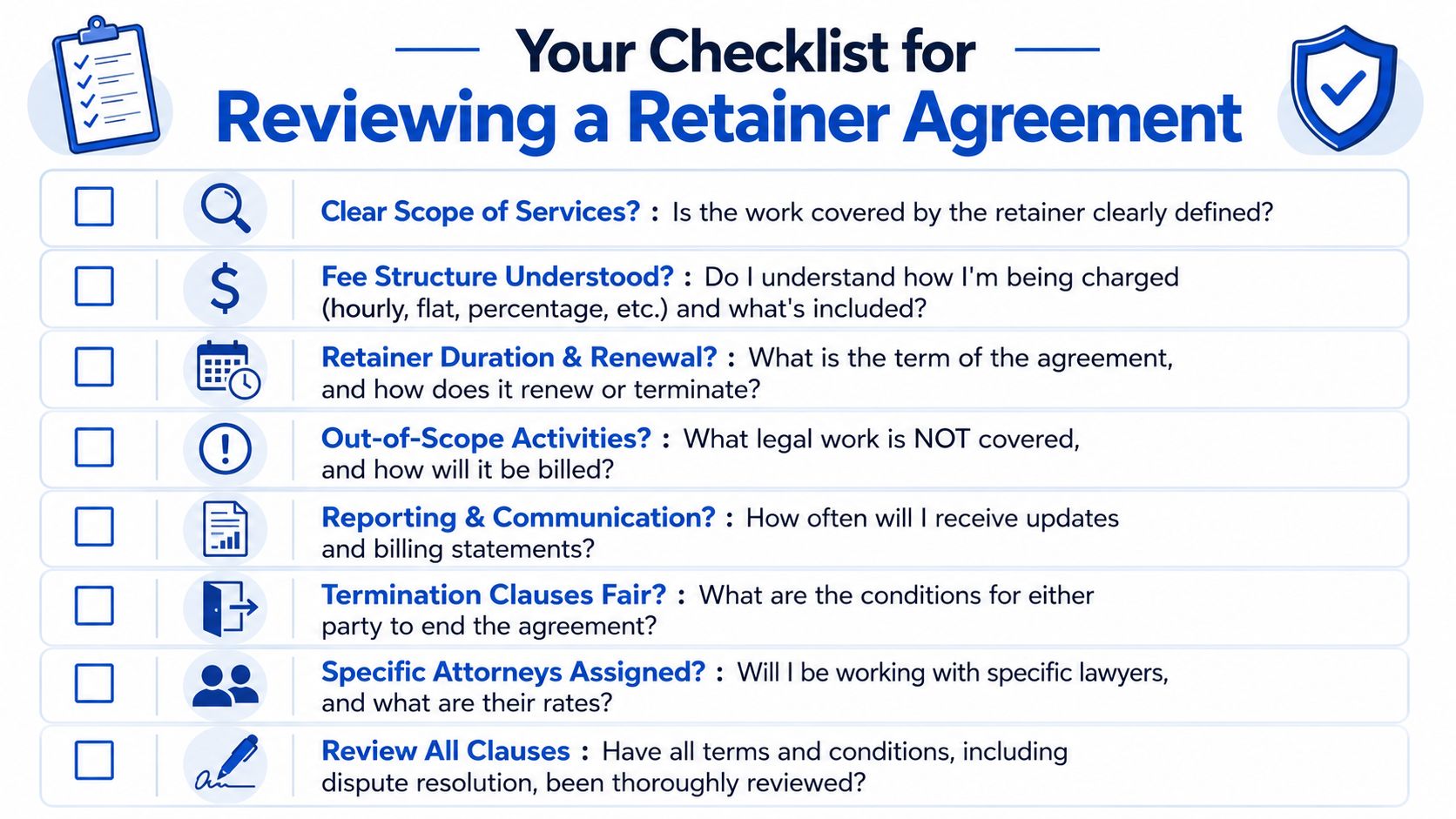
Start with these questions:
- Is the scope specific enough to tell what is covered and what is excluded?
- Is the fee structure clear about whether the payment is for availability, future work, or a hybrid?
- Are billing and replenishment rules visible enough that finance can track them?
- Is trust treatment explained so the company knows when funds are earned or refundable?
- Can either side terminate cleanly with reasonable notice and file-transfer mechanics?
- Are dispute terms understandable before a disagreement happens?
- Does the agreement fit Washington practice on client protection and fund handling?
For founders who like review frameworks, a broader free contract review checklist can help structure the final pass before signing.
This short video can also help founders think about agreement review in a more practical way.
A strong legal retainer agreement is not just a payment document. It is the operating system for a long-term attorney-client relationship. When it is drafted well, the founder gets predictability, visibility, and faster access to legal judgment. When it is drafted poorly, every invoice becomes a fresh negotiation.
If a Washington business needs practical guidance on retainer agreements, outside general counsel structures, contract strategy, data privacy, IP, or dispute planning, By Design Law Firm & Legal Consultancy, PLLC helps startups and established companies build legal systems that are clear, workable, and aligned with how the business operates.