A founder often reaches the operating agreement stage after the exciting work is already underway. The LLC is filed. A bank account is pending. A co-founder wants to know how profits will be split, who can sign a contract, and what happens if someone leaves six months from now.
That's exactly where a business operating agreement template helps, but only if it's treated as a starting point rather than a shortcut. In Washington State, a generic form can leave critical issues to default law at the worst possible time: during a dispute, a departure, or a financing conversation. A stronger agreement does something more useful. It turns vague assumptions into written rules the members can follow.
What Is a Business Operating Agreement
An operating agreement is the LLC's internal rulebook. It doesn't exist to impress the Secretary of State. It exists so the owners know, in writing, how the company will run when decisions get harder than they seemed on formation day.

The U.S. Small Business Administration explains that operating agreements are generally 5 to 20 pages long and become an official contract once signed. The SBA also notes that they usually address ownership percentages, voting rights, member and manager duties, profit-and-loss distribution, meetings, and buyout or buy-sell rules. That's why many founders begin with a template rather than drafting from scratch from a blank page. The SBA summary is a useful baseline for understanding scope and function in practical terms, not just legal terms, and it appears in the agency's guidance on basic information about operating agreements.
What the document actually does
A good business operating agreement template answers the questions that come up in ordinary business life:
- Who owns what and whether ownership tracks cash, services, or other contributions.
- Who decides what, including day-to-day authority versus major company actions.
- How money moves, both for profits and for losses.
- What happens when relationships change, including exits, transfers, or forced buyouts.
For a single-member LLC, the value is structure and separation. The owner can document how the company is managed and show that the LLC is being treated as a separate legal entity rather than as an informal side project.
For a multi-member LLC, the value is conflict prevention. Two people can agree in principle on “equal partnership” and still have sharply different assumptions about salary, reinvestment, hiring authority, or selling the business.
A useful operating agreement doesn't predict every problem. It assigns a process for handling the problems that are most likely to happen.
Why founders shouldn't treat it like boilerplate
Templates are helpful because they organize the conversation. They are not enough on their own because the hard part isn't filling in names and percentages. The hard part is choosing rules that match how the company will really operate.
That's also why founders usually need their operating agreement coordinated with other core documents, especially vendor contracts, founder agreements, IP assignments, and customer terms. Businesses that are still building that legal stack often benefit from reviewing the broader list of essential contracts for business owners alongside the operating agreement, so governance and operations don't drift in separate directions.
Why Washington State LLCs Need a Custom Agreement
Washington LLCs don't operate in a vacuum. They operate under Washington law unless the members have written a different internal arrangement that the law allows. That's the practical reason a generic online form is risky. It may read smoothly, but if it doesn't fit Washington defaults or the company's actual structure, it can fail when it matters.
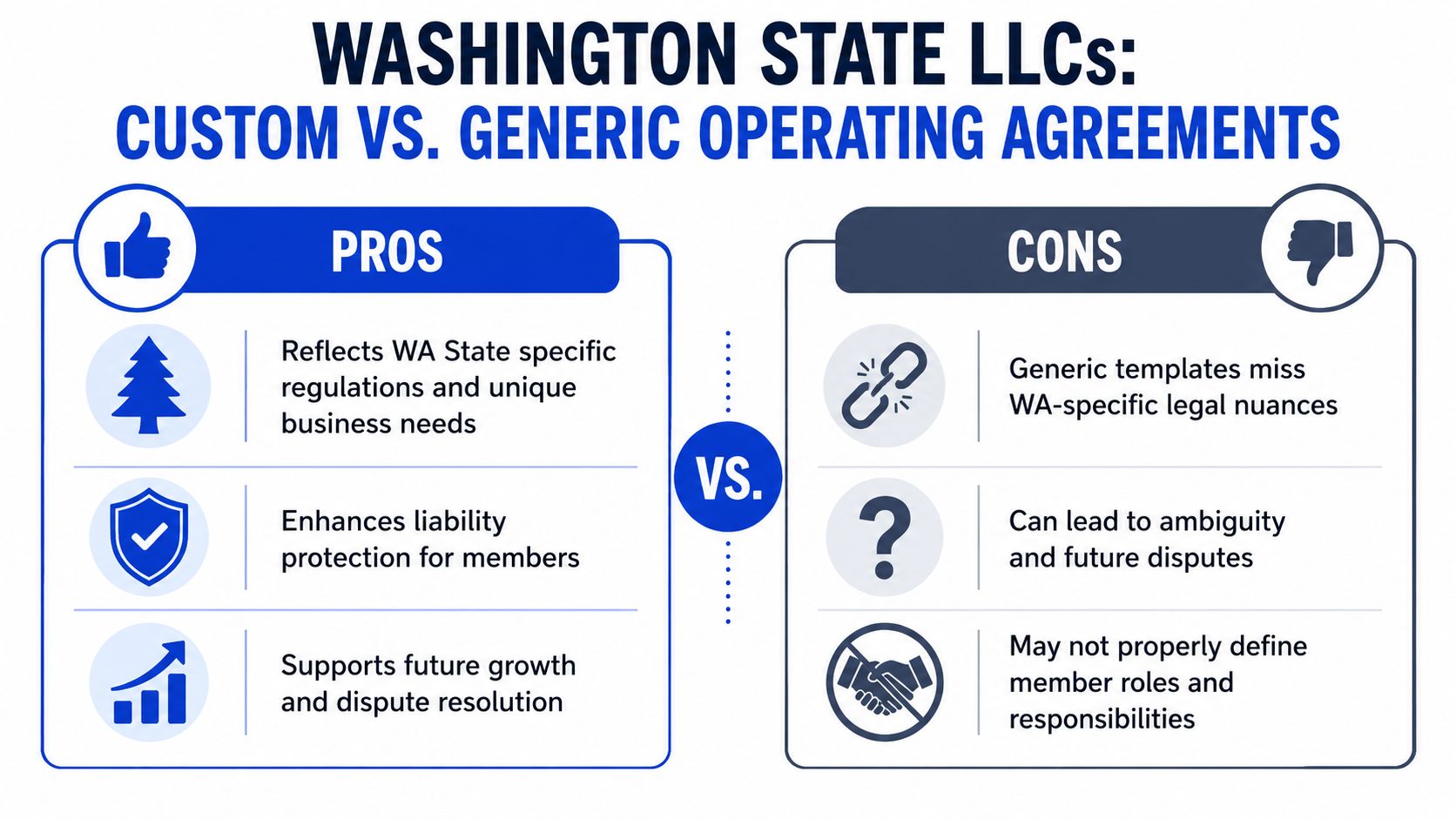
Thomson Reuters describes an operating agreement as a state-law document that sets an LLC's ownership, management, decision-making, profit allocation, transfer provisions, and dissolution procedures, and notes that it becomes a binding contract once signed. Wolters Kluwer adds that, without one, the LLC is governed by the state's default rules and recommends reviewing the agreement annually so it remains aligned with member intent. That general point is especially important in Washington, where founders often assume handshake understandings will fill the gaps. They usually don't. Thomson Reuters discusses that framework in its overview of what an operating agreement is.
Generic templates miss Washington-specific business choices
A Washington startup usually needs to answer questions that generic templates soften or ignore:
| Issue | Weak template approach | Better Washington-focused approach |
|---|---|---|
| Management authority | Says all members may act | Separates ordinary-course authority from extraordinary actions |
| Voting | Uses broad majority language | Defines when majority, supermajority, or unanimous approval is required |
| Ownership transfers | Says transfers need consent | Builds a process with notice, timing, pricing, and restrictions |
| Exits | Mentions buy-sell rights generally | Accounts for founder departure, death, disability, divorce, and bankruptcy |
| Updates | Signed once and forgotten | Reviewed against current filings and actual ownership changes |
A Seattle-area startup with two founders often starts as a practical 50/50 venture. That sounds fair until the first deadlock over hiring, debt, dilution, or whether to accept an acquisition offer. If the agreement doesn't break that tie, the company may stall at exactly the wrong moment.
Custom drafting overrides assumptions that don't fit the deal
The point of customization isn't legal ornament. It's operational control.
A stronger Washington operating agreement usually does three things:
- Matches the formation record. The legal name, registered details, and member information should line up with the company's actual filings and internal records.
- Overrides weak defaults where needed. Founders can choose governance rules that fit their business instead of inheriting rules by silence.
- Anticipates change. The agreement should still work after an investor discussion, a founder departure, or a leadership transition.
Businesses formed elsewhere and later doing business in Washington often run into a second problem. Their template reflects another state's assumptions. That mismatch can create avoidable friction, which is one reason founders weighing jurisdiction issues should understand LLC formation pitfalls and why out-of-state setups can be a costly mistake.
A custom agreement isn't about adding more pages. It's about making sure the pages that exist answer the questions the business will actually face.
Download Your Free WA Operating Agreement Template
A workable business operating agreement template for Washington should feel less like a static form and more like a decision document. It should prompt the members to choose a management model, define voting thresholds, identify capital contributions, and think through transfer and exit provisions before conflict forces those decisions.
That's how the free Washington template should be used. Start with the structure. Then customize every clause that affects control, money, and succession.
What a useful template should include
A strong template for a Washington LLC should give the founders clear placeholders for:
- Company details such as legal name, principal office, and registered information
- Member schedule listing ownership percentages and initial contributions
- Management design stating whether the company is member-managed or manager-managed
- Voting rules for routine and extraordinary decisions
- Transfer restrictions covering admissions, assignments, and internal buyout rights
- Dissolution mechanics addressing winding up and final distributions
That same discipline helps outside the operating agreement too. Founders who are setting up bookkeeping processes at the same time often benefit from practical administrative tools such as templates to manage business finances, especially when they need consistent records for contributions, reimbursements, and distributions that should match the agreement.
What the template won't do by itself
No template can know whether a founder's sweat equity vests, whether a spouse should be excluded from ownership rights, or whether a deadlock should trigger mediation, a rotating casting vote, or a buy-sell process. Those are business decisions with legal consequences.
That's why the template should be treated like the framework of a house, not the finished structure. If the company expects future fundraising, variable member involvement, or any chance of founder turnover, the drafting choices matter more than the template itself.
Practical rule: If a clause matters during an argument, it deserves more than one sentence in the template.
Tailoring Key Clauses for Your Business Structure
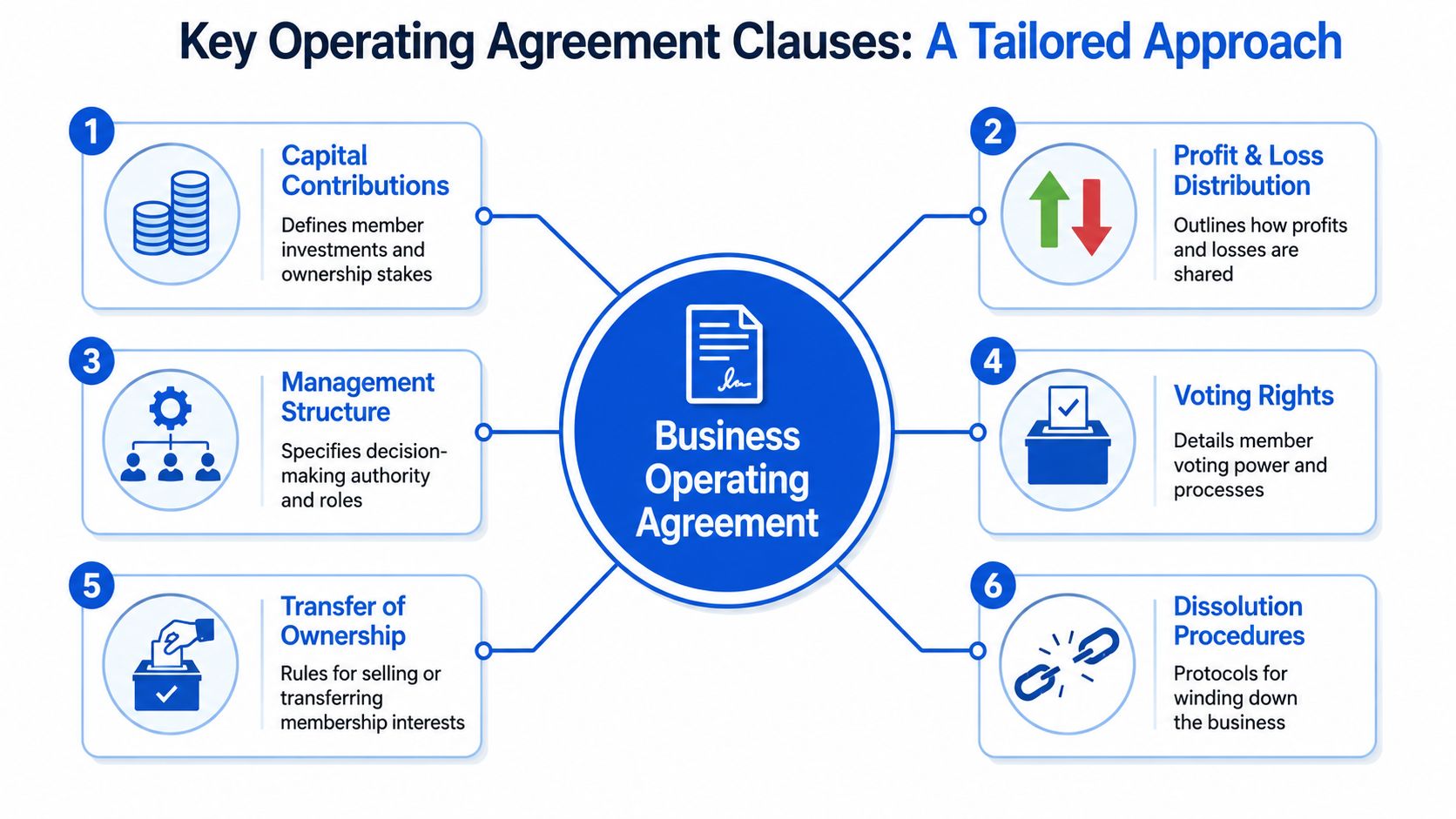
The clauses that deserve the most attention are the ones that control authority, economics, ownership changes, and shutdown procedures. Those are also the clauses most likely to be tested later. Authoritative template guidance consistently focuses on management authority, voting and deadlock procedures, capital accounts, transfer and exit rules, and winding-up provisions. Thomson Reuters also notes that notarization usually isn't legally required in most jurisdictions, but signed copies materially improve enforceability and operational clarity, as summarized in Wolters Kluwer's discussion of an LLC operating agreement template.
Management and voting
The first major choice is whether the LLC is member-managed or manager-managed.
A member-managed structure usually works when the owners are all active in operations. A manager-managed structure usually fits better when one founder runs the company day to day, when passive investors are involved, or when authority needs to be concentrated for speed.
“No member has authority to bind the Company outside the ordinary course of business unless approved under this Agreement.”
That sentence is simple, but it does serious work. It limits unilateral action.
A stronger clause then separates decisions into categories:
- Ordinary-course actions that a manager or managing member may approve alone
- Major actions such as admitting a new member, taking significant debt, amending the agreement, or selling substantial assets
- Deadlock procedures if key votes split evenly
A founder still deciding whether an LLC is the right vehicle at all may also want a tax-and-structure comparison like this guide to business entity selection for 2026, because management and distribution terms often interact with broader entity planning.
A short explainer can also help orient founders before they draft detailed governance language:
Capital contributions and distributions
This section needs precision. If one founder contributes cash and another contributes services, the agreement should say what each contribution is worth for ownership purposes and whether future required contributions can change percentages.
Sample approaches differ:
“Members are not required to make additional capital contributions unless all Members approve the amount and terms in writing.”
That version protects against surprise capital calls.
“If the Company requires additional capital and a Member declines to contribute the Member's approved share, the remaining Members may fund the shortfall on terms approved under this Agreement.”
That version gives the company more flexibility but needs follow-on language about dilution, priority return, or debt treatment.
Distribution language should also answer a basic operational question: will the company distribute available cash regularly, only at manager discretion, or under a tax-distribution formula? If the clause is vague, members often confuse profit allocations with cash payouts.
Transfer restrictions and founder exits
Most template failures happen here. The agreement should address whether a member may transfer economic rights, whether voting rights transfer automatically, and whether the company or other members get a right of first refusal.
A practical Washington clause often covers these events separately:
- Voluntary sale to a third party
- Founder resignation
- Death or disability
- Divorce or bankruptcy
- Expulsion for cause, if the members want that remedy
A buyout clause without a valuation method is often just a promise to argue later.
Valuation can be tied to appraisal, a formula, a pre-agreed schedule updated periodically, or another method the members understand and can use.
Dissolution and winding up
Even healthy companies need a clean shutdown clause. Without one, members can agree that the venture is over and still fight about who finishes contracts, pays creditors, handles records, and distributes remaining assets.
A solid clause should identify the trigger, the person or persons responsible for winding up, and the order of payment. It should also align with any separate dispute framework the company uses. For Washington companies that want a clearer path on mediation, arbitration, venue, or fee allocation, specific drafting around dispute resolution clauses often belongs in parallel with the operating agreement rather than as an afterthought.
Common Pitfalls That Weaken Your Agreement
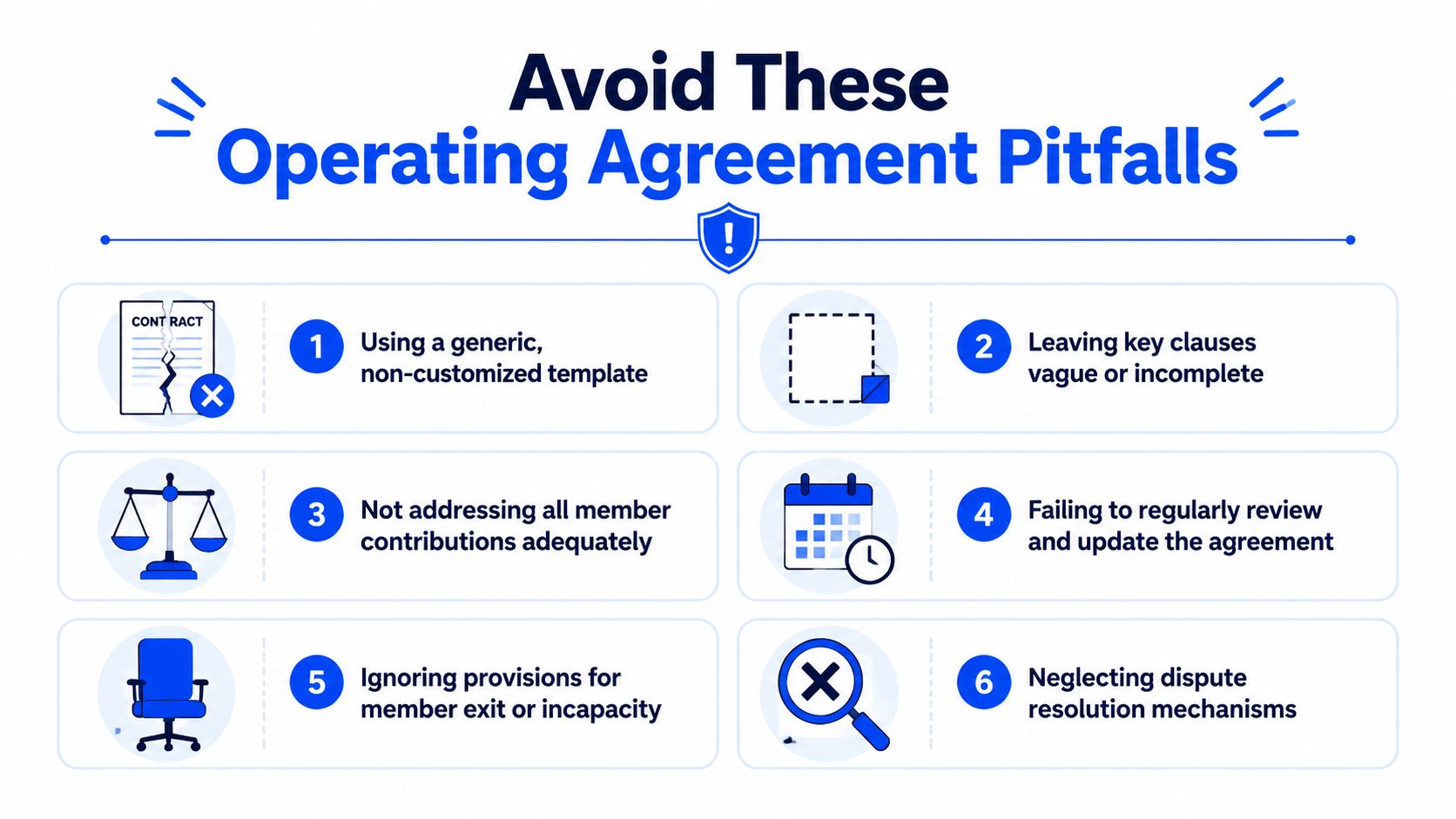
The most common mistake isn't failing to download a template. It's believing the template is complete because it looks formal. A document can have signature lines, defined terms, and ten pages of text and still leave the most important business risks unresolved.
Forms and legal-guidance platforms consistently warn about the same technical failure mode: under-specification. Templates that omit transfer mechanics, death, disability, or bankruptcy buyouts, valuation methods, or deadlock resolution leave the LLC exposed to default state rules and expensive disputes. Another recurring problem is using a generic template without aligning it to the formation state or the Secretary of State record, a point captured in FormSwift's operating agreement guidance on operating agreements.
The clauses that fail under pressure
The weak spots usually show up only after relationships change.
A startup has two founders. One leaves for another job but wants to keep the equity. The company now has an inactive owner with information rights, economic rights, and perhaps voting rights. If the agreement doesn't distinguish between those rights or define a buyout path, the remaining founder may be trying to operate a business while negotiating every decision with someone who no longer contributes.
A different version shows up after death or disability. A membership interest can become part of an estate problem, a family conflict, or a cash-flow problem for the company if the agreement doesn't set the rules in advance.
What founders often leave vague
The vague areas are remarkably consistent:
- Authority to bind the company. If several members can sign contracts, vendors may receive mixed signals and members may later dispute whether the deal was authorized.
- Withdrawal mechanics. A sentence saying a member may withdraw on notice is not enough if there's no pricing method, payment timing, or restriction on immediate competition.
- Admission of new members. A company can issue promises informally and later discover that nobody defined the approval threshold.
- Recordkeeping. If the books don't match the agreement, disputes over capital accounts and distributions get harder to resolve.
- Dissolution triggers. Members often agree on how to start a company and avoid discussing how to end one.
The most expensive clause in an operating agreement is usually the one that was never written.
Why generic buy-sell language usually disappoints
Founders often assume a buy-sell clause solves exit risk. It usually doesn't unless it answers three practical questions.
| Question | Weak clause | Better clause |
|---|---|---|
| How is the interest valued? | “Fair market value” only | Appraisal, formula, or named method |
| When is payment due? | Not stated | Installments, closing timeline, security terms |
| Who has priority to buy? | Not stated | Company first, then members, then outside sale on conditions |
If a 50/50 Washington LLC has no deadlock breaker, no pricing method, and no right of first refusal, the members may be left with power struggles instead of governance. That's not a drafting technicality. It affects whether the company can hire, borrow, bring in investors, or unwind without litigation.
Review drift is its own problem
Even a strong agreement can become stale. Member percentages change. A spouse becomes relevant. A founder starts drawing compensation not reflected in the document. The business opens a second line of work. None of that automatically amends the agreement.
That's why founders should treat the operating agreement as a living governance system. If the business evolves but the document doesn't, the paper record stops matching the company people think they own.
Your Final Checklist for Adoption and Recordkeeping
The last stage is less dramatic than drafting, but it matters just as much. A careful operating agreement can still fail if the members never properly adopt it, never circulate final copies, or never build procedures around it.
Succession and dispute design are especially important here. Generic buy-sell language often sounds complete until someone attempts to use it. Template guidance in this area repeatedly points to the same gap: agreements need operational valuation mechanics, right-of-first-refusal procedures, deadlock-breakers, timing rules, and funding terms so members have a workable path when conflict hits. DocuSign's guidance on LLC operating agreement templates is particularly useful on that point.
Final adoption steps
Use a checklist and complete it in order:
Confirm the member list
Make sure the final draft matches the actual owners, percentages, and contributions. If the names or percentages are wrong, the whole document starts off compromised.Review authority sections line by line
The members should confirm who can sign contracts, approve hires, authorize debt, admit new members, and approve extraordinary transactions.Test the exit provisions with real scenarios
Ask whether the agreement still works if a founder resigns, becomes disabled, divorces, dies, or stops participating. If the answer is “the members will work it out,” the clause probably needs revision.Sign the agreement and date it consistently
Signed copies matter. Even where notarization isn't generally required, execution should be orderly and complete.Store the agreement with company records
Keep the final signed version with formation documents, cap records, tax elections, and major contracts. Every member should also have a copy.Calendar a review
Revisit the agreement after ownership changes, financing activity, leadership changes, or major business pivots. Washington businesses that are still getting their formalities in place may also want to confirm their setup process against this practical guide on how to register a business in Washington.
If the agreement can't be used during a hard conversation, it hasn't been finished yet.
A business operating agreement template is valuable because it accelerates the drafting process. It becomes protective only when the members make clear choices, sign the document, and keep it aligned with how the company runs.
Founders who need a Washington-specific operating agreement, or need help revising one that no longer fits the business, can work with By Design Law Firm & Legal Consultancy, PLLC. The firm advises Washington companies on LLC governance, contract drafting, dispute planning, and related business law issues so the operating agreement matches the company's real ownership and operating model.