A Washington founder usually confronts the registration question at an inconvenient moment. The product is close enough to sell, a customer wants an invoice, the website is live, and then someone asks, “Is the business registered yet?”
In Washington, registration is rarely one filing. It is a sequence. A startup may form with the Secretary of State, open tax and licensing accounts through the Department of Revenue, and still need city approvals before it can operate lawfully. Remote businesses and tech companies run into this early because they can form the entity quickly, then miss the tax, payroll, or local licensing steps that follow.
The trouble point is not paperwork alone. It is the multi-agency handoff. Founders often complete one step and assume they are done, only to learn later that formation, state licensing, tax registration, and local permits are separate requirements with different rules, timelines, and consequences.
Your Washington Business Starts Here
Washington doesn't treat business registration as a single event. It treats it as a connected system. The central connector is the Unified Business Identifier, or UBI, which becomes the common identifier used across agencies after formation and licensing, according to Washington business registration guidance summarized here.

For LLCs and corporations, the process generally starts with the Washington Secretary of State. For sole proprietorships and general partnerships, the path typically starts through the Department of Revenue's business licensing process. After that, many businesses still need a Washington State business license and then separate city, professional, or industry-specific licenses depending on where they operate and what they do, as noted in that same Washington registration overview.
The roadmap most founders actually need
The cleanest way to think about how to register a business in Washington is as a sequence of milestones:
- Choose the legal structure
- Form the entity if entity formation is required
- Receive the UBI
- Apply for the state business license
- Add local permits, professional licenses, and tax registrations
That sequence matters because founders often reverse it in their heads. They think the state filing itself grants authority to operate everywhere. It usually doesn't.
Practical rule: Formation creates the legal entity. Licensing authorizes operation. Local approvals may still control whether the business can actually open, hire, or serve customers in a specific place.
Why this trips up startups and remote businesses
A Washington SaaS startup can form an LLC in a few clicks and still miss a local business license. A remote agency can hire a Seattle employee and assume the Delaware or out-of-state entity is enough. A sole proprietor can start invoicing under a brand name without realizing the legal setup and licensing path differs from an LLC's path.
The state also allows name reservation for 180 days, which gives founders a concrete planning window before filing formation documents, according to the same Washington business registration guidance. That's useful when branding is settled but ownership, tax elections, or founder equity terms still need attention.
The practical takeaway is simple. Washington registration isn't hard because any one step is impossible. It's hard because the process lives in more than one place, and each agency is handling a different part of the business.
Choosing the Right Business Structure
The first registration decision isn't where to file. It's what is being filed. That means choosing the legal structure that matches the business's risk, tax posture, ownership plan, and growth model.
A founder building a solo consulting practice has a different set of needs than a startup expecting outside investment. Washington allows several paths, but most new businesses start with one of three buckets: sole proprietorship or partnership, LLC, or corporation.
Washington Business Entity Comparison
| Feature | Sole Proprietorship / Partnership | LLC | Corporation |
|---|---|---|---|
| Liability | Owner or partners usually carry personal exposure | Liability protection is generally stronger than an unincorporated business | Strong liability separation if corporate formalities are maintained |
| Tax treatment | Usually flows through to owners | Often flexible, commonly used for pass-through treatment unless another election is made | Can fit venture-backed growth or more complex tax planning |
| Administration | Lowest formality, but often weakest legal separation | Moderate maintenance, practical for many small businesses | Highest formality, governance, and recordkeeping burden |
| Ownership flexibility | Limited for scaling and investor expectations | Flexible for many founder-owned businesses | Often preferred where stock, investor rights, or future financing are central |
| Best fit | Solo operators testing a concept | Small businesses, service firms, many startups, real estate and ecommerce ventures | Venture-scale companies, complex cap tables, businesses planning institutional fundraising |
What works for most founders
A sole proprietorship can work when someone is testing demand, doing freelance work under a personal name, or keeping operations very lean. The trade-off is exposure. If the business creates liability, the owner's personal assets are closer to the problem.
A general partnership is often underestimated as a risk category. Founders sometimes treat it as an informal collaboration, but that informality is exactly what creates trouble. If there are two people, shared revenue, and no entity planning, legal exposure and management disputes tend to arrive before anyone expects them.
An LLC is the practical default for many Washington founders. It offers a cleaner liability shield than an unincorporated business and usually fits owner-managed operations well. It also gives enough flexibility for many closely held companies without forcing the governance structure of a corporation. Founders comparing state options should understand why local formation details matter, especially if they are tempted by cheap online setups or out-of-state entity packages. This discussion of LLC formation pitfalls and out-of-state setups is relevant for that decision.
When a corporation is the better answer
A corporation usually makes more sense when the founders expect:
- Outside investment through equity financing
- Formal stock issuance and a cap table that needs to scale
- Board governance from the start
- A structure investors already expect in startup financing conversations
A founder choosing an entity should ask one question before filing anything: “Will this business stay owner-operated, or is it being built for investors, co-founders, and scale?”
That question often resolves the structure choice faster than any abstract legal definition.
What does not work
What doesn't work is choosing the structure solely because it's cheap, popular, or recommended in a generic online checklist. A solo consultant may not need a corporation. A startup seeking venture capital usually shouldn't drift into an informal partnership. And a multi-owner business should never treat the entity choice as separate from ownership terms, tax planning, and operational control.
Navigating State-Level Registration Filings
A common Washington startup mistake looks like this: the founders file with the Secretary of State, get the stamped approval back, and assume the company is ready to sign customers, open accounts, and hire. Then the next problem surfaces. The bank asks for more state registration information, a city license issue appears, or payroll setup stalls because the founders treated registration like one filing instead of a sequence.
Washington does not use a one-agency system for business registration. Formation for LLCs and corporations starts with the Secretary of State. The Department of Revenue handles the business license application and tax registration. Local governments may still require separate approvals depending on where the business operates. Tech companies, remote-first businesses, and ecommerce sellers run into trouble here because their footprint is harder to map than a single office with a sign on the door.
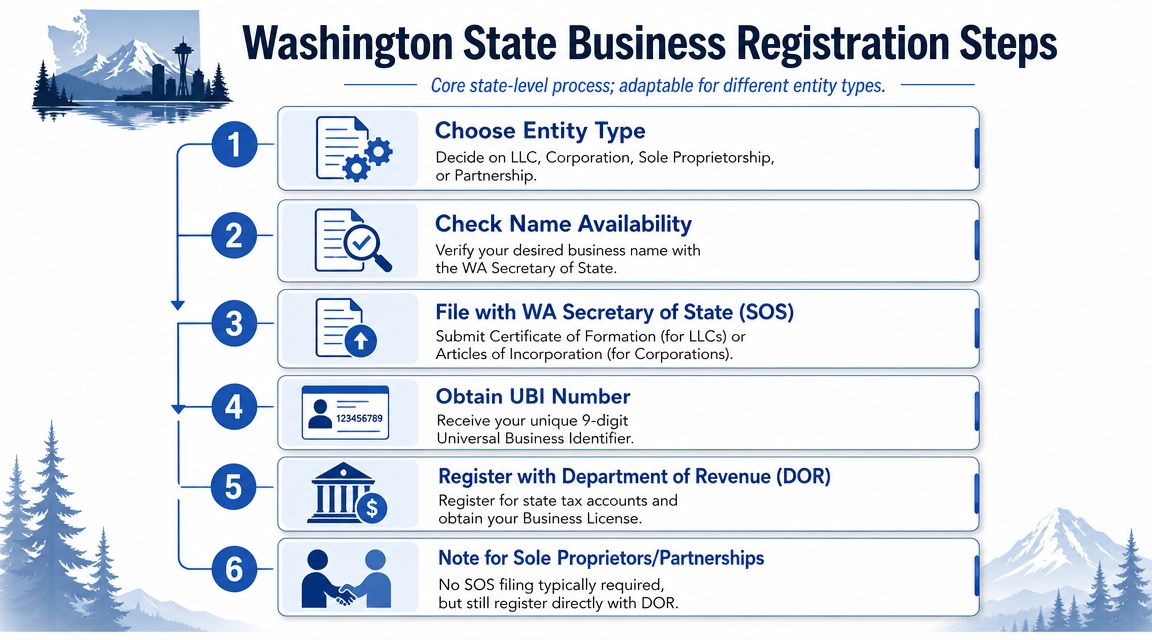
For a domestic LLC or corporation, the sequence usually runs like this: choose the entity type, file formation documents with the Washington Secretary of State, receive or use the UBI that becomes the company's state identifier, file the Washington State business license application with the Department of Revenue, and then complete the follow-up items required to keep the entity in good standing.
For LLCs and corporations
For LLCs and corporations, state registration usually breaks into four practical steps.
Confirm the entity type
This choice drives the filing itself, the governance structure behind it, and many of the follow-up documents. If the founders have not settled ownership percentages, management authority, or stock plans, filing too early often creates cleanup work.
Prepare and file the formation document
LLCs and corporations generally file through the Washington Secretary of State's Corporations and Charities Filing System. The filing needs to match the business structure, including the correct legal name, registered agent, and management setup.
Use the UBI consistently
The UBI becomes the common identifier across later state interactions. If the business records, license application, payroll setup, and tax accounts do not line up under the same identifying information, delays are common.
File the Washington State business license application
This step goes through the Department of Revenue, not the Secretary of State. Founders who stop after entity formation often discover the gap when they try to invoice customers, register for taxes, add employees, or satisfy a city licensing requirement.
For sole proprietors and general partnerships
Sole proprietors and general partnerships often start in a different place. In many cases, the first state-level registration step is the Department of Revenue business licensing process, not a Secretary of State filing.
That distinction matters because many online guides blur the lines between entity formation and business licensing. A freelance developer operating under a trade name, a married couple running a small service business, and two founders who never formed an LLC do not all begin in the same portal.
How to keep the filing sequence clean
The fastest way to create delays is to start entering information before the business facts are settled. Gather the key details first:
- Final business name
- Physical business address and mailing address
- Owner and manager information
- Registered agent details, if required
- A short, accurate description of business activities
- Operating footprint, including remote workers or multiple cities
- Post-formation documents such as an operating agreement, bylaws, or incorporator and board consents
I tell founders to treat the filing like a legal record, not an intake form. If the ownership terms are still changing or the company has not decided who has signing authority, wait until those decisions are settled.
Post-formation items founders miss
LLCs and corporations still have follow-up obligations after the formation filing is accepted. The registered agent must be valid and kept current. If a corporation did not file its initial report with formation, that report still needs to be filed within the required deadline. Missing that step is an avoidable problem.
There is also a federal reporting layer that sits beside state registration. It is separate from Washington formation and licensing, but many new entities need to review it while the company file is being assembled. This guide on Corporate Transparency Act reporting and preparedness is worth reviewing early.
Common failure points for startups and remote businesses
Washington registration problems often come from mismatched assumptions, not complicated law. A software startup files a corporation but has no signed founder stock documents. A remote company lists one address on formation documents and operates payroll from another. An ecommerce business finishes state registration but never checks whether the city where inventory is stored requires local licensing.
The pattern is consistent. One agency clears one part of the process. Another agency handles the next part. Local government may still have its own rules.
Founders who understand that sequence usually avoid the expensive mistakes. Those who treat registration as a single filing often end up correcting records after contracts, banking, tax setup, or hiring has already begun.
Securing Licenses Permits and Tax Accounts
The state-level filing gets the business organized. It does not automatically clear the business to operate in every location or every line of work. In Washington, the next layer is operational authority. That usually means the state business license first, then city licensing, then any activity-specific approvals.

The state license is only the first operating license
Many Washington businesses need a Washington State business license. After that, the primary question becomes where the company is operating and what it is doing. A Seattle-based consultancy, a Bellevue ecommerce seller, and a remote software company with home-based employees can trigger different local review points.
The mistake is treating the state license as universal clearance. It isn't. The state's own structure routes many businesses into separate local, professional, or industry-specific approvals depending on the activity and location.
Local licensing changes the answer
A business can be properly formed and still not be fully cleared at the city level. That matters for businesses operating from leased space, home offices, client sites, or distributed teams.
Common local issues include:
- City business licensing for operations within a city's jurisdiction
- Zoning or home occupation review for home-based businesses
- Industry approvals tied to the specific service or product
- Location-specific permit layers when a business crosses city lines
Founders who need a practical way to sort that out can use a legal checklist like this guide on how to tell whether a business license is required.
Tax registrations need separate attention
Registration and tax setup overlap, but they aren't identical. Once the business is active, founders also need to identify which tax and employment accounts apply. In practical terms, businesses often need to review obligations involving the Department of Revenue, and if they hire workers, they may also need accounts or registrations involving the Employment Security Department and Labor & Industries.
That review is especially important for startups that move fast on hiring. A founder may think of the business as “just software” or “just consulting,” but the compliance picture changes as soon as employees, payroll, or regulated services enter the mix.
A visual overview can help if the agency split still feels abstract:
A practical way to audit the license stack
Before launch, every founder should answer four operational questions:
- Where is the business physically operating
- Will any employee work in Washington
- Is the business using a trade name different from its legal name
- Does the business activity fall into a licensed profession or regulated industry
A company can be correctly formed and still be noncompliant on day one if the licensing analysis stops at the Secretary of State receipt.
That's why the licensing phase deserves its own review. It's not paperwork for paperwork's sake. It's the step that determines whether the business may transact, hire, advertise, or occupy space lawfully.
Advanced Topics and Common Registration Pitfalls
A common Washington startup problem starts like this. The company is formed online in another state, the product team is spread across Seattle and Bellevue, sales begin, a bank asks for matching business records, and someone discovers the company never finished the Washington filings that allow it to operate here.
That happens because Washington registration is rarely one filing. It is usually a sequence. The Secretary of State may handle entity registration. The Department of Revenue handles the Business License Application and trade names. Cities and counties may require their own licenses. Remote businesses and tech startups miss this sequence all the time because the business feels digital while the legal obligations are tied to where people work, sign contracts, and perform services.
Trade names and DBAs
If the business uses a name different from its legal entity name, check the trade name record early. In Washington, that issue usually runs through the licensing process, not just the formation filing. Agencies, ecommerce brands, software products, and solo consultants often market under one name while the legal entity operates under another.
The risk is operational. Contracts, invoices, merchant processing, and bank onboarding become harder when the public-facing name does not line up with the state's records. That mismatch also creates avoidable diligence questions when the company raises money or signs a major customer.
Foreign qualification for out-of-state entities
Founders often assume a valid Delaware or Wyoming filing answers the Washington question. It does not. If the company is doing business in Washington, the company may need to register here as a foreign entity and then complete the separate tax and licensing steps that follow.
The SBA explains that LLCs, corporations, partnerships, and nonprofits generally need to register in every state where they conduct business activities, and local governments may still require separate licenses and permits even after state formation, as explained in the SBA's guide on registering your business in every state where it conducts activities.
A fact pattern I see often is straightforward:
- The founders form outside Washington
- A founder or employee works from Washington
- Management decisions or customer work start happening here
- The company collects revenue connected to Washington activity
- No one completes foreign qualification or reviews city licensing
For remote-first companies, this is not unusual. It is one of the most common registration gaps.
Remote and hybrid teams create hidden triggers
Remote work obscures where the business is legally operating. A founder may describe the company as "online only," but Washington agencies look at actual activity. One employee working from a home office, one executive managing operations from Seattle, or one leased coworking space can change the analysis.
The multi-agency structure is crucial. A company may need to qualify with the Secretary of State, open or update tax accounts through the Department of Revenue, and confirm city licensing where people work. Tech startups often complete the first step and overlook the next two.
Remote-first does not mean location-free. If business activity is happening in Washington, Washington may expect registration, tax setup, licensing, or all three.
Frequent errors that get expensive later
The cleanup work usually costs more than doing it correctly at the start. The repeat problems are familiar:
- Using a trade name without registering it through the proper Washington licensing path
- Forming in another state without checking whether Washington foreign registration is required
- Assuming a digital business has no city license obligations
- Letting contracts, invoices, and bank records use a name that does not match state records
- Missing follow-up filings after the entity is formed
These issues tend to surface at the worst time. A financing round, payroll setup, contract negotiation, acquisition review, or agency notice forces the company to fix old filing gaps on a deadline. In practice, the best way to avoid that scramble is to treat Washington registration as a coordinated process across multiple agencies, not as a one-time filing receipt.
Your Legal Checklist After Registration
A founder files the entity, gets the state confirmation, opens a bank account, and starts selling. Then the first real stress test arrives. The bank asks for governing documents, a customer contract goes out under the wrong company name, or a city license issue surfaces after a hire starts work from home. In Washington, those problems usually trace back to one mistake. Treating registration like one filing instead of a sequence of setup steps across state and local agencies.
The work after formation is what makes the company usable. It is also where remote businesses and tech startups miss details. The legal entity may be on file with the Secretary of State, while tax registration, licensing, internal authority, and ownership records are still incomplete.
The checklist that should follow formation
Soon after registration, a Washington business should usually complete five follow-up items:
- Put the internal documents in place. LLCs should sign an operating agreement. Corporations should adopt bylaws, appoint officers, issue shares, and approve the initial actions in writing.
- Match operations to the legal entity. Open the business bank account, update payment processor profiles, and make sure contracts, invoices, and vendor records use the company's exact legal name or properly registered trade name.
- Set signing authority. Decide who can sign contracts, hire workers, open financial accounts, and approve spending. If that is left vague, disputes start early.
- Track recurring filings. Annual reports, tax filings, business license renewals, and registered agent updates need owners, deadlines, and a system.
- Review licensing again before the business changes. A new city, a Washington-based remote employee, a DBA, or a regulated product line can trigger another filing with the Department of Revenue or a local government.
For LLCs, the operating agreement is often the missing document that causes the first preventable delay. Banks ask for it. Investors ask for it. Co-founders need it once money, IP ownership, or exit rights become real issues. The filing receipt does not solve any of that.
When legal review usually pays for itself
Some founders can handle a straightforward filing on their own. Others should get legal advice early because the cleanup cost is predictable. The usual risk factors are multiple founders, outside investment plans, contractor-created IP, tax election questions, remote workers in more than one state, or uncertainty about whether a foreign entity must register in Washington.
Washington also separates formation from other required setup. The state filing fee is only one line item. A business may still need tax registration, local licensing, internal governance documents, and name cleanup before the company is ready for contracts, payroll, or diligence.
By Design Law Firm & Legal Consultancy, PLLC advises Washington businesses on formation, governance, contracts, and startup legal setup. Founders who need help getting the entity structure right, cleaning up post-registration gaps, or confirming what Washington and local agencies require can seek counsel before those issues show up in financing, hiring, or contract review.
Built with Outrank