A Seattle startup borrows against its equipment and receivables. The founders sign a detailed security agreement, the lender wires the funds, and everyone assumes the collateral is protected. Months later, another creditor claims the same assets, the company enters bankruptcy, and the lender discovers that a signed agreement alone may not establish priority against a trustee or later creditor.
That result surprises many founders and lenders. Perfection of security interests is the step that generally turns a private promise between debtor and secured party into a claim visible and effective against competing claimants. Under the public-notice model formalized by UCC Article 9, the correct method can be filing, possession, control, automatic perfection, or a separate statute, regulation, or treaty, depending on the collateral.
Introduction Why Perfection Decides Who Gets Paid
A security agreement answers one question: what did the borrower and lender agree to? Perfection answers a different question: what must the lender do to protect that agreement against the rest of the world?
That distinction becomes critical when a borrower defaults, sells collateral, grants another lien, or files bankruptcy. An unperfected interest can lose to a competing secured creditor, a trustee, or another claimant even when the loan documents are enforceable between the original parties. Perfection supplies the public notice or legally recognized control that supports the lender's position in that contest.
The modern U.S. framework began with the original Uniform Commercial Code Article 9, promulgated on May 19, 1952, and was substantially revised on July 25, 1998, with a uniform effective date of July 1, 2001 in enacting states, as described in this UCC Article 9 historical overview. Those milestones established the dominant system used across all 50 states for protecting collateral rights against third parties, trustees, and later creditors.
A Washington lender therefore has to look beyond the signature page. The lender must identify the collateral, select the legally appropriate perfection method, file or obtain control in the correct place, and preserve that status over time.
Practical rule: A valid security agreement creates the relationship. Proper perfection protects the relationship in a priority dispute.
The most common mistake is treating every asset as if it were equipment covered by a UCC-1. Deposit accounts generally require control, money requires possession, investment property may require control, and some interests perfect automatically. Cross-border transactions add another layer because a single U.S. filing may not protect assets governed by another jurisdiction.
The analysis below moves from the basic distinction between attachment, perfection, and priority to collateral-specific methods, Washington filing decisions, proceeds, digital assets, and practical closing checks.
What Perfection Means Under UCC Article 9
Think of attachment as the moment the lender's security interest becomes enforceable against the borrower. The parties have a security agreement, value has been given, and the borrower has rights in the collateral or the power to transfer rights in it. The agreement may be enforceable between those parties, but that does not automatically settle a later priority contest.
Perfection is the next step. It generally requires an act that gives legally sufficient notice to other potential claimants or places the collateral under the secured party's possession or control. The UCC filing rule for perfection states that a financing statement must be filed for most security interests and agricultural liens unless another method applies.
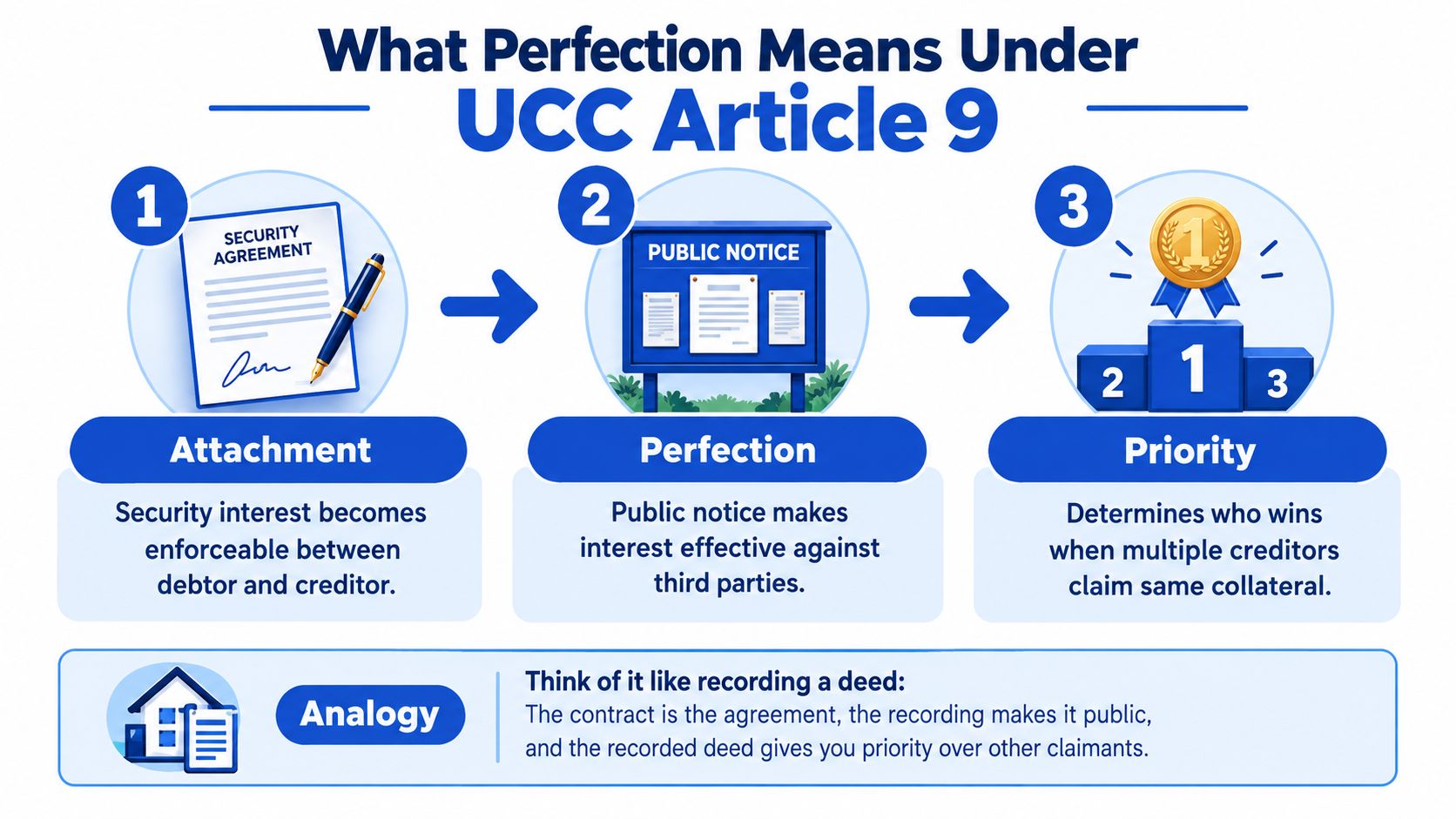
The three-stage structure
Attachment is the private-law stage. The borrower grants the interest, the lender provides value, and the collateral is identified sufficiently for the agreement to operate.
Perfection is the protection stage. A UCC-1 filing serves as a public notice for many assets. Possession works for certain tangible collateral. Control works for assets where the secured party must have a legally recognized ability to direct or manage the asset.
Priority is the contest stage. If two creditors claim the same collateral, the applicable priority rule determines who is paid first. Perfection doesn't guarantee victory in every dispute, but an unperfected interest usually starts from a substantially weaker position.
A real estate analogy helps. Signing a deed creates an agreement about property rights, while recording the deed gives notice in the public land records. Article 9 uses a similar notice concept for personal property, but it divides the process by collateral category.
The main channels are filing, possession, and control. Automatic perfection and perfection under another statute, regulation, or treaty operate as exceptions. The UCC filing exception provisions expressly recognize categories perfected through possession, control, automatic perfection upon attachment, or separate legal regimes.
The method matters because an incorrect step can leave the interest unperfected even when the underlying contract is carefully drafted. A lender can't solve a control problem by filing a broader UCC-1, and a generic filing may not replace possession where possession is the exclusive method.
How to Perfect Different Types of Collateral
Collateral classification drives the answer. A lender should identify the asset first, then select the perfection channel. Filing remains the default for many categories, but the default has important exceptions.
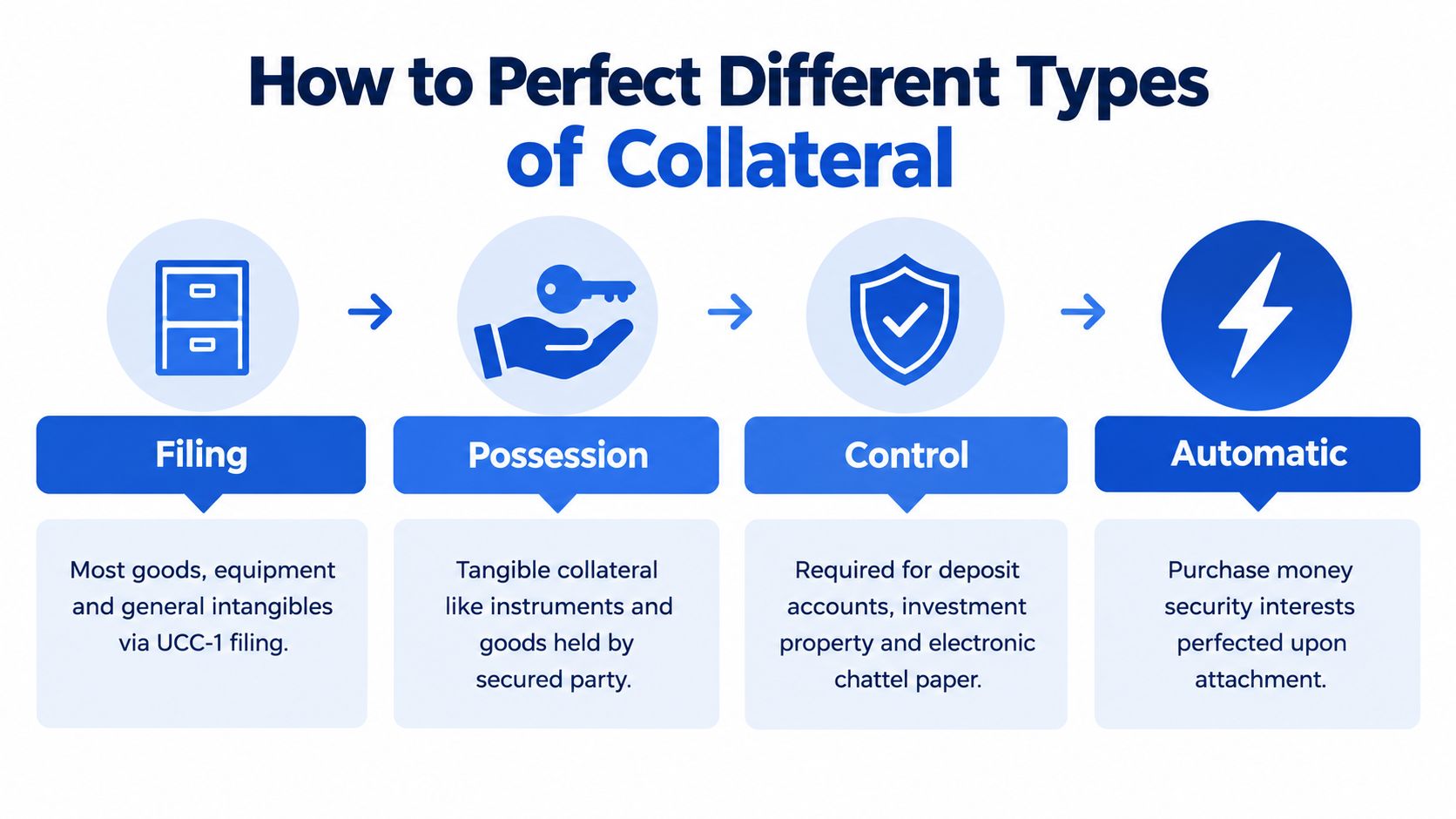
For equipment, inventory, receivables, and many general intangibles, filing a financing statement is generally the primary route. The filing provides notice that the debtor's assets may be encumbered, while the security agreement defines the parties' rights in greater detail.
Fixtures require special care. Equipment that becomes sufficiently connected to real property may implicate fixture filing rules and real property records. The lender should not assume that a central UCC filing alone produces the desired priority against real estate interests.
For investment property, filing may be available, but control is a distinct and often stronger route. Under the UCC control rules for investment property, perfection by control attaches when control is obtained and continues while control is maintained.
Deposit accounts are different. For an account taken as original collateral, control is generally exclusive. Control may exist when the secured party is the depository bank, when the bank, debtor, and secured party enter an authenticated control agreement requiring the bank to follow the secured party's instructions without further debtor consent, or when the secured party becomes the bank's customer. The UCC deposit-account perfection rules explain why a financing statement usually has no perfection effect for the original deposit account.
Money requires possession, while some purchase-money security interests in consumer goods perfect automatically upon attachment. Electronic chattel paper and certain newer digital records can also depend on control rather than a public filing. Virginia's amendments concerning controllable accounts, controllable electronic records, and controllable payment intangibles became effective July 1, 2025, illustrating how asset technology is pressing states to refine control-based rules, as explained in the UCC control provisions.
| Collateral Type | Primary Perfection Method | Alternative or Exclusive Rule |
|---|---|---|
| Equipment and inventory | Filing | Possession may matter for goods actually held by the secured party |
| Receivables and general intangibles | Filing | Review special statutory rules and proceeds |
| Fixtures | Fixture filing or applicable real property record | Location of the goods and real property records can control |
| Investment property | Filing or control | Control can provide a distinct priority position |
| Deposit accounts | Control | Filing generally doesn't perfect original deposit-account collateral |
| Money | Possession | Filing isn't the required perfection method |
| Certain consumer-goods purchase-money interests | Automatic upon attachment | No filing may be needed for automatic perfection |
| Electronic and controllable records | Control or applicable statutory method | Asset-specific drafting and operational control are essential |
The Kons Law asset protection guide offers another practical overview for readers comparing filing, possession, and control. Founders handling platform rights, electronic records, or data-linked assets should also review digital assets, data rights, and online platforms in legal contracts, because the contract may need to establish operational control rather than merely describe the asset.
A short visual summary can help reinforce the distinction.
The central lesson is simple: the wrong perfection channel can defeat an otherwise valid transaction. A lender financing cash balances needs control documentation. A lender taking money needs possession. A lender taking ordinary equipment usually needs a properly indexed filing.
Filing Your UCC-1 and Getting Jurisdiction Right in Washington
A Washington UCC-1 filing starts with the debtor, not the collateral’s physical location. For many collateral types, perfection and priority are governed by the law of the jurisdiction where the debtor is located. Fixtures are a major exception because the law of the jurisdiction where the goods are located can govern, as stated in the UCC governing-law provision.
For a Washington business, the filing workflow should be deliberate:
-
Confirm the debtor’s legal identity. Use the exact legal name shown in the formation records. A trade name, shortened name, or informal brand can prevent the filing from producing effective notice.
-
Locate the debtor for the collateral at issue. A Washington filing may be appropriate for a Washington debtor, but multi-state structures require a separate jurisdictional analysis. The borrower’s headquarters, registered office, assets, and formation state aren’t interchangeable concepts.
-
Use the correct filing office. Most ordinary Washington central filings are handled through the state’s designated filing system. Fixture filings require attention to the real property records and the location of the affected goods.
-
Describe the collateral reasonably. The financing statement should give notice of the collateral covered. The security agreement can provide the detailed grant, exclusions, proceeds language, and operational covenants.
-
Verify the filing after acceptance. Acceptance by a filing office isn’t the same as legal effectiveness. A post-filing search can confirm that the record appears under the debtor’s correct name and in the expected index.
Washington founders often work through several entities, holding companies, subsidiaries, and assumed business names. A lender should identify which entity owns the collateral and which entity incurred the debt. The filing must connect to the actual debtor whose property secures the obligation.
A continuation calendar matters as well. A standard financing statement generally remains effective for five years, and a continuation statement must be filed within six months before the lapse date to maintain effectiveness, according to the UCC continuation rule. A missed continuation can create a gap that changes the priority analysis.
Filing discipline: The closing checklist should verify the legal name, debtor location, filing office, collateral description, search results, and continuation date before funds are released.
A founder organizing a Washington entity can use this Washington business registration guide to understand formation records that may later supply the debtor’s legal name. That administrative detail becomes a secured-lending issue when a creditor relies on the public index.
A UCC-1 also has limits. It generally won’t perfect an original deposit account, replace possession for money, or create control over investment property or electronic records. The filing decision must therefore follow collateral analysis, not routine.
Priority Rules and What Happens to Proceeds
Priority determines which claimant receives the collateral’s value first. The general rule among competing perfected security interests is first to file or perfect, rather than first to make the loan or first to sign the security agreement. The rule can allow a creditor to file before attachment, provided the interest later attaches and perfection remains continuous, as described in the first-to-file-or-perfect priority rule.
Consider a simple sequence. Lender A files a financing statement covering a startup’s equipment before Lender B closes a later loan. Lender B signs its agreement first but files later. If both interests attach and no special priority rule changes the result, Lender A may hold the earlier position because filing time, not the loan-signing date, controls the general contest.
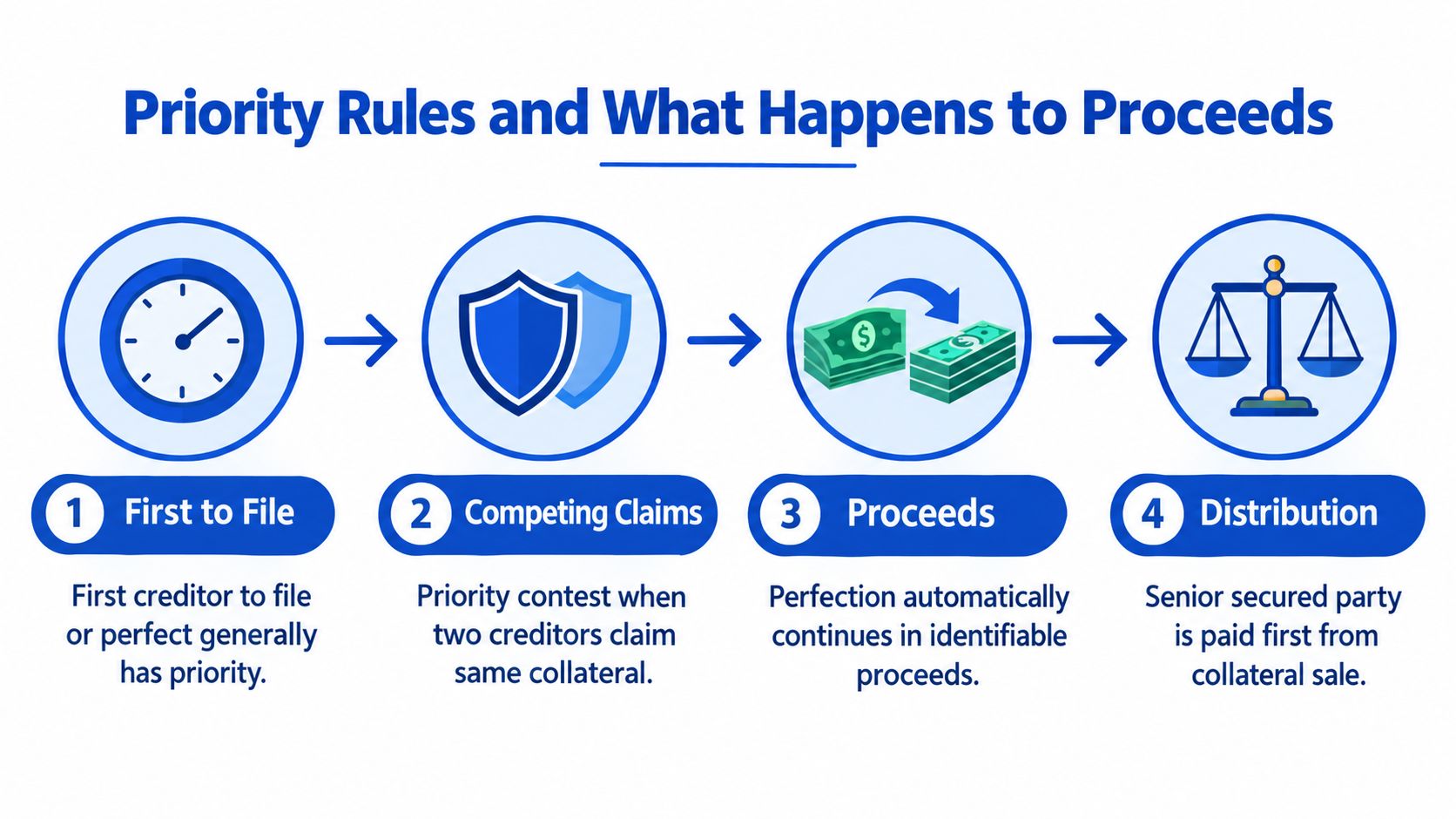
Proceeds create a moving target
Borrowers often sell, collect, replace, or transform collateral. A perfected interest in original collateral generally continues automatically into proceeds, but that protection can lapse on the 21st day after the interest attaches to the proceeds unless the applicable filing or identifiable-cash-proceeds conditions are satisfied, as summarized in Cornell’s explanation of perfection.
For example, a lender files against inventory. The borrower sells that inventory and receives payment into an account. The lender shouldn’t stop at the original filing. The lender must analyze whether the proceeds remain identifiable and whether another filing, control arrangement, or statutory condition is needed to preserve perfection.
Control-based perfection in investment property can be especially durable while control is maintained. That strength also creates an operational obligation. If the secured party loses the required control arrangement, the legal position may change even though the loan documents remain untouched.
Priority reviews should therefore examine more than the original closing file:
- Filing sequence: Determine when each creditor filed or perfected.
- Attachment: Confirm that the relevant security interest attached.
- Continuity: Check for lapse dates, continuation filings, and any perfection gaps.
- Proceeds: Trace sales, collections, replacements, and transfers.
- Control: Confirm that account-control or investment-control arrangements remain effective.
A senior secured party may be paid first from a collateral sale, but only if its priority position survives these technical tests. The lender with the best-looking agreement isn’t necessarily the lender with the first enforceable claim against the value.
Common Pitfalls and Overlooked Perfection Gaps
Perfection failures usually begin with a reasonable assumption applied to the wrong asset or jurisdiction. A lender files one UCC-1 against a startup and treats the filing as a universal lock on everything the company owns. Article 9 doesn’t work that way.
The wrong debtor name can undermine notice. The filing should identify the legal debtor accurately, not merely the brand customers recognize. A post-filing search under the jurisdiction’s ordinary search logic can reveal whether the record appears as intended.
The wrong jurisdiction creates a separate problem. Many collateral categories follow the debtor-location rule, while fixtures may follow the location of the goods and real property. A Washington company with an out-of-state subsidiary, remote equipment, or fixtures in another state needs an entity-by-entity and asset-by-asset review.
A UCC-1 doesn’t create control. Filing against a deposit account as original collateral generally doesn’t perfect the account. The secured party needs a qualifying control relationship with the bank. Similar analysis applies to investment property, electronic chattel paper, and newer controllable records.
Fixtures deserve their own diligence. Equipment attached to real property can require a fixture filing or other real-property recording strategy. A central filing may provide some notice but fail to achieve the priority the lender expects against a property owner or mortgage holder.
Cross-border deals expose another gap. A 2025 cross-border analysis explains that perfection is required to establish priority against third parties, including in bankruptcy, but UCC-style systems still vary by asset category and jurisdiction, with possible reliance on filing, possession, control, automatic perfection, or treaty and statute-specific rules, as discussed in cross-border creation and perfection of security interests. A single U.S. financing statement isn’t a global solution.
Digital collateral creates the same misconception in newer form. A controllable electronic record may be valuable, but the decisive act can be operational control, not public filing. Contracts should identify who can direct the record, alter access, transfer rights, or prevent the debtor from acting without consent.
A structured review such as venture capital due diligence can help surface these issues before a financing, investment, or bankruptcy exposes them.
Your Practical Checklist for Startups and Lenders
A practical perfection review should follow the collateral rather than the form document. At origination and during portfolio review, the parties should:
- Characterize each asset. Separate equipment, inventory, receivables, fixtures, deposit accounts, money, investment property, and digital or controllable records.
- Choose the method. Decide whether the asset requires filing, possession, control, automatic perfection, or a separate legal regime.
- Confirm the debtor and venue. Verify the exact legal name, debtor location, filing office, and any fixture location.
- Complete the public filing. Use a reasonably informative collateral description and confirm that the accepted record appears in a search.
- Obtain control or possession. Secure bank control agreements, securities-account arrangements, possession of instruments or money, and digital control mechanics where required.
- Calendar maintenance. Track continuation dates, amendments, entity changes, collateral transfers, and proceeds.
- Recheck priority. Search for competing filings and investigate earlier liens before closing or increasing exposure.
The business due diligence checklist can support a broader transaction review, but complex collateral, multi-state debtors, fixtures, cross-border assets, and controllable digital records warrant transaction-specific legal analysis.
By Design Law Firm & Legal Consultancy, PLLC advises Washington startups, lenders, and established businesses on collateral descriptions, UCC filings, control agreements, priority reviews, and multi-state transaction risk. Visit By Design Law Firm & Legal Consultancy, PLLC to request counsel before closing a secured transaction or relying on an existing perfection strategy. Contact our law office at (206) 593-1519.